

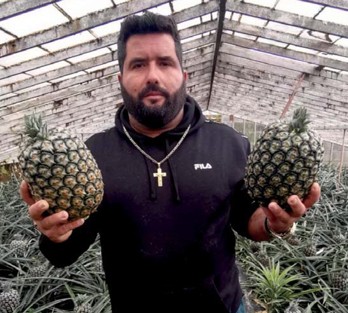
Cláudio Botelho is a pineapple producer from the Azores and manages 100 greenhouses that produce around 100,000 fruits. He intends to increase production in the future, especially since he already exports to the mainland. However, the labor shortage has been an obstacle to his plans.
This week, we introduce you to Cláudio Botelho, a pineapple producer from the Azores.
Aged 38, our interviewee has been a producer for 13 years. He started working during school holidays with his parents, who were also greenhouse workers. On weekends and even during the week, Cláudio Botelho would go to the greenhouses when he was still a child. He left school at 15 to work for a pineapple production company in Fajã de Baixo, where he stayed for 10 years at Quinta das Três Cruzes. “At 18, he was already a greenhouse worker and acquired some greenhouses, a number that grew over the years.”
Cláudio Botelho currently manages 100 greenhouses, half of which are his own. The other greenhouses, although not his, are under his responsibility. These greenhouses are spread across several locations, including Fajã de Baixo, Fajã de Cima, São Roque, Livramento, and Arrifes.
And because he speaks from knowledge and experience in the field, Cláudio Botelho confirms that Fajã de Baixo and São Roque have the most favorable climates for growing pineapples and are where most of the greenhouses are located.
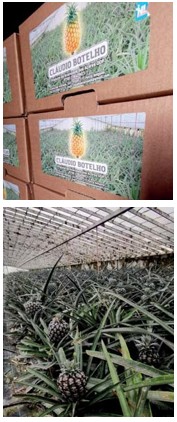
Whitewashing more frequently in spring and summer reduces the need for heavy watering.
Half of the plants are grown on the farm, and the other half are purchased. The distance between each plant is 52/53 cm, keeping a certain distance from the wall, because these are cattle for the domestic market. Thus, “every week, at least 500 pineapples are exported to the mainland, a number limited by a lack of manpower.”
Speaking of climate differences, Cláudio Botelho, who conducted the interview in Arrifes, pointed out that the atmospheric conditions that characterize the parish are different. “Here the climate is colder and we work with less lime.” He added that “at this time of year, we don’t have much lime on the greenhouse windows here, but in Fajã de Baixo, whitewashing is already necessary, not much, but necessary.”
Thus, we learn that lime is applied more frequently in spring and summer, when there is more sunlight. Whitewashing the greenhouse windows protects plant leaves from burns caused by direct sunlight and helps control the temperature inside the greenhouse.
Preparing the soil
One of the most important steps in growing pineapples is preparing the soil. Cláudio Botelho says that this is done with bran and wood (old soil, sawdust, and incense) and natural fertilizers (manure). The manure used in Cláudio Botelho’s pineapple greenhouses comes from poultry farms. It is left to rest for a few months before being used in the greenhouses, resulting in several advantages, including helping retain moisture in the soil and in colder areas. One greenhouse can yield around 1,400 pineapples, but as Cláudio Botelho manages 100 greenhouses, “just do the math, that is, we are talking about a number around 100,000 pineapples.”
In addition to the regional market, Cláudio Botelho’s pineapples are already available in supermarkets and restaurants, as well as in a company that also exports to other islands in the region.
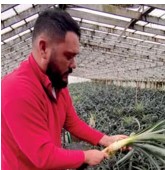
Employees and a labor shortage
Cláudio Botelho has 10 employees, two of whom handle painting.
“The lack of labor has also been a problem in production, because young people can’t stand the hot temperatures in the greenhouses,” he laments. “I started working when I was still a child, but these young people, aged 19/20, don’t want to work, even if they are paid 45/50 euros a day.” Cláudio Botelho does not want to stop producing and plans to export more pineapples abroad. To this end, he wants to “continue to focus on quality over quantity.” He also criticizes the way pineapples are sold in hypermarkets, “like sacks of potatoes, piled on top of each other. People have no idea how much work this takes. Pineapples could be placed in boxes, without being piled up,” he adds. Aware of climate change, he points out that “nowadays, the entire pineapple production process takes about two and a half years, from the moment the seedling is planted until the fruit is ready to be harvested.”
Marco Sousa is a journalist for Correio dos Açores-Natalino Viveiros, the director.
Translated into English as a community outreach program by the Portuguese Beyond Borders Institute (PBBI) and the Modern and Classical Languages and Literatures Department (MCLL), in collaboration with Bruma Publication and ADMA (Azores-Diaspora Media Alliance) at California State University, Fresno. PBBI thanks Luso Financial for sponsoring NOVIDADES.

 Novidades - The Islands and the Diaspora