

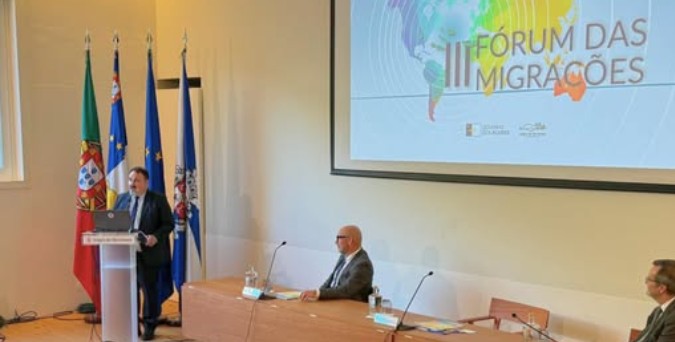
At the start of the III Migration Forum in Angra do Heroísmo, the Regional Secretary for Parliamentary Affairs and Communities argued that the Government of the Republic should give “full national coverage” to the Return Program, which since 2019 has only covered emigrants returning to mainland Portugal. Paulo Estêvão argued that the Azores and Madeira face labor shortages and have significant emigrant communities, so the exclusion of the autonomous regions leaves out potential beneficiaries and limits the program’s impact.
The Regional Secretary for Parliamentary Affairs and Communities, Paulo Estêvão, opened the Migration Forum yesterday in Angra do Heroísmo, asking the Government of the Republic to guarantee “full national coverage” for the Return Program, which provides various tax and other incentives to all emigrants who wish to return to Portugal.
“The Azores and Madeira are growing significantly from an economic point of view and are facing problems such as labor shortages. This program is very important, and the Azorean and Madeiran communities represent a very significant portion of the Portuguese diaspora that may wish to return,” said the minister, speaking at the Angra do Heroísmo Interpretation Center on Terceira Island on the first of two days of the Forum.
The PSD/CDS-PP/PPM coalition recently presented a draft resolution to the Azores Parliament that aims to include the entire national territory in the Return Program—since 2019, when it came into force, it has only covered citizens returning to mainland Portugal.
Paulo Estêvão also addressed several advances made in the Azores with regard to the integration of immigrants, valuing the “local responses on all islands” guaranteed by the protocol between the Government of the Azores, RIAC, and AIMA, and also highlighting the role and “vast accumulated experience” of entities such as AIPA and Cresaçor.
“Here we respect different national identities, we value them, but we want to raise awareness among this population to serve the Azores and serve Portugal. Being proud of your identity is not incompatible with participating in a spirit of solidarity and loyalty to the project of the Azores and Portugal,” he said, recalling the experience of centuries of Azorean emigration to various territories.
In any case, he acknowledges that the challenge in the Azores is “of a different dimension” to that faced by the country as a whole and Madeira itself, given the smaller percentage of foreigners living on the nine islands.
Speaking about Azoreans abroad and those of Azorean descent, the Regional Secretary said: “We want our communities to value themselves wherever they are. We want them to preserve their language and identity and contribute to the development of their host societies. With hard work and persistence, taboos of discrimination have been broken, and the Azorean community is recognized and valued.”
The III Migration Forum follows the editions held in Faial and Pico in October 2023 and in São Miguel in December 2024. Participants include Rui Armindo Freitas, Deputy Secretary of State for the Presidency and Immigration, José Andrade, Regional Director of Communities for the Government of the Azores, and Sancho Gomes, Regional Director of Communities and External Cooperation for the Government of Madeira.
In Correio dos Açores-Natalino Viveiros, director
Translated into English as a community outreach program by the Portuguese Beyond Borders Institute (PBBI) and the Modern and Classical Languages and Literatures Department (MCLL), in collaboration with Bruma Publication and ADMA (Azores-Diaspora Media Alliance) at California State University, Fresno. PBBI thanks Luso Financial for sponsoring NOVIDADES.

 Novidades - The Islands and the Diaspora