


Since 2023, the Olhar Poente institution has held the Protector Seal, a distinction that further elevates its work in promoting and recognizing children’s rights. Sandra Serpa, President of Olhar Poente, and Carlota Dâmaso, the educator responsible for the process, explain to Correio dos Açores what it was like to receive this distinction, what added responsibility it brought to the institution, and what projects Olhar Poente will be developing.
The Olhar Poente institution, on Terceira Island, was awarded the Protector Seal in 2023. This seal is a recognition of good practices and work to recognize children’s rights.
For Sandra Serpa, the awarding of this seal was “important in the sense that we can tell the community that we, as an institution, are willing and focused on guaranteeing children’s rights in all contexts of life.”
“Of course, we all try to comply with and take into account all the rights that children have, but sometimes people forget some of the rights that everyone has. And I think that having the Protector Seal makes the team more aware, makes everyone who works with children more aware of the need to really guarantee these rights,” she continued.
According to the president of Olhar Poente, “in addition to everything that involves the Protective Seal, which is always related to the conduct of workers, or to certain procedures that we have in place for recruitment, or even through the plan that we strategically promote for children, the fact that we have this Seal will compel us a little more to develop certain skills and to put certain mechanisms in place, to create certain signals or to promote certain contexts that we might not otherwise have done.”

The Seal almost ‘forces’ us to improve our services. And we, as an institution, welcome this, because the Olhar Poente institution has also undergone a process of requalification of its social responses, that is, in order to improve the services we already provided as a whole, from bureaucratic processes to processes of speaking directly with children. all these processes have been improved through quality management, and I think the Protector Seal also helps us to improve in terms of really guaranteeing children’s rights and, through a connection, allowing something that Olhar Poente has always had and always worked for, which is a closer relationship with the family and the community. It also allows us to work more with families and promote to families, in addition to the peace systems we already promoted and other small training courses we already do for the community, we focus on these issues that are important in terms of children’s rights. And also on how families act. Regarding the issue of reporting, the team is more alert to reporting a child,” said Sandra Serpa.
For the president, “it is very common in the community in general to let things we see pass by, but if we keep a watchful, protective eye, we will be able to act more easily. The Protective Seal has made the team grow and improve in its day-to-day practice, always in favor of and always for the benefit of children. That is why I think the Seal is an asset and something to be maintained.”

The projects developed at Olhar Poente
At the moment, at Olhar Poente, Sandra Serpa informs us, “we have daycare and after-school care facilities, and then we have the Study Center, which is the Olhar Poente Academy. Most of our work is related to these services, and we have several parishes where we operate, in this case, both with the daycare center and the after-school program, we have been in the parishes of Vila Nova, Fontinhas, Fonte Bastardo, and Biscoitos.”
“Then there is Academia Olhar Poente, which is in Praia da Vitória, opposite the Francisco Ornelas da Câmara School, and we are also currently in the process of obtaining a license to open an after-school program in Conselho Angra, more specifically in the parish of São Bartolomeu,” she said.
For the president of the institution, “our work ends up being a little bit connected to these areas, and within these areas, we have other projects that we are developing, which will then be applied within those same areas.”
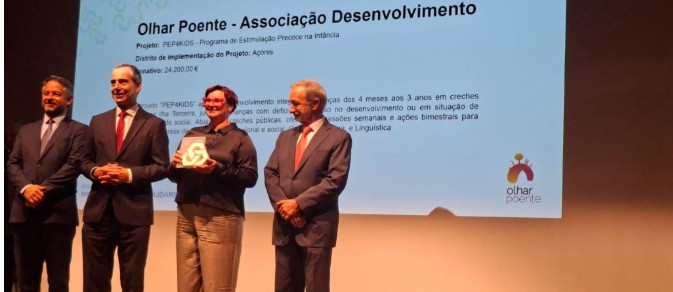
“Within the ATL daycare area, we have implemented the projects that were recently launched on social media, which are: the Educamente project, Meditation and Relaxation, and also PEP4Kids, which is an early stimulation project, that is, two projects that are developed for different age groups. Educamente is developed in both age groups, in the daycare center and in the ATL, but this year, due to the award we received from BPI, it is being involved more specifically in the ATL agencies, with all the parishes. In other words, the techniques are directed at the parishes where we develop and apply the project in all parishes. The award given to the PEP4Kids project is more aimed at daycare. Although we also did some activities with after-school care, this year, due to the award we received from Caixa Social, it will be implemented more in daycare ages, in all parishes,” said Sandra Serpa.
“In addition to these projects, we have others that we carry out throughout the year, within the educational project and the activity plan, but also other small applications, such as the protective seal,” she said.
Development of other projects with other entities
However, it is not only the projects described above that are carried out by the Olhar Poente institution. According to Sandra Serpa, the institution has “an application to the Unicef school, where this year we are going to implement some activities and some work in the field of children’s rights, because it is also related to the Protective Seal, so all this logic of Unicef and the Protective Seal ends up working in a complementary way, that is, we end up working on both practices within these projects.”
“We also end up doing other projects in the same field, but with other entities. We have AMA, which helps us with some activities, more specifically with Educamente and PEP4Kids activities. CCPJ also helped us with the Protective Seal, and other partners come up according to the projects we are working on,” she continued.
In terms of the Academy, Olhar Poente does something a little different. “We have study support plans, a project supported by the Regional Government, where we support disadvantaged children who come through the study plan. These are children who have low academic performance and low family incomes. These children attend the academy free of charge through this study plan, which, as I mentioned, is supported by the Regional Government.
And we also provide study support at the Academy, with the help of volunteers and other professionals we hire. During school breaks, we usually also run summer camps, specifically during Easter and then again in the summer. In addition, this year we have approved internship and volunteer projects and we will have some activities from the Estagiar L and Estagiar programs, both to receive and to send,” said Sandra Serpa.
The president also mentioned a new project they are developing. “We will have a project to send our employees for job shadowing. We are currently defining where this will take place, based on the teaching methods we also work with and develop at the institution. We will receive other groups of interns from both Portugal and other European countries. These are projects that we apply for throughout the year, and that we also carry out and implement. The interns we receive end up working with us, since we do work on the topics they need to work on, but always based on our skills to develop this type of work.”

The institution helps more than 420 children
When asked about the number of children they are able to help, Sandra Serpa said, “We have been updating our numbers because, throughout the year, we sometimes have some fluctuations, because people move out of the parish, or we have new people coming in. At the ATL, we are practically at full capacity in all of them, except for the ATL in Biscoitos. At the daycare level, we have about 150 children. They are all family daycare centers, with a room for each age group. Babies stay until they are two years old and then at three they go to the ATL. At the ATL, we have 225 children attending. Then at the academy, there are about 50 students,” she concluded.

The awarding of the Seal and its importance
Carlota Dâmaso, an educator at Biscoitos and responsible for awarding the Protector Seal, first explained what the Seal is. “The Protector Seal is a national initiative of the National Commission for the Protection of Children’s Rights and was awarded to us in 2023. We applied for it and since then we have been developing a culture of protection, prevention, and support that involves the entire educational community,“ she said.
When asked about its importance, the educator said that ”it ended up being a recognition of the work that we were already doing. But, in my opinion, it was also a starting point for us to somehow deepen this so-called culture of perfection, which is becoming much more complex. The truth is that being awarded this Seal meant making a commitment that must be ongoing, that is, to continue training, change procedures, and involve the entire community in this issue of prevention. We have now received several awards, namely the Healthy Workplaces and Protector Seal, and we are developing a project called SOS Casa. We are also a certified institution, meaning we are a training entity and have several other projects in progress.”
This award was given for the implementation of some practical measures in the different areas. “We didn’t really have to create the project, that is, given what they suggested to us, we had some requirements to do so, which we did. We implemented some concrete measures, such as the installation of electric signage in the different areas, such as no smoking and no photography. We are also involved in internal training directly with the CPCJ (Child Protection Commission) of the Praia da Vitória Council. We held discussions that were open to the community and addressed topics of great interest, such as bullying and inclusive language, which allowed us to involve people from the community in this type of reflection, which is very important for the Seal in question. In fact, what we also did, and continue to do even more, is to integrate certain commemorative days into our annual activity plan, such as National Pajama Day, Non-Violence Day, and Anti-Bullying Day. As an institution that has been awarded this Protective Seal, we cannot let these days pass unnoticed.”

Difficulty in implementing measures and the importance of the community
According to Carlota Dâmaso, “we know that the implementation of the Protective Seal project presents us with some challenges, namely ensuring that the entire team and everyone involved are constantly up to date with best practices, so to speak, in child protection. We also have some difficulty, for example, in actively involving families and the community so that child protection is not just the responsibility of the institution, but a shared commitment. But the truth is that despite these challenges, we believe that with every step we take, we can reinforce this culture of protection and that we contribute, in some way, to a society and a community that is much more aware and, above all, committed to the issue of children’s rights.
Regarding the importance of community involvement, the educator said that “we have always had some support and, in fact, what is done by the community is mainly done for them. We have here an example of SOS Casa, which is a project that aims to help build structures for people who have some kind of need here. Therefore, all the projects we are involved in always have this social aspect so that we can respond to the needs of our community, our families, and, in general, the environment around us.

The second edition of the charity walk
Last year, Olhar Poente organized a charity walk to raise awareness about children’s rights. This walk will be repeated this year. “This is the second consecutive year that we have held our walk, which is nothing more and nothing less than a symbolic initiative for us to celebrate this month of November, which, as we know, is very important, as it is dedicated to children’s rights. As I said, this is the second edition of the event. Last year, we had around 80 participants, and we hope to reach a similar number this year. But above all, we value the intention behind it: to walk together for children’s rights. Our team, our families, social organizations, members, and partners of the institution are participating. Basically, we are opening the walk to everyone who shares the same intention as us.”
According to Carlota Dâmaso, “it was very gratifying to have our families participate and to be able to bring our good practices from our daily lives to this event, such as taking care when crossing at crosswalks, the fact that there is a whole line-up during the walk, that is, there is a person who starts, who ensures that the path is clear for us to follow. Let’s hope this year goes the same way,” she concluded.
Frederico Figueiredo is a journalist for Correio dos Açores, Natalino Viveiros, director.
Translated into English as a community outreach program by the Portuguese Beyond Borders Institute (PBBI) and the Modern and Classical Languages and Literatures Department (MCLL), in collaboration with Bruma Publication and ADMA (Azores-Diaspora Media Alliance) at California State University, Fresno. PBBI thanks Luso Financial for sponsoring NOVIDADES.

 Novidades - The Islands and the Diaspora