

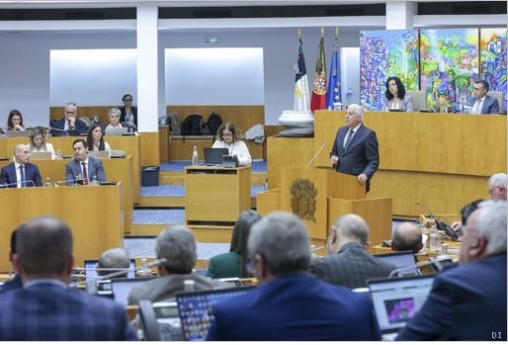
The Azorean government is living beyond its means, said Nuno Barata from the IL political party.
The Regional Government is calling for an additional €250 million per year in the revision of the Autonomous Regions Finance Law. “We believe that this revision should be based on clear negotiations: the Region must ensure a minimum increase of €250 million per year, guaranteeing the necessary means for sustained, stable, and predictable development, taking into account the provisions included in the 2026 State Budget, on account of extraordinary transfers,” said the Regional Secretary for Finance, Duarte Freitas, at the start of the debate on the Region’s Plan and Budget for 2026.
With the €75 million increase in transfers from the State Budget for 2026, approved by the Assembly of the Republic, the Finance Minister assured that “the region’s net debt for 2026 will be zero.” Regarding the documents under discussion, the minister said that the priority is to implement the Recovery and Resilience Plan (PRR) and to execute €192 million of the Azores 2030 program, in order to comply with the n+3 rule.
“We look at the most difficult documents to implement in the history of Autonomy with great responsibility, some concern, but also with great confidence,” he stressed. Criticizing the “apostles of chaos” who announced that the region would lose €117 million from the PRR, Duarte Freitas pointed out that the Azores “have already approved €169 million from national notices alone.”
As for the Operational Program, the governor announced that the region has already met the 2025 n+3 rule target, with an execution exceeding €154 million. “We are the territorial operational program with the best execution of funds in the country,” he stressed.
Carlos Silva, of the PS, accused the PSD/CDS/PPM coalition, which has governed the region since 2020, of having led the region “into the greatest cycle of indebtedness, imbalance, and external dependence in recent decades,” with a “financial hole of €1.4 billion.”
“The region’s financial situation is dangerously close to ‘bankruptcy’. This is the result of growing dependence, electoral policies, without rigor, without vision, and without economic sustainability,” he stressed. According to Carlos Silva, the Regional Government “is merely pushing responsibilities into the future, waiting for external help.”
“We cannot constantly wait for the Republic or Brussels to solve all our problems. Because this is not autonomy: it is chronic dependence,” he criticized.
Joaquim Machado, of the PSD, highlighted the priority given to the PRR, “a historic opportunity that could not be missed,” but noted that social policies had also been strengthened. “Throughout this debate, there will be no shortage of speeches about debt and spending, made by those who, when it comes to proposals, always call for more spending. That is politics without consistency and responsibility,” he accused. The Social Democrat deputy called on the opposition to act responsibly, pointing out that education, health, and social security alone “consume half of the regional budget.”
“Those who advocate spending restraint must have the courage to point out what they are sacrificing. Is the solution to close classrooms, cut surgeries, and reduce pensions, or to raise taxes?” he asked.
Pedro Neves, of the PAN, questioned the Azorean executive on how it can present such an ambitious plan when “to date, it has not demonstrated the ability to deliver on its promises.” The PAN deputy also condemned the “clear discrepancy between the discourse on priorities and the actual distribution of resources,” claiming that the documents show “clear underfunding” in areas such as education, the environment, the sea, and civil protection.
“This will be a demanding debate, not only because the moment demands it, but because this budget, as it stands, raises more questions than certainties, more risks than solutions, more rhetoric than measures, and the Azores need a budget that is up to the challenges, not a document that thrives on the appearance of commitment rather than its substance,” he stressed.
In turn, Pedro Pinto, of the CDS-PP, argued that the documents under discussion contribute “to continuing to improve the lives of the Azoreans.”
“When the Azoreans vote for the CDS, they know what they can count on. They know that we do not change our position with the wind. They know that we do not make impossible promises. The CDS is a party that keeps its word, and keeping one’s word remains, in politics, a rare virtue,” he stressed. The leader of the centrist parliamentary group said that the coalition had started “a social revolution in the Azores.”
“Since 2021, we have improved the living conditions of workers, families, young people, and the elderly. We protect the most vulnerable and value Azoreans who work so that they have more opportunities to realize their dreams and life projects,” he pointed out.
António Lima, of the BE, pointed out that public debt reached €3.4929 billion in 2024, claiming that this was “largely the result of the right wing’s tax break for large profits.”
“The consequences are that workers in the Azores are now being called upon to pay for this tax break in the form of debt interest, worse public services, delays, and disinvestment,” he warned. The BE deputy accused the Regional Government of shelving the Regional Plan for Social Inclusion and Citizenship (PRISC), postponing investments in health, and cutting social security. “I would remind you that the objective of PRISC is to reduce monetary poverty by 40% by 2028. Today, that objective is a mirage,” he stressed.
Nuno Barata, of the IL, warned about the region’s debt and said that, if this path continues, the coalition will push the region “into a financial bailout, capitulating in a humiliating manner.”
“The Region exceeds its debt capacity by €1.09 billion – 68.7% above the limit. We are reaching the level that puts the Region at real risk of sanctions, including withholding of State transfers. And when we are sanctioned, Autonomy loses strength, loses margin, and loses meaning. Autonomy is not defended by begging; it is defended by keeping the accounts in order,“ he said. ”The numbers don’t lie: the Region’s financial model is exhausted. The longer the Regional Government takes to admit this, the more expensive it will be to correct,” he stressed.
In Diário Insular, José Lourenço-director
Translated into English as a community outreach program by the Portuguese Beyond Borders Institute (PBBI) and the Modern and Classical Languages and Literatures Department (MCLL), in collaboration with Bruma Publication and ADMA (Azores-Diaspora Media Alliance) at California State University, Fresno. PBBI thanks Luso Financial for sponsoring NOVIDADES.

 Novidades - The Islands and the Diaspora