


A recent study conducted by Iryna Hulevata, a student in the 16th edition of the Master’s Degree in Integrated Ocean Studies, in collaboration with researchers from OKEANOS – Institute of Marine Science Research at the University of the Azores, has officially confirmed the presence of the bluntnose sixgill shark (Trachinocephalus myops) in the archipelago.
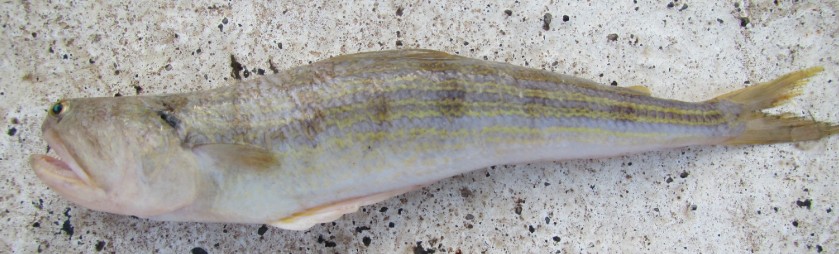
According to the authors, “this study reports the validated record of an adult T. myops in the Azores archipelago, caught by a fisherman on the island of Faial.” The fish was identified after morphological and genetic analyses which, according to the team, “confirmed the identity of the species.”
An Atlantic species that reaches the islands
T. myops, known internationally as “snakefish,” is an Atlantic species that inhabits tropical and temperate waters. The article explains that “T. myops occurs in tropical and temperate coastal waters, on sandy or muddy bottoms (…) It is an ambush predator, using its sharp teeth and camouflaged body to attack unsuspecting prey.” It mainly feeds on small fish and crustaceans and can live at depths of 0 to 400 meters.
Physically, it has an elongated body, short snout, and distinctive coloring. The study describes that “its typical coloring consists of alternating yellow and bluish stripes along the trunk, all edged with narrow brownish lines,” and it can reach 40 centimeters in length.

First adult recorded in the Azores
Until now, there was only one larval record of the species in the archipelago. The study recalls that “there is a single historical record of a T. myops larva, caught by a pelagic trawl net off the island of Faial in September 1984.” No adult individual had ever been observed until this capture.
The researchers emphasize that “this study reports the first documented occurrence of an adult T. myops fish in the Azores,” stating that the morphological characteristics and genetic analyses “correspond positively to the description of adults of T. myops from other Atlantic populations.”
Difficult identification and possible errors in the past
The absence of previous records may be due to its similarity to Synodus saurus, a species already present in the archipelago. The study admits that “the lack of previous references reporting adults of T. myops in the Azores can be explained by a recurring identification of this species as S. saurus,” since both share similar behaviors and characteristics.
Furthermore, as the article points out, “the differences between them may have been systematically ignored by fishermen,” since they have no commercial interest and are usually thrown back into the sea.
Natural colonization driven by currents
The arrival of the species may be linked to the ocean dynamics of the North Atlantic. The article states that “the oceanographic regime of the Azores is strongly influenced by the Gulf Stream and more directly by the Azores Current,” currents known to promote long-distance larval dispersal: “ocean currents are known to promote long-distance dispersal in several fish species.”
Thus, the authors consider that this occurrence may represent a natural process of colonization of oceanic islands.
“Regardless of the population of origin (…) the observations reported in this study may illustrate the natural process of colonization (…) of remote oceanic archipelagos by coastal benthic organisms,” they conclude.
With this confirmation, the article states: “T. myops is included as a native species in the Azores.” The blunt-nosed lizard is thus officially part of the archipelago’s marine fauna, enriching the biodiversity of the islands’ sandy habitats.
José Henrique Andrade is a journalist for the newspaper Correio dos Açores-Natalino Viveiros, director
Translated into English as a community outreach program by the Portuguese Beyond Borders Institute (PBBI) and the Modern and Classical Languages and Literatures Department (MCLL), in collaboration with Bruma Publication and ADMA (Azores-Diaspora Media Alliance) at California State University, Fresno. PBBI thanks Luso Financial for sponsoring NOVIDADES.

 Novidades - The Islands and the Diaspora