

Today marks the end of one of the most listened to morning radio programs ever in the Azores, “Inter-Ilhas.” And with it, the professional life of one of the greatest journalists to have worked at Antena 1 Açores also comes to a close: Sidónio Bettencourt.
I first got to know Sidónio through the radio, through his confident, firm, and conspiratorial voice that, in the late 1970s, resonated daily on “our station,” as we affectionately called RDP Açores.
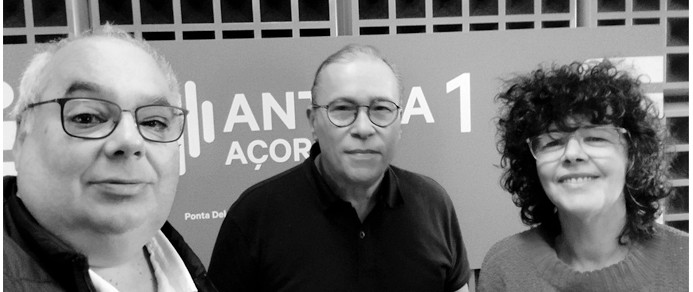
He began his career in 1976 and was already part of the team when, in 1980, I started my career as a photojournalist at Açoriano Oriental. Only then did I have the privilege of meeting him in person, the man behind that radio presence that was already part of the lives of so many Azoreans. In the photographs accompanying this text, Sidónio is at the “First Meeting of Azorean Journalists,” which took place between December 1 and 3, 1983, and which I had the privilege of reporting on for Açoriano Oriental. In the other photograph, more recent, in the Antena 1 Açores studio, I am with my wife, on one of the many occasions we were interviewed there.
Sidónio went through everything at the radio station he always called “his.” Over the decades, he held positions of enormous responsibility: Editor-in-Chief, Head of Production Services, Head of Information Services, Head of Programming at RDP Açores, and Deputy Director of “Media and Content” at RTP Açores. Between 1996 and 2000, he also brought his voice and experience to the Regional Legislative Assembly of the Azores, where he served as a deputy.
It is impossible to talk about Sidónio without mentioning his roots. The son of a family of whalers from Pico, he was born in 1955 in the parish of Arrifes, in São Miguel, but life would soon take him to live in his family’s homeland, Pico. His father, a career military man, was mobilized for war overseas during Sidónio’s childhood, which led mother and son to settle on the island of Pico. There he spent six years, surrounded by the familiar but deeply human environment of communities linked to the sea.
With the end of his father’s first commission in Africa, the family returned to São Miguel, where they remained for two years. However, a new change would ultimately have a decisive impact on his development: the move to Águeda, in the district of Aveiro. This move opened up a world of experiences that had been unknown to him until then. He started attending school in Aveiro, had access to television for the first time, and, above all, discovered a passion for radio.
It was also in Águeda that he had the opportunity to spend time with Otelo Saraiva de Carvalho, who knew his father from his first commission in Africa and taught military tactics there. Even then, reciting poems fascinated him and fed his imagination. In the early 1970s, he returned to São Miguel, this time to study at the Liceu de Ponta Delgada, marking the beginning of a new, more mature, more conscious, and deeply rooted stage in his life.
Through all this life experience, Sidónio Bettencourt brings to his spoken and written words the memory, the sea, the harshness, and the beauty of the vast Azorean cultural heritage that shaped him. Each story, each poem, and each gesture bears the mark of the islands: the strength of the whalers, the silence of departures, the courage of returns, and the deep connection to a territory where nature dictates the rhythm of existence. It is from this heritage that the authenticity of his voice is born, always anchored in the collective memory and identity of the Azores.
Author of several literary works, a tireless promoter of poetry and Azorean and Portuguese writers, he has been a regular presence at recitals, conferences, and cultural events both inside and outside the country. His journalistic activity was not limited to radio. He was a contributor to several newspapers, magazines, and television programs, as well as a special correspondent for regional, national, and international events.
The excellence of his work has earned him numerous awards and distinctions. I will not list them in this chronicle, not because they lack merit, but because there are so many that I would risk making the text too long and, perhaps, tiresome for the reader. Nevertheless, it is important to note that he has received several national and regional awards in the field of journalism, a fitting recognition of a career marked by dedication, rigor, and a deep sense of public service. In addition to these awards, he has received a number of tributes from official bodies, including several municipal councils, the Government of the Azores and, of particular significance, the Azorean diaspora, which sees in his career a reflection of the collective identity that unites them overseas.
The defender of the voices of the islands
However, there is something that marks Sidónio Bettencourt’s long career in a very special way: the enormous contribution he has made to cultural dissemination through his programs. Inter-Ilhas, which has been on the air for 22 years thanks to his efforts, has become a true meeting place for the archipelago. Hundreds of artists have appeared on the program: writers, singers, visual artists, photographers, party organizers, and cultural agents from all the islands.
The same happened on the program “Atlântida,” which he presented for 21 years on RTP-Açores, where Sidónio always took the voice of the best of the Azores further. Among these artists were also many representatives of our philharmonic bands, institutions that Sidónio always defended with passion and persistence.
He was undoubtedly one of the greatest promoters of Azorean philharmonic bands, regardless of the island or the size of their bands. For this reason, I firmly believe that those responsible for these cultural institutions owe him a debt of gratitude and should pay tribute to this journalist who did so much to preserve and promote their activity.
I also speak from personal experience. In our cultural activities, books, photo exhibitions, theater, or fashion-related events, my wife and I were invited several times to Inter-Ilhas and Atlântida. Sidónio always welcomed us with his good humor, listening to us attentively and highlighting our work with his characteristic generosity. As a representative of some circuses from the mainland that visited the Azores, I also had the opportunity to be on his programs, where I always found professionalism, rigor, and friendship.
A void impossible to fill
It is certain that the radio station will continue, but Sidónio’s departure leaves a huge void, of that I have no doubt. His voice, so often a guide, so often a companion, remains etched in the memory of several generations of Azoreans, including our emigrants. But more than his voice, what remains is his example: that of an honest journalist, a passionate communicator, a man committed to the culture, traditions, and identity of our islands.
But Sidónio’s legacy does not end with his departure from the microphones. Every interview, every conversation, every space he opened up for others to showcase their talent leaves a trail that will continue to inspire those who come after. Sidónio Bettencourt helped shape the way Azoreans see and hear themselves, both on and off the islands, reinforcing the idea that culture is, above all, an ongoing dialogue between people, memories, and landscapes. That is why his contribution is not confined to the radio archives: it lives on in the stories he helped to tell, the artists he helped to reveal, and the ties he helped to strengthen between the islands of our archipelago. His retirement marks the end of a cycle, but his influence will continue for many, many years to come.
For our part, the Freitas couple would like to express their heartfelt gratitude for everything Sidónio Bettencourt has done for us, for Azorean culture, and for the archipelago’s media.
We wish him a retirement that is everything he deserves: peaceful, happy, and full of accomplishments. Because, without a doubt, the Azores are greater because Sidónio Bettencourt passed through them.
João Freitas in Correio dos Açores-Natalino Viveiros, director
Translated into English as a community outreach program by the Portuguese Beyond Borders Institute (PBBI) and the Modern and Classical Languages and Literatures Department (MCLL), in collaboration with Bruma Publication and ADMA (Azores-Diaspora Media Alliance) at California State University, Fresno. PBBI thanks Luso Financial for sponsoring NOVIDADES.

 Novidades - The Islands and the Diaspora