

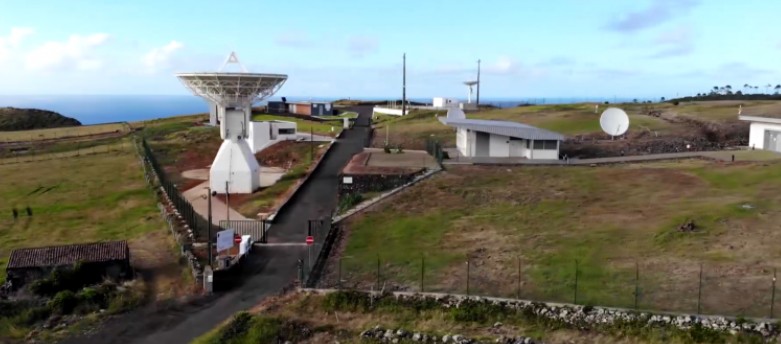
Portugal and the European Space Agency signed an agreement on Thursday in Bremen confirming the island of Santa Maria as the landing site for the inaugural flight of Space Rider and guaranteeing an investment of €15 million in the future Space Hub, consolidating the development of the region’s Space Technology Center.
Portugal and the European Space Agency formalized on Thursday in Bremen the choice of the island of Santa Maria as the landing site for the inaugural flight of Space Rider. The agreement, signed during the ESA Ministerial Summit, commits to invest €15 million in the future Space Hub of Santa Maria and consolidates the development of the island’s Space Technology Center.
The agreement was signed by the Minister of Education, Science, and Innovation, Fernando Alexandre, the Director General of ESA, Josef Aschbacher, and the President of the Portuguese Space Agency, Ricardo Conde. The moment was witnessed by the Italian Minister of Enterprise, Adolfo Urso, who leads the Space Rider mission. Within the framework of the national subscription to ESA programs, Portugal ensures this development with the contribution and commitment of the Regional Government of the Azores, as announced by the Portuguese Space Agency. According to the Ministry of Education, Science, and Innovation, “Portugal is taking a decisive step towards establishing itself as a true Atlantic Nation through Space.” Fernando Alexandre stated at the ESA Ministerial Council that Portugal intends to assert itself “with a significant contribution to elevating the future of Europe through space,” arguing that national participation in ESA programs can contribute to “a more resilient Europe.” The minister also highlighted the more than 50 percent increase in Portugal’s contribution, totaling €204.8 million and involving more government areas.

The agreement includes several ESA programs that promote new European space transportation capabilities, including access and return services from space. Space Rider, currently under development, is a reusable, unmanned orbital vehicle designed for short-duration missions in low orbit, with applications in microgravity, technology demonstrations, and the eventual deployment of small satellites, before returning to Earth. The maiden flight is scheduled for 2028, aboard a Vega-C launcher, from the French Guiana Spaceport, with a planned return to the island of Santa Maria. The formalization of this agreement, witnessed by the Minister of Education, Science, and Innovation, the Secretary of State for Science and Innovation, and the Italian Minister of Enterprise, is the result of joint work carried out in recent years by the Portuguese Space Agency, which included a feasibility study of the landing site. This study, completed in July 2024, confirmed the technological and economic feasibility of Santa Maria as a landing site for the vehicle.
With the design phase underway, the development of the Santa Maria Space Hub will follow, including the Space Rider landing and post-landing processing infrastructure integrated into the future Space Technology Center. These capabilities will be scaled to support various space activities, providing the island with permanent means of support for access and return missions. The national investment, made through ESA, ensures the necessary resources for preparing the infrastructure, strengthening Portugal’s participation in structuring European programs, and enhancing the competitiveness of the national industry linked to space technologies.
In the next phase, which will be operational, the objective is to prepare Santa Maria to host the landing of the inaugural Space Rider flight and subsequent missions, as well as experimental entry missions. The choice of Santa Maria as a landing site “reinforces the strategic role of the Azores in the European context and is part of a broader vision of creating a multifaceted space hub on the island, which also includes initiatives for access to space to be set up in Santa Maria,” said the Portuguese Space Agency. “With this agreement and the financial commitment made, Portugal is taking a new step in consolidating Santa Maria as a European space hub and in creating scientific, technological, and economic opportunities for the country and for the Autonomous Region of the Azores,” the statement concluded.
In Correio dos Açores-Natalino Viveiros, director.
Translated into English as a community outreach program by the Portuguese Beyond Borders Institute (PBBI) and the Modern and Classical Languages and Literatures Department (MCLL), in collaboration with Bruma Publication and ADMA (Azores-Diaspora Media Alliance) at California State University, Fresno. PBBI thanks Luso Financial for sponsoring NOVIDADES.

 Novidades - The Islands and the Diaspora