


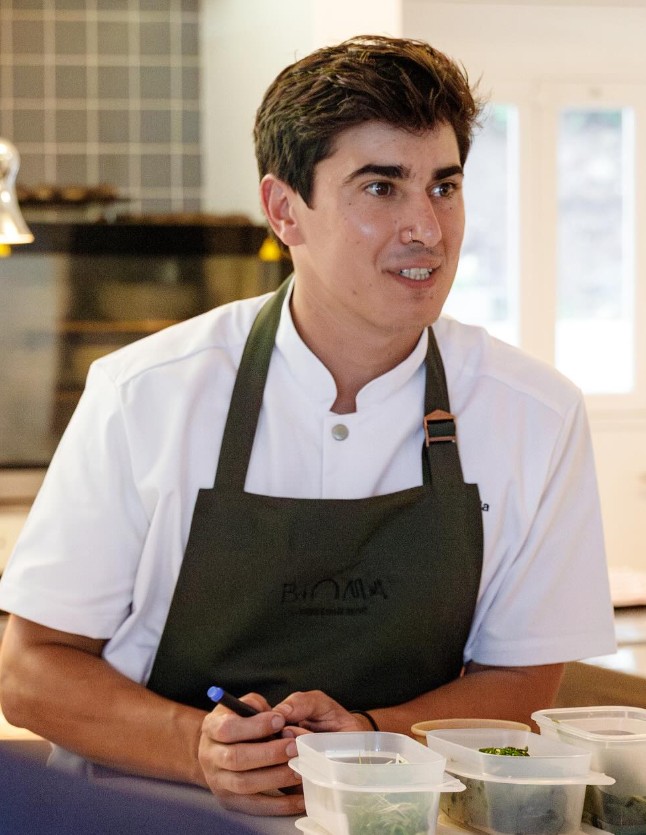
Franco Pinilla and Rafael Ávila Melo, two young chefs who met in Argentina, created Bioma Restaurant in Lajes do Pico, a project that values Azorean gastronomic heritage, promotes local products and producers, and focuses on sustainability by using raw materials from the island. The project, which also seeks to raise customer awareness of the preservation of nature and Azorean culture, won this year’s Gastronomic Tourism category at the 7th edition of the National Tourism Awards.
Correio dos Açores – What is the story of the founders? How did you meet?
Franco Pinilla (Argentinian Chef and Co-Founder of Bioma Restaurant) – We met in Argentina, at the Mishiguene restaurant, where I was head chef. We participated in a six-handed event with chefs Tomás Kalika, who was my chef, Josean Alija, who was Rafael’s chef at the time, and chef Micha from Peru. Rafael was at that event, and we cooked together for a few hours. After that day, we kept in touch, and some time later, when I traveled to Bilbao for another event, we were together again, further strengthening our friendship.
How did the idea of opening a restaurant on the island of Pico come about?
FP – In 2022, I was traveling through Spain and Portugal and thought about visiting Rafael in Pico. We did many activities and had several conversations about our life goals. He conveyed to me the island’s potential, which I agreed with after observing the area while I was there. We were also at a point where we were both willing to take a risk.
Rafael Ávila Melo (Portuguese Chef and Co-Founder of “Bioma Restaurant”) – I think it came from the idea that we were both at a point in our lives where we wanted to change our lifestyle and where we had new professional and personal goals. Combined with the potential and opportunities we saw, we didn’t hesitate and went for it. We were sure of the concept and style of the restaurant we wanted.
What is the main objective of the establishment?
RM – The main objectives are to promote the Azorean gastronomic heritage, raise awareness of products and producers, and showcase the best the Azores has to offer.
FP – In addition to wanting to be a benchmark for quality, we created this space to add value to everything being developed on the island, supporting sustainable, high-quality growthto put the archipelago on the world’s gastronomic map.
The name “Bioma” is closely linked to nature. How is this concept applied in the day-to-day running of the restaurant?
FP – It is applied in all aspects. The Azores are located in the Macaronesia biome, a large ecological region characterized by unique geographical and climatic conditions. This means that both the flora and fauna, as well as the agricultural products and local culture, are influenced by these special conditions, making them unique. At “Bioma,” we aim to embody this as much as possible, with nature and culture as the fundamental pillars of our cuisine and the experiences we offer.
Is investing in local products a priority? What types of products do you use?
RM – Yes, without a doubt. That is our commitment: to build a local market and, in this way, make everything around us grow. We think it is very important, as islanders, to support each other, and we try to transpose this into the establishment. We use everything available to us through local trade, producers, and all people—whether farmers or not—who may, in some way, have small harvests. With the restaurant’s growth, we have been receiving more and more people who want us to use their goods.
We research and investigate a lot about the wild foods that exist on the island, which we are happy to harvest ourselves, such as sea spinach, halophytes, herbs, seaweed, and some fruits. The fish is sourced in partnership with a local fishmonger, and the meat comes from our own farmer, Mr. António. We really work with any raw material grown here, doing justice to this heritage and its quality.

How does the restaurant contribute to the sustainability of the region?
FP – We work with local products, supporting farmers and breeders in the region. This strengthens the local economy and helps reduce the environmental footprint created by transportation. We try to use the whole animal and make the most of everything we are supplied with, avoiding waste as much as possible. We have also installed solar panels at the restaurant and operate in a circular economy. In addition, we have our own vegetable garden and prioritize sustainable techniques and practices.
We also seek to raise awareness among our customers about the importance of preserving Azorean nature and culture, showing that it is possible to produce high-quality cuisine that is both responsible and sustainable.
What challenges did you encounter during the creation process? Is insularity an obstacle?
RM – We face a lack of skilled labor in all areas, and being on an island with a small population makes the challenge even greater. We also have logistical problems with deliveries and suppliers, very long waiting times, and the absence of basic services in the restaurant industry, such as laundry.
Insularity is undoubtedly an obstacle. However, these are steps that a small island like Pico still has time to take. Part of our role is to show results and solutions to these same challenges.
FP – Another major challenge is seasonality. We face some very slow winter months, during which we need to be financially and mentally prepared to take advantage of the drop in customer volume to improve our experience and keep our minds active. Otherwise, winter can be very hard on our morale.
How did the island community receive the space? Did they embrace it?
RM – I think there are two aspects to consider here. On the one hand, with customers, we had less uptake initially, which is understandable, given that the “Bioma” is a different idea from what people are used to on the islands, but over time, more and more people came. Whenever we have visitors, they leave with a smile and feel well represented, which is very satisfying for us.
The other point to consider is the support we received. The locals were and are of great importance to the concept. Sharing with them was fundamental to understanding what we had to do. We received a lot of support from the island, and we hope that they are also happy with what we are doing.

Who are your most common customers? What has their feedback been like?
FP – Mostly tourists looking for experiences that represent the place they are visiting, and nature lovers. The reception and feedback from our visitors have been very good.
How does the “Chef’s Table” service work? How does it differ from the others?
FP – The idea was to create a more engaging service, where customers can talk, ask questions, see, and experience the service from a different perspective, almost as if they were inside the kitchen. It is a 12-course menu, served at the kitchen counter, featuring more exclusive products, and is available to only 4 people per day.
This allows us to provide a much more personalized and in-depth experience. With this type of initiative, we can tell the story of the restaurant, the products, and everything that involves the “Bioma.”’

What was it like to participate in the National Tourism Award?
RM – It was really great to be among all the nominees. I think that for us, for our team, and for everyone who is part of this, directly or indirectly, it is recognition for our work and dedication. These awards give us the energy to continue on our path.
FP – We were already happy just to be among the finalists. Realizing that what we are doing is being valued gives us a lot of strength. We created “Bioma” literally from scratch, without funds or resources, just believing in our idea from the beginning. Receiving this recognition fills us with pride. We intend to continue improving and pursue all the goals we have ahead of us.
What does it mean to leave the event with the Gastronomic Tourism award? How will this influence the restaurant? How did it feel?
RM – It was a mixture of emotions, including happiness, ecstasy, and gratification. We went through a lot to create this, and receiving such recognition is very satisfying. We think it is another important step for the gastronomy of the Azores, and especially for the island of Pico.
It means we have taken a big step forward on the concept, clarified some doubts, and confirmed that we are on the right track. It motivates us a lot, because it is not an endpoint, but a reason to continue investing in the island. We hope it will further strengthen the community’s support and help them believe in what we are developing. It is also an incentive for new visitors to come to us.

What message would you like to leave the community with?
FP – That the Azores have potential. It is important to value and take care of everything we have. We must walk together towards growth, focused on quality rather than quantity. We are a small island, but one that offers a lot for community growth.
RM – In addition, we want to tell young people that it is possible to create things, that they – or we – are the future, and they must invest in it. Go out, see the world, and learn, but come back and invest in your homeland. When things are done with passion, desire, and hard work, incredible initiatives happen.
We are also open to anyone who wants to be part of this adventure. Our team is growing, and we are looking for people who want to add value to the business and learn with us.
Diogo Simões Pires is a journalist for Correio dos Açores-Natalino Viveiros, director.
Translated into English as a community outreach program by the Portuguese Beyond Borders Institute (PBBI) and the Modern and Classical Languages and Literatures Department (MCLL), in collaboration with Bruma Publication and ADMA (Azores-Diaspora Media Alliance) at California State University, Fresno. PBBI thanks Luso Financial for sponsoring NOVIDADES.


 Novidades - The Islands and the Diaspora