

For many years, the Azores were forgotten by commercial shipping routes in the North Atlantic, where, in the 1950s, the passenger liners ‘Leonardo da Vinci’, which replaced the ‘Andrea Doria’ and ‘Cristóvão Colombo’, made stopovers on their way from Europe to North America. I still remember seeing them pass through the Pico-São Jorge channel, coming from Italy and heading for the United States. Their grandeur transported me to the American dream, where my mother lived her childhood and youth and from where she returned with her family in the 1930s aboard the Fabre Line liner SINAIA.
As a child, I have vivid memories of the voyages and stops of the Insulana liners in Ponta Delgada and Angra. In the days of steam, the dock was bustling with taxis, people, porters who had their hands full carrying suitcases, and street vendors (some of whom spoke English) with stalls set up next to the service staircase, selling tourist postcards, handicrafts, and pineapples.
Times have changed. The Azores have become a stopover for cruise tourism. Every year, the number of requests to call at São Miguel, currently the port with the highest demand for large ships, increases. On a smaller scale and in this transport segment are the islands of Faial and Terceira. The remaining islands continue to receive smaller ships with visitors more interested in other specific segments related to environmental and nature tourism and ocean exploration.
As the year draws to a close, the transatlantic liners head for other destinations. The most popular destinations are the Caribbean, the Canary Islands, the Middle East (Dubai, Abu Dhabi), and Northern Europe, which offers Christmas markets. It is an escape from the low temperatures of the north and a search for warmer climates with sun and beaches.
Even so, two more cruises are scheduled to arrive in Ponta Delgada in early December, carrying more than 3,600 passengers, including crew members.
Estimates of maritime traffic in the port of Ponta Delgada for 2026 are already available. On February 4, around 3,000 visitors are expected in Ponta Delgada. In March, at the end of the Caribbean summer and the beginning of the European spring, cruises cross the North Atlantic, bound for Europe, with very impressive stops in the Azores.
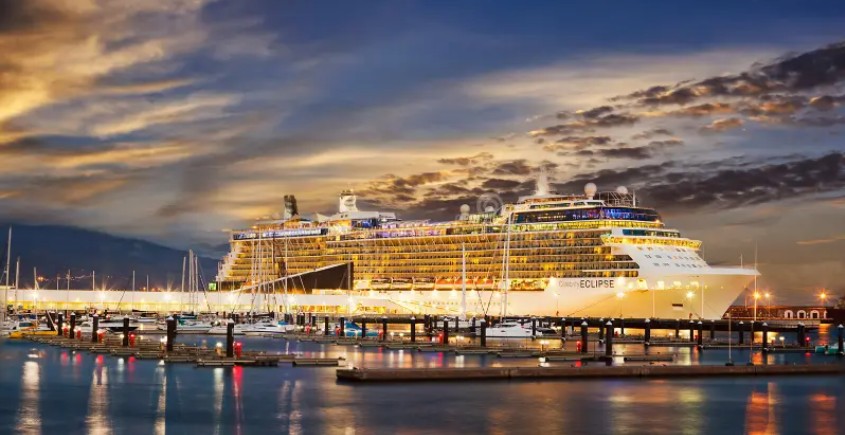
According to ‘Portos dos Açores’, ships are expected to call at the port that month, with around 27,000 passengers and 11,000 crew members, totaling 38,000 people. In April, almost every day, 32 cruise ships will stop in Ponta Delgada, carrying around 75,000 visitors (approximately 52,000 passengers and 22,000 crew members). On the 19th alone, four large cruise ships are expected to arrive, which, although not a unique occurrence, reaffirms the growing demand for São Miguel and the considerable expansion of this tourism segment.
In May, there is a sharp drop in the number of ships and visitors (around 25,000, including crew members). Only in October and November will the sea routes head west, resuming their usual circuits.
If we add to this number of visitors those who travel to the archipelago by air, staying for an average of at least three days, we are led to conclude that a huge leap has been made in recent years in an economic sector that is highly demanding in terms of professional competence and of enormous social and wage importance.
Tourism cannot be assessed solely based on its infrastructure: accommodation, hotels, restaurants, transport and mobility, and related services. The components of environmental and natural preservation must be taken into account, together with the promotion of our social and cultural identity.
2026 will be the year in which Ponta Delgada will be the National Capital of Portuguese Culture. This means that all events and initiatives undertaken must reflect the culture of the country’s various regions, especially our island culture and identity – AÇORIANIDADE – our way of being and living Portugal here.
It is up to the organizers to involve social and cultural agents in this process with a view to promoting and disseminating the best of who we are and what we have to those who visit us.
Ponta Delgada, in 2026, must be a space with Open Doors to the Sea and to those who visit us, in a healthy exchange, open to other and new cultures that other people bring us when they pass through here.
Ponta Delgada, November 27, 2025
José Gabriel Ávila Journalist c.p. 239 A
http://escritemdia.blogspot.com
José Gabriel Ávila is a professional journalist, now retired in the Azores and writes regularly for the Azorean Press.
NOVIDADES will feature occasional opinion pieces from leading thinkers and writers in the Azores, providing the diaspora and those interested in the current state of the Azores with a sense of the significant perspectives on some of the archipelago’s issues.
Translated to English as a community outreach program from the Portuguese Beyond Borders Institute (PBBI) and the Modern and Classical Languages and Literatures Department (MCLL).
 Novidades - The Islands and the Diaspora