

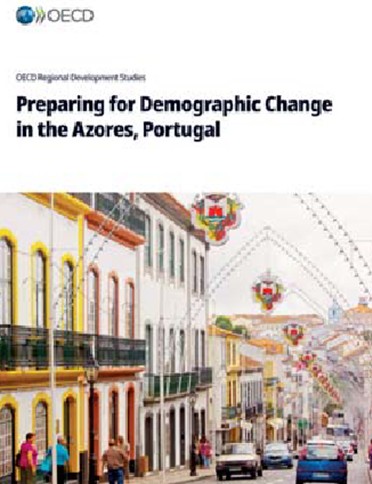
The Azores is at risk of losing nearly a third of its population by 2080, despite a slight demographic recovery in recent years. The warning comes from the Organization for Economic Cooperation and Development (OECD) in its report “Preparing for Demographic Change in the Azores, Portugal,” which analyzes in detail the evolution and demographic projections of the archipelago and places the region among the European territories most exposed to the so-called “talent development trap.”
With around 240,000 residents, the Autonomous Region of the Azores lost 2.7% of its population between 2010 and 2023. The OECD points out that this decline was strongly fueled by the departure of young people: the net migration rate in the 15-39 age group was -8.1% during this period, more than three times higher, in absolute terms, than the rate recorded for the population as a whole (-2.4%). At the same time, the age structure has changed markedly: the population under the age of 14 has decreased by about a quarter, while the number of residents aged 65 or over has increased by approximately a third.
The report notes that the archipelago, covering 2,355 square kilometers and comprising 9 islands, has a highly uneven population distribution. São Miguel, the largest island, has a population of almost 140,000, more than half of the Azorean population.
At the other end of the scale, the four smallest islands, Corvo, Flores, Graciosa, and Santa Maria, together account for less than 6% of residents, with Corvo, the smallest island, having just over 400 inhabitants. This geography increases the costs of providing public services and the difficulty of maintaining infrastructure and a dynamic economy in the most peripheral areas. The disparities are also evident at the municipal level. Between 2011 and 2023, the municipality of Nordeste, in São Miguel, lost 10% of its population, while Madalena, on the island of Pico, and Corvo itself recorded gains of around 7%. The islands of São Jorge, Flores, and Graciosa, on the other hand, suffered declines of more than 5% in the same period. In most municipalities, the natural balance is negative, with recent growth mainly explained by migratory flows; the islands of Pico and Corvo stand out for stronger immigration than in the rest of the region.

Despite this situation, the OECD notes that the trend of depopulation has slowed in recent years. After a low point in 2018-2019, the population of the Azores has grown by 1.3% since 2019, thanks to immigration, in a context marked by the liberalization of airspace, strong growth in tourism, and an increase in teleworking after the COVID-19 pandemic.
However, the natural balance has become increasingly negative, and the organization warns that this recent stabilization is likely to be temporary if more ambitious adaptation policies are not adopted. The demographic projections used by the OECD, based on Eurostat’s reference scenario, are clear: between 2025 and 2060, the Azorean population is expected to decline by 17%, and by 2080, the decline could reach 29%.
At the same time, the working-age population could shrink by about a third, while the number of elderly people is expected to increase by 76% by 2060, putting pressure on the labor market, health systems, and long-term care. In comparison, Portugal as a whole is expected to lose nearly 11% of its residents, the Alentejo region could decline by 36%, and the Lisbon Metropolitan Area is the only Portuguese region where population growth is anticipated, in the order of 5%.
The OECD links these indicators to the difficulty of retaining young and skilled talent. The region is identified by the European Commission as one of 82 European regions at risk of a “talent development trap,” that is, territories where the combination of aging, youth outflow, and weak ability to attract and retain skilled workers threatens the potential for economic development.
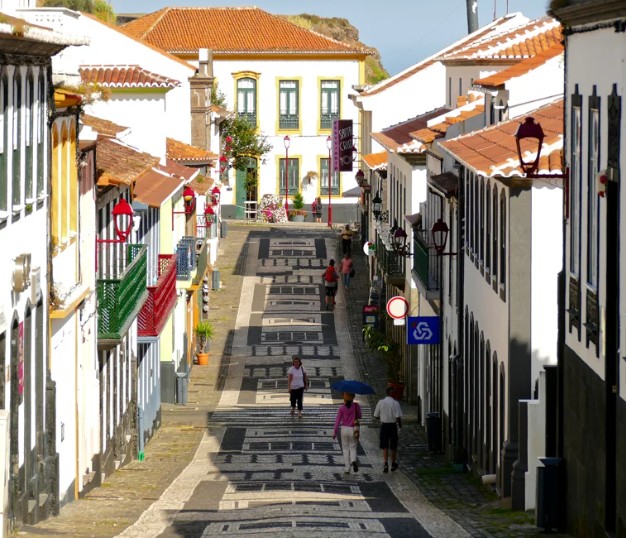
The still high weight of the primary sector, public administration, and tourism, with limited opportunities for an increasingly skilled youth, is pointed out as a factor that fuels the emigration of skilled workers.
The report also links demographic pressure to developments in the housing market. Since 2015, house prices in the Azores have risen faster than in any other Portuguese region, driving young professionals and families away from areas of high demand. At the same time, social housing accounts for only 2.3% of the housing stock, a figure considered insufficient in view of the need for access to affordable housing, especially in urban and tourist areas, where the population and services are concentrated.
Given this scenario, the OECD argues that the response to population decline and aging in the Azores cannot be limited to trying to “retain people at any cost,” but must involve an intelligent adaptation of the territory and public policies to the new demographic profile. Among the priorities identified are the redevelopment of underutilized urban land, strengthening inter-municipal coordination, investing in local public services, improving mobility and digital connectivity, and an active strategy to attract and integrate new residents, including migrants, to halt population loss and prevent the region from falling into the demographic trap that is already evident in the statistics.
In Diário dos Açores, Paulo Viveiros-director.
Translated into English as a community outreach program by the Portuguese Beyond Borders Institute (PBBI) and the Modern and Classical Languages and Literatures Department (MCLL), in collaboration with Bruma Publication and ADMA (Azores-Diaspora Media Alliance) at California State University, Fresno. PBBI thanks Luso Financial for sponsoring NOVIDADES.

 Novidades - The Islands and the Diaspora