


The official opening of the Micaelense Holstein Frísia Autumn Competition, at the Santana Fairgrounds in the municipality of Ribeira Grande, was marked by speeches from the president of the São Miguel Agricultural Association (AASM), Jorge Rita, and the president of the Azores Regional Government, José Manuel Bolieiro, on the sustainability of the Azorean agricultural sector.
Jorge Rita demanded an end to delays in aid payments and a tax incentive policy for young Azorean farmers, to which the president of the Regional Government of the Azores responded with the announcement of EU funds and a commitment to greater financial predictability for 2026.
In his speech, the president of the regional government, José Manuel Bolieiro, acknowledged that the delay in payments leaves him “moved and upset,” promising an effort to fulfill the commitments. The main investment announcement was the launch, starting in December, of PEPAC – the Strategic Plan for the Common Agricultural Policy, with €24 million in investments available on a monthly basis over six months “to ensure timely payments.”
In response to criticism of bureaucracy, the president of the Azorean executive announced simplification measures, including an increase in the co-financing rate from 75% to 85%, the elimination of maximum investment limits, and the elimination of the requirement for economic studies, with a view to improving the liquidity of entrepreneurs. In addition, he announced and highlighted the reinforcement of two million for applications to the VITIS program, financed by the European Agricultural Guarantee Fund, encouraging the diversification of viticulture.
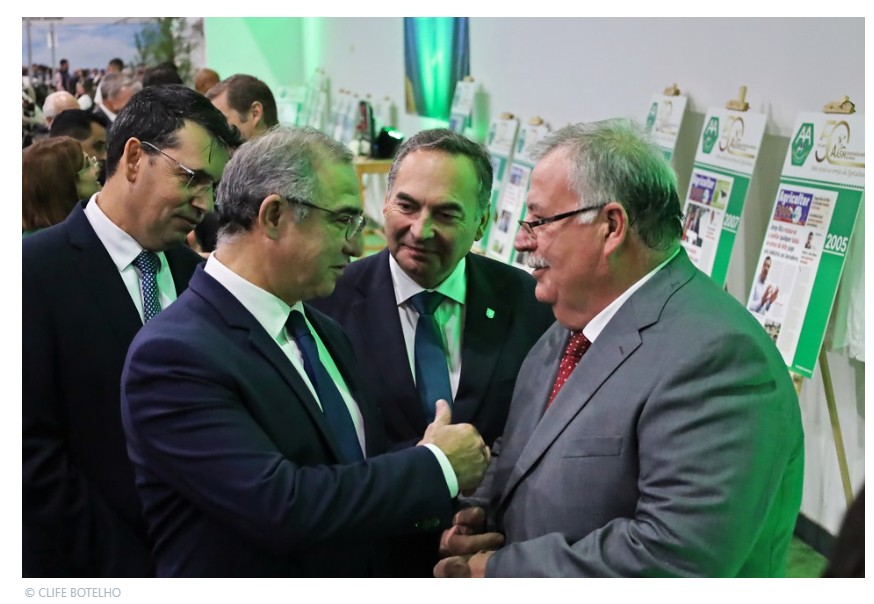
In view of the delays in payments, the minister undertook to negotiate a payment schedule: “We will negotiate a payment schedule for 2026, to ensure predictability, stability, and regularity in payments,” he assured. The speech ended with recognition of the essential role of Azorean farmers as “gardeners of our environment” and praise for “Commander Jorge Rita” for his capacity for “dialogue and constructive criticism.”
The president of the AASM began his speech by praising the “extraordinary quality” of regional production, which leads all the rankings of the CAP – Confederation of Farmers of Portugal. However, he stressed that this performance is not fairly reflected in farmers’ incomes, criticizing the lack of commercial aggressiveness and the need to promote the Azores brand more consistently.
The association leader pointed out what he considers a serious social problem: the difficulty of attracting young people to a sector that requires “dedication 365 days a year.” To reverse the situation, he argued that, in addition to strengthening aid, it is crucial to “reduce tax issues” and eliminate alleged discrimination in national assistance. The most urgent demand focused on late payments, with Jorge Rita demanding a schedule for aid so producers have predictability, while stressing that they comply “strictly” with their tax and social security commitments and expecting the same integrity from the Azores Government.
In Diário da Lagoa, Clife Botelho-director.
Translated into English as a community outreach program by the Portuguese Beyond Borders Institute (PBBI) and the Modern and Classical Languages and Literatures Department (MCLL), in collaboration with Bruma Publication and ADMA (Azores-Diaspora Media Alliance) at California State University, Fresno. PBBI thanks Luso Financial for sponsoring NOVIDADES.

 Novidades - The Islands and the Diaspora