

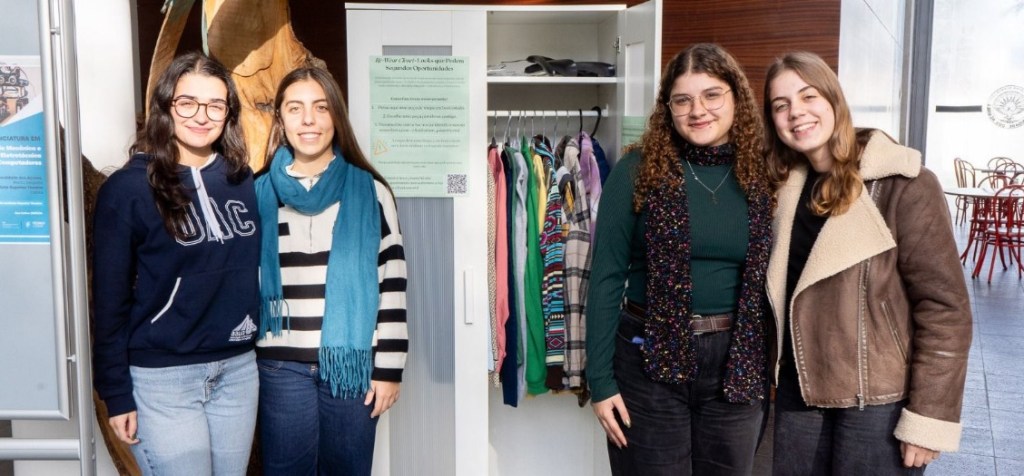
Psychology students at the University of the Azores, Ana Sofia Fernandes, Iara Barata, Ana Beatriz Barbosa, and Raquel Mata, created Re-Wear Closet, a closet open to the community where, for one week, anyone could exchange clothes they no longer wear for others in good condition. The initiative, developed in the Environmental Psychology course and which ended last Sunday, aims to combat ‘fast fashion’ through reuse, reduce textile waste, and encourage more sustainable consumption habits. Any items not claimed will be donated to families in need. “Although it was limited to just one week, we believe that Re-Wear has the potential to become a permanent fixture at the institution. The idea of exchanging clothes in an environmentally friendly way is something that could attract more students, if done with the right publicity and organization,” say the psychology students.
Correio dos Açores – What was the motivation for creating the Re-Wear Closet project? How do you define the concept?
Ana Sofia Fernandes, Iara Barata, Ana Beatriz Barbosa, and Raquel Mata (Founders of Re-Wear Closet) – The creation of Re-Wear Closet arose as part of an intervention project in the Environmental Psychology course, which aimed to select an issue of unsustainable consumption. We chose the phenomenon of fast fashion, a movement characterized by the rapid and cheap production of clothing that encourages constant consumption and generates significant environmental and social impacts.
The initiative was born out of concern for these same negative impacts that contribute to environmental pollution and waste of resources. We therefore decided to create something for the whole community, with the aim of raising awareness and promoting good consumption habits through clothing swaps.
The concept is based on a sustainable wardrobe accessible to everyone, where they can swap items they no longer use for another available item they like. This gives a second life to items they no longer use, while allowing them to take something new home. In this way, the project integrates sustainability, reuse, and waste reduction, offering a responsible alternative to the fast-fashion culture.
The idea arose in the context of the Environmental Psychology course. What does this course consist of, and what is its objective?
The Environmental Psychology course is one of the new subjects included in the new Psychology degree program and is taught by Professor Ana Arroz. The course examines how the environment influences individuals’ behavior, attitudes, and well-being, and how humans interact with the spaces they occupy.
This aspect of the course seeks to explore theories, research methods, and practical interventions to improve relationships with physical spaces and promote conscious and sustainable behaviors.
In our case, the knowledge gained from the course allowed us to develop an activity that promotes the reuse of textile products and combats fast fashion through sustainability and social responsibility.
What were the biggest challenges you faced in building this initiative?
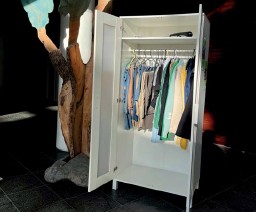
In its development, one of the biggest challenges was to create something that was appealing and that would be accepted by society. Initially, we planned to use boxes for exchanges, but we wanted to go beyond that and create something that would really capture attention and arouse interest and motivation to participate.
We decided to bring one of our own closets from home, which presented a logistical challenge, not only in transporting and installing it in a visible location, but also increating an open and efficient system. We decided to put the closet in the UAc Scientific Complex.
Another obstacle we encountered was publicity and subsequent evaluation. To publicize it, we used Instagram, created as part of the intervention, in order to reach as many interested parties as possible. We also had the support of the university’s social media department, which helped us in this stage by sharing news and publishing a video on its official platforms.
With regard to evaluation, defining how to collect users’ opinions proved equally challenging. Despite the success of the initiative, with some exchanges taking place during the period it was in operation, many did not leave their feedback, which left us without access to all the experiences and opinions.
What did you learn from this activity and how would you describe the community’s reception?
We expected some participation, so it was interesting to see that those who took part considered the closet a way to combat the effects of the problem. We also noticed curiosity and interest on the part of the crowd, which shows that they are open to smarter consumption actions.
We learned that if there were more similar initiatives or if our service were available for longer, people would be willing to participate and continue to encourage sustainable behavior, which highlights the potential that Re-Wear Closet has to generate impact and change.
Were the items that were not selected during the initiative period donated to institutions and families in need? How did this process work?
The items not selected during the initiative will be donated to an institution that supports families in need. We are carefully selecting the location for our donation to ensure it reaches the families who need it.
Is there a possibility of making Re-Wear a permanent feature at UAc?
Although it was limited to just one week, we believe that Re-Wear has the potential to become a permanent feature at the institution. The idea of exchanging clothes in an environmentally friendly way is something that could attract more students if done with adequate publicity and organization.
With greater support from the university, it is possible to expand and consolidate this initiative, encouraging more sustainable consumption habits in the academic community and, perhaps, among Azoreans in general.
We have also received two requests to expand, both in duration and to other areas of the Azores, which motivates us to continue.
Do you consider it feasible to create a sustainable community closet open to the entire community throughout the year? If so, what kind of support or partnership do you consider essential to make this idea a reality?
It is something we would like to do and will possibly try in the future. We loved this experience and felt it was fantastic to give people the opportunity to give their clothes a new lease on life. We offered this possibility in a subtle and light-hearted way, so we would like to show this concept to more people, beyond students.
As we only had our doors open for a week, there wasn’t much time for collaboration, so if there were a chance to be present year-round, it would be wonderful. In terms of partnerships, it would depend on where we wanted to put the wardrobe, whether in Ponta Delgada, at the university, or somewhere else. If we place it in the city, we may need to consult the City Council and obtain permission. We would also have to find a piece of furniture that didn’t belong to one of us.
To make people aware of its existence, we would also need to share it as much as possible and get involved on social media, which is very helpful and essential nowadays. So, with the resources and commitment, it might be possible to open a Re-Wear Closet all year round.
As young people, how do you view the issue of fast fashion and the waste it generates in today’s world?
As young people, we see this issue as something worrying, and it is getting worse and worse. Fast fashion facilitates access to cheap, fashionable products, which is appealing in today’s economy andbecause of its ease. Many people buy it, not because they mean any harm, but because it is what is around us, both in shopping malls and online stores.
It is simply sad and devastating to know how much this type of fashion harms the environment now and, not least, our future. Resource waste, worker exploitation, and pollution are among the negative effects this style brings to the world. It is frustrating to know that we cannot end it with just one gesture.
Action and will are needed, not just from a small group, but from everyone. There are several more environmentally friendly alternatives, such as buying second-hand, supporting ethical brands, or supporting ideas like ours.
We can only say that we feel powerless and hope these small ideas will show everyone that planet Earth is our priority andmore important than trends.
How do you observe this phenomenon within the Azorean reality?
The presence of fast fashion in the region is limited, and existing stores do not offer particularly low prices compared with those in mainland Portugal. We believe that this affects young people’s need for rapid, impulsive consumption and increases their openness to alternative options.
In fact, there is a growing interest in second-hand clothing stores that seek to keep up with current trends while offering more sustainable and affordable options. These establishments are not only present but are also gradually gaining popularity.
In your opinion, what are the essential steps that each person can take to contribute to reducing textile waste?
Before any major change, it all starts with a genuine intention to transform and the decision to turn that desire into action. Even when they seem like small choices, such as rethinking purchases or exploring more conscious alternatives, these are the starting points for a significant impact.
We can change our behavior by shopping at local and second-hand stores. We should donate to families in need, support activities that promote exchange, support more sustainable brands, and adopt a more minimalist style. It is important to buy clothes only when we need them, not because they are fashionable or because a new collection has been released.
Is there anything else you would like to add to this interview?
We would like to thank Professor Adolfo Fialho, Vice-Rector of UAc and President of the Faculty of Science and Technology, Luís Silva, for welcoming our project and for their support throughout the process.
We would also like to thank the University of the Azores’ marketing and social media team, Carlota Dâmaso and André Mendonça, for their help in promoting the project, including through news articles and the production of a video that greatly publicized the initiative.
Diogo Simões Pires is a journalist for Correio dos Açores-Natalino Viveiros, director
Translated into English as a community outreach program by the Portuguese Beyond Borders Institute (PBBI) and the Modern and Classical Languages and Literatures Department (MCLL), in collaboration with Bruma Publication and ADMA (Azores-Diaspora Media Alliance) at California State University, Fresno. PBBI thanks Luso Financial for sponsoring NOVIDADES.

 Novidades - The Islands and the Diaspora