

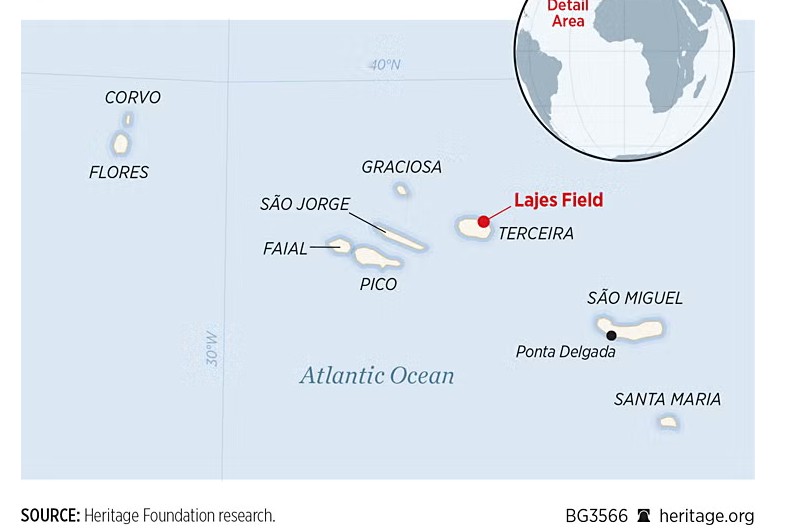
He has devoted particular attention to the geostrategic space of the Azores, putting the region on the map in this regard in his work at CNN. How do you analyze the role of the Azores in the dynamics underway on a global scale and especially in the Atlantic?
In a rapidly changing world, there is one thing that never changes—or changes very slowly: geography.
When we look at a map of the Western Hemisphere, Portugal and the Azores, a country and a region that are supposedly peripheral, are at the center of the northern half of that hemisphere, a half through which between a third and a quarter of all world trade passes. Today, as yesterday, the Azores are the “roundabout” on the “road” between North America and Europe, a connection that goes far beyond economics. A connection that has been one of the defining constants of the last century.
The problem is that, as we know when we look at the roundabouts on our roads, they are very rarely valued. They are useful and sometimes decorative, but nothing more than that. People pass through them, but no one stays. They are used, but they don’t count.
This is the challenge facing Portugal and the Azores—to count, to act, and not just be used by others. For various reasons that would take too long to analyze, the Portuguese in general, and the Azoreans in particular, have not known how or been able, with few exceptions, to take advantage of their geographical centrality in the Atlantic for at least the last two centuries.
Now, with the political, economic, military, and environmental changes we are witnessing in the North Atlantic, a window of opportunity—or even several—is opening to change that. All that is needed is the will and the capacity.
What opportunities do you see?
Firstly, we have security, without which nothing can be built. The Russian Navy, particularly its nuclear submarines, is returning to the Atlantic. The Chinese Navy may make its presence felt in the South Atlantic in the short to medium term, thanks to the possible acquisition of naval bases on the African coast.
In any of these situations, the Azores, and the Lajes base in particular, take on great importance. They are the indispensable lookout post, the “eye” that sees everything (if it is prepared for that), or even the “bolt” of the North Atlantic… and the Arctic.
Yes, because the Arctic is also gaining new economic and military importance. I began by saying that geography never changes, or changes very slowly, but there is at least one obvious exception: thanks to global warming, new trade routes are opening up through Antarctic waters that were previously impassable, and the Azores may be part of some of them.
This is already causing fierce competition among the major powers for access to this region and the enjoyment of its natural resources—because the thaw is also helping in this regard.
The Azores may also have great riches in its waters and seabed, but there is much to be done in terms of exploration—in fact, there is often a suspicion that others will know more about what is there than we do ourselves.
One of the basic obligations of any government is to know exactly what exists in its territory, whether land or sea. There may or may not be exploitation; what there cannot be is deliberate ignorance.
The extension of the Portuguese Exclusive Economic Zone and the hydrographic studies being carried out with this in mind are very important steps in the right direction, but one thing must be borne in mind: current technologies do not allow many of the things that exist on the seabed to be extracted profitably. Even in the case of gas and oil, whose extraction techniques have been mastered for many years, huge investments are required. It is easier to go into space than to the depths of the ocean.
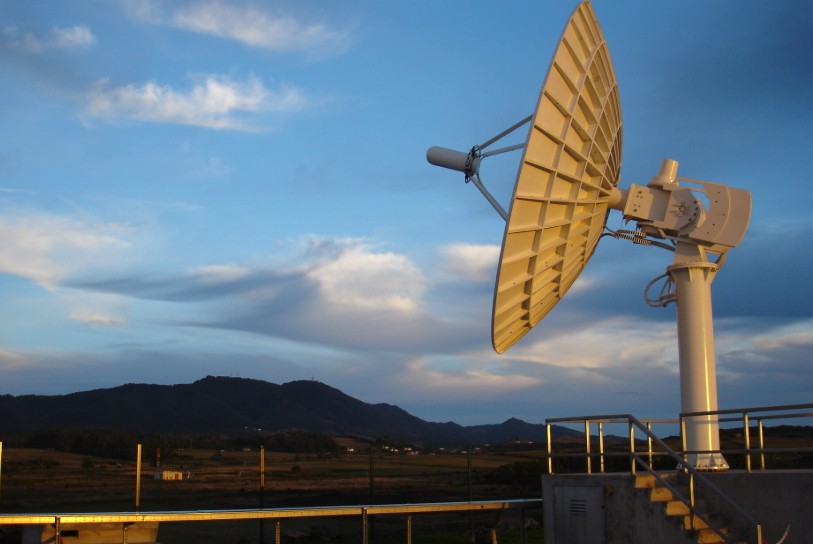
Speaking of space, could the installation of a spaceport in Santa Maria also be an opportunity, or will it once again make the island and the archipelago just a transit point that benefits little or nothing from other people’s business?
This is yet another case that shows that the geographical position of the Azores can be transformed into wealth, because the launch and recovery of space aircraft cannot be done anywhere on the globe. Now, everything depends on the imagination and dynamism of the region and the country in taking advantage of these comparative advantages.
The Portuguese aerospace industry is still small on a European scale, but it is growing rapidly and already participating in very significant international projects. Santa Maria may not be the next Florida or Texas, which benefited enormously from the US space program, but it also does not have to be French Guiana, which benefited little or nothing from having France’s space launch base.
The very recent confirmation that the European space shuttle, SpaceRider, will make its first ever landing in Santa Maria in 2028 will give the spaceport great visibility and credibility. Demand for launch services is exploding, and I am sure that Santa Maria could be a major hub for the development of the sector and the Azorean economy, if this is properly exploited.
The government is already taking steps to make this happen. The Atlantic Constellation project plans to launch 26 satellites to monitor the national strategic space, and the first of these is scheduled to be launched as early as February 2026.
There is a clear return to large-scale anti-submarine warfare from the Lajes Base, with US P8s and even French aircraft launching impressive quantities of sonobuoys into the Atlantic. What significance do you attach to this activity, which had been dormant since the deactivation of the US P3s at Lajes in 1994?
It is a clear sign that Russian nuclear submarines capable of launching intercontinental ballistic missiles (SSBNs) are returning to the Atlantic. Russia is currently undertaking a major program to modernize its fleet, and President Putin attaches great importance to this. In the last two years alone, it has commissioned or launched four or five nuclear submarines.
One of the last commanders of the US detachment in Lajes made a public statement in which he said, in no uncertain terms, that his military had assisted some Navy P-8s in the search for such a submarine.
This means that Lajes is already regaining some of the strategic and military importance it had until the end of the Cold War. Visits by P-8s have become very frequent in the last three or four years, and we know that, in the short term, they will no longer be visits. Work has been contracted to allow for a permanent detachment at the base, as was the case until 1994. The sight familiar to any Terceira resident over the age of 40, of US Navy planes always ready to take off at the head of the Lajes runway, may soon be back.

The new dynamics involving the Atlantic have been analyzed by Portuguese experts, who advocate the installation of national P3 aircraft at Lajes and the creation of a naval base at Praia da Vitória. Are these just wishes, or is there any consistency in these possibilities?
I know that there is a very concrete intention, which, everything indicates, will materialize in the short term. The Portuguese Air Force recently purchased six P-3 Orion maritime patrol aircraft that belonged to the German Navy. Last week, the government authorized an investment of €24 million to upgrade five of these aircraft so that they have the same capabilities as the other five P-3s that Portugal already had. This program should be completed by 2028.
At that point, Portugal will have one of the largest fleets of maritime patrol aircraft in Europe, not least because five of its C-295 aircraft also have this capability. The Air Force’s plan is to station some of these P-3s permanently at Lajes, and there is even talk of creating a new squadron.
This has not been confirmed to me by anyone in the Air Force, but I believe there will be collaboration with the US Navy in monitoring the Atlantic. I would not be at all surprised if the American P-8s and Portuguese P-3s were stationed at Lajes at the same time—in 2028, or even earlier.
This is clearly part of a broader plan for surveillance and control of the Atlantic, involving warships, drones, and satellites. To this end, it would be very important to have a naval base in Praia da Vitória. Admiral Gouveia e Melo had advocated this and, as far as I know, the intention remains. If this happens, it will be a very large investment, which will change a lot in Terceira.
However, unlike the P-3s, I am not aware of any concrete measures to implement the plan – which does not mean that they do not exist. We do know that the US Navy recently carried out hydrographic surveys of the port. When I asked the 6th Fleet about this, they told me that it was just routine work, which was being carried out in various places in Europe. However, I know that the possibility of permanently stationing some ships in Praia da Vitória was being studied – something that did not even happen during the Cold War.
It seems clear to me that the new military capability targets that NATO has assigned to Portugal this year imply a very significant strengthening of our capacity to monitor and defend the North Atlantic. The re-equipment of the Navy, which is already underway and worth billions of euros, shows this. Our waters are crossed by maritime routes and submarine cables that are essential to our collective defense and the well-being of our societies. The Azores are essential to this mission.
With the new stance of the US as an ally, what roles can the Azores play in strengthening European defense and security? Could we see clashes of interest between allies in our geostrategic space?
I never believed, as some have said, that the United States could abandon Lajes, if only because the cost of its presence there is minimal, and because there is one thing that will never change: the Azores are too close to the US for the latter to ever give up its presence there. Even if they are of no use to them, they must deny their use to other powers.
This could lead to conflict if the current administration’s policy is continued by subsequent administrations. President Trump is on the verge of provoking something that was unthinkable until recently: a divorce between the United States and Europe.
Portugal has always sought to be, along with the United Kingdom, the most pro-American of the Western European states. If the transatlantic relationship continues to evolve as we have seen, our country may have to make a choice: either stand alongside the main states of the European Union or become a kind of Hungary—geographically and even institutionally within Europe, but in all other respects outside it.

A war that is difficult to end
…Russia wants, at the very least, to turn Ukraine into a vassal state, similar to Belarus; Ukraine wants to remain a free and independent state, integrated into the European Union and NATO
There seems to be a great deal of confusion in diplomatic activity that could lead to the end of Russia’s war against Ukraine. Have you been able to understand the motivations of the main protagonists, given what is public knowledge?
Diplomatic activity is very confusing, but the strategic objectives of both sides are very clear: Russia wants, at the very least, to turn Ukraine into a vassal state, similar to Belarus; Ukraine wants to remain a free and independent state, integrated into the European Union and NATO.
There has been much talk about the territorial issue, but that is not the crux of the matter. Ukraine has already realized that it will have to give up part of its territory—if not de jure, then at least de facto. Portugal also lost Olivença 200 years ago—and still does not recognize it today—but that does not mean we have stopped living in peace and having a good relationship with Spain.
The crux of the matter is that Russia, an imperial country that it always has been, does not accept that Ukraine is truly independent and can follow its own path without asking permission from the Kremlin. And on this point, Ukraine cannot—and should not—compromise. Volodymyr Zelensky was elected on the naive promise that he would resolve the dispute with Russia through negotiations. He has learned the hard way, at the cost of hundreds of thousands of Ukrainian lives, that there are no negotiations with Russia—only capitulation.
Therefore, there are only three ways for this to end. One, as we have already said, is the subjugation of Ukraine, which would pose a huge danger to Europe and the world, because Putin and others like him will realize that crime pays and that there are other Ukraines out there, ready to be taken. Another way, the most unlikely, is for Russia to suffer a total defeat on the battlefield, which would generate a huge crisis within the country and beyond. That is why the United States never wanted to give Ukraine all the military aid it requested.
Finally, we have the most likely scenario. Russia and Ukraine realize that they can no longer sustain the enormous material and human cost of the war and decide to make a deal, even if only temporary, to stop the fighting. This agreement, which will inevitably be unpleasant for both sides, will only last if Europe and the United States give Ukraine real security guarantees—entry into NATO, which will not happen, or the presence of a substantial military force in Ukraine. Anything else would be a fiction, serving only to give Russia time to prepare for a new invasion. And next time, it may not even be Ukraine.
Translated into English as a community outreach program by the Portuguese Beyond Borders Institute (PBBI) and the Modern and Classical Languages and Literatures Department (MCLL), in collaboration with Bruma Publication and ADMA (Azores-Diaspora Media Alliance) at California State University, Fresno. PBBI thanks Luso Financial for sponsoring NOVIDADES.

 Novidades - The Islands and the Diaspora