

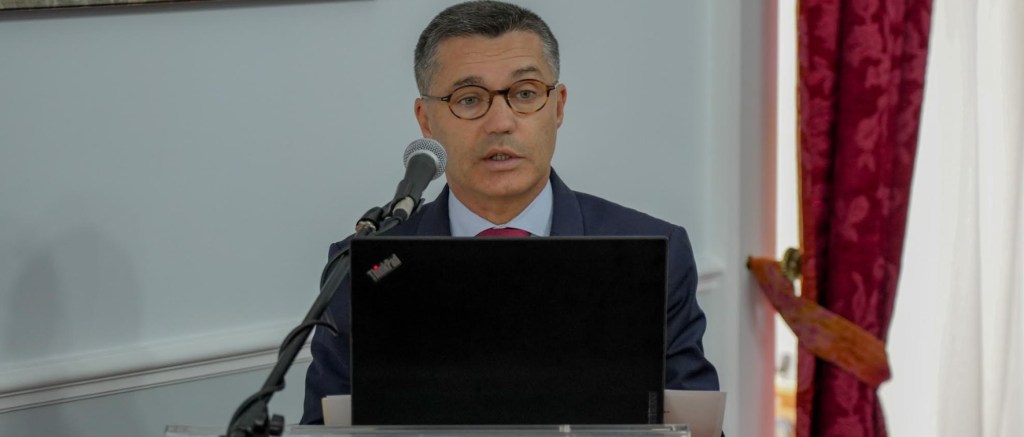
The President of the Legislative Assembly of the Autonomous Region of the Azores (ALRAA), Luís Garcia, stated today in Horta that the Atlantic centrality of the Azores “is not only geographical, it is strategic” and that “affirming it is an autonomous goal.” He therefore stressed that this centrality should be reflected in the management of the Azores’ sea, advocating a relationship with the Republic based on “coherence, co-responsibility, and partnership.”
At the opening of the conference “The Azores of Europe and the Atlantic: Cultures of the Sea,” the President of the Azorean Parliament acknowledged that the management of the sea remains a central issue to be resolved in the effective implementation of the Political-Administrative Statute of the Region, evoking the Principle of Subsidiarity, which “justifies that decisions be made at the level closest to the citizens.” In this regard, he argued that “this level is clearly the regional level.”
Faced with this reality, President Luís Garcia warned that the sea surrounding the archipelago continues to be regulated “by legislation that too often ignores the principle of shared management,” regretting that the Constitutional Court follows “a restrictive and sometimes incomprehensibly centralizing logic,” which has prevented the Region from exercising powers “politically and democratically legitimized in its Statute.”
Recognizing the Region’s consistent work in the maritime field, the President of the Legislative Assembly highlighted Okeanos’ “internationally recognized” scientific research, the approval of the Network of Marine Protected Areas, and the Azores Parliament’s position against deep-sea mining. He also emphasized that Faial has been consolidating a true maritime cluster, with the Sea School, the MARTEC Technopole, and the Region’s future Research Vessel. “All this proves that we have the vision, critical mass, and conditions to lead,” he concluded.
From Press Release
Translated into English as a community outreach program by the Portuguese Beyond Borders Institute (PBBI) and the Modern and Classical Languages and Literatures Department (MCLL), in collaboration with Bruma Publication and ADMA (Azores-Diaspora Media Alliance) at California State University, Fresno. PBBI thanks Luso Financial for sponsoring NOVIDADES.

 Novidades - The Islands and the Diaspora