


WASHINGTON — A new proposal in the U.S. Senate seeks to end all forms of dual citizenship for Americans. Introduced by Senator Bernie Moreno, the Exclusive Citizenship Act of 2025 would require every U.S. citizen to hold only one nationality and would create the first federal system for cataloging dual nationals. The bill would require existing dual citizens to formally renounce either their foreign citizenship or their U.S. citizenship within one year. It would automatically treat anyone who naturalizes abroad in the future as having relinquished U.S. nationality. If enacted, the measure would represent the most sweeping revision of U.S. citizenship law in decades, affecting millions of Americans with ties to other countries.
Exclusive Citizenship Act of 2025 — Informational Summary
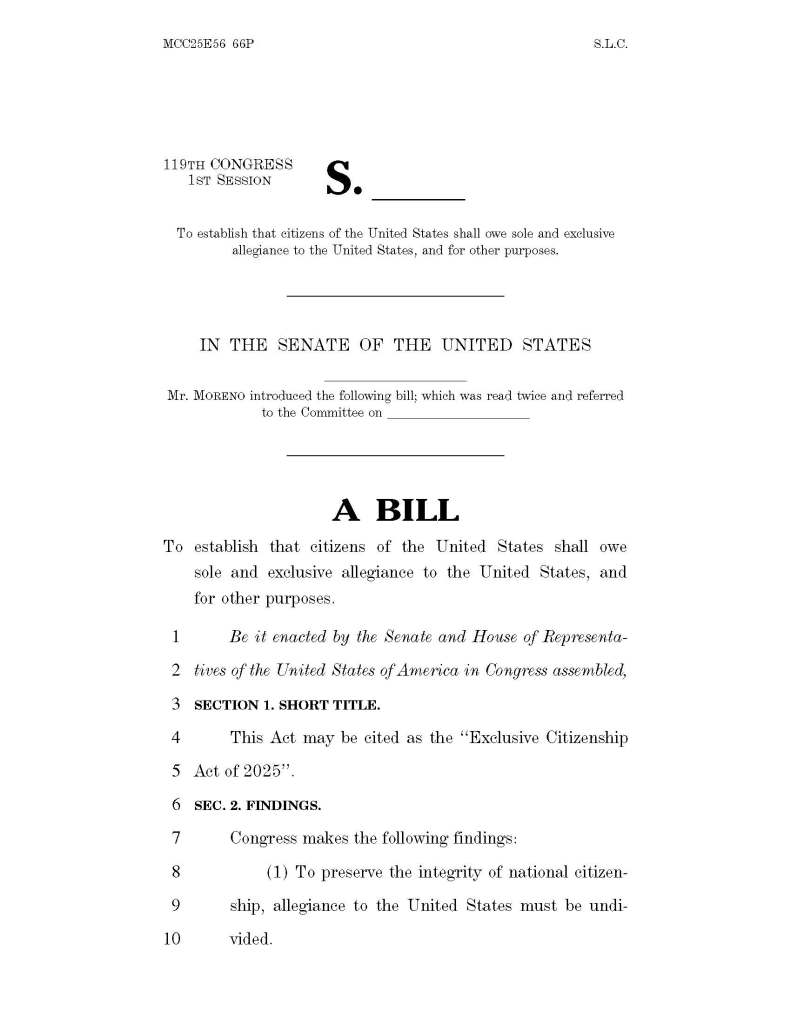
Bill: Exclusive Citizenship Act of 2025
Sponsor: Senator Bernie Moreno
Purpose: To require that U.S. citizens hold sole and exclusive allegiance to the United States by prohibiting dual or multiple citizenship.
1. Short Title and Stated Purpose
The bill may be cited as the “Exclusive Citizenship Act of 2025.”
Its stated objective is “to establish that citizens of the United States shall owe sole and exclusive allegiance to the United States.” Exclusive-Citizenship-Act-of-20…
2. Congressional Findings
The bill includes three specific findings:
- “To preserve the integrity of national citizenship, allegiance to the United States must be undivided.”
- Existing law permits certain citizens to maintain foreign citizenship, which “may create conflicts of interest and divided loyalties.”
- It is in the national interest to ensure that U.S. citizenship “is held exclusively.” Exclusive-Citizenship-Act-of-20…
3. Key Definitions
The bill defines:
- Foreign citizenship: “Any status recognized by the government of a foreign country that confers… nationality or citizenship… or requires the allegiance” of the individual.
- Immigration laws: As defined in §101(a) of the Immigration and Nationality Act.
- All other terms adopt existing immigration-law definitions unless otherwise stated. Exclusive-Citizenship-Act-of-20…
4. Major Provisions of the Bill
4.1 Prohibition on Dual or Multiple Citizenship
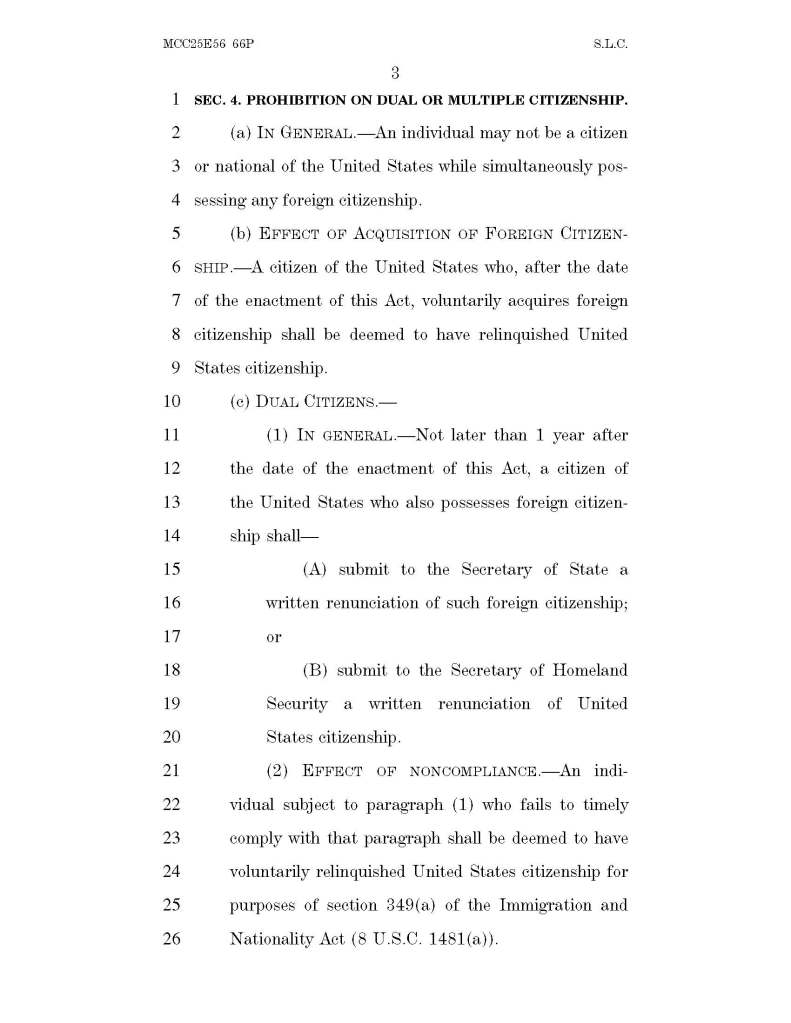
- “An individual may not be a citizen or national of the United States while simultaneously possessing any foreign citizenship.” Exclusive-Citizenship-Act-of-20…
This requirement applies to all U.S. citizens, regardless of how foreign citizenship was acquired (at birth or later).
4.2 Automatic Loss of U.S. Citizenship for Future Foreign Naturalizations
A U.S. citizen who voluntarily acquires foreign citizenship after enactment:
- “Shall be deemed to have relinquished United States citizenship.”
This deemed relinquishment applies automatically upon naturalizing in another country. Exclusive-Citizenship-Act-of-20…
4.3 Mandatory Renunciation for Existing Dual Citizens
Within one year of enactment, any U.S. citizen who also possesses foreign citizenship must:
- Renounce foreign citizenship in writing to the Secretary of State, or
- Renounce U.S. citizenship in writing to the Secretary of Homeland Security. Exclusive-Citizenship-Act-of-20…
Non-compliance:
Individuals who do not submit either renunciation within one year “shall be deemed to have voluntarily relinquished United States citizenship for purposes of section 349(a)” of the INA. Exclusive-Citizenship-Act-of-20…
4.4 Effective Date
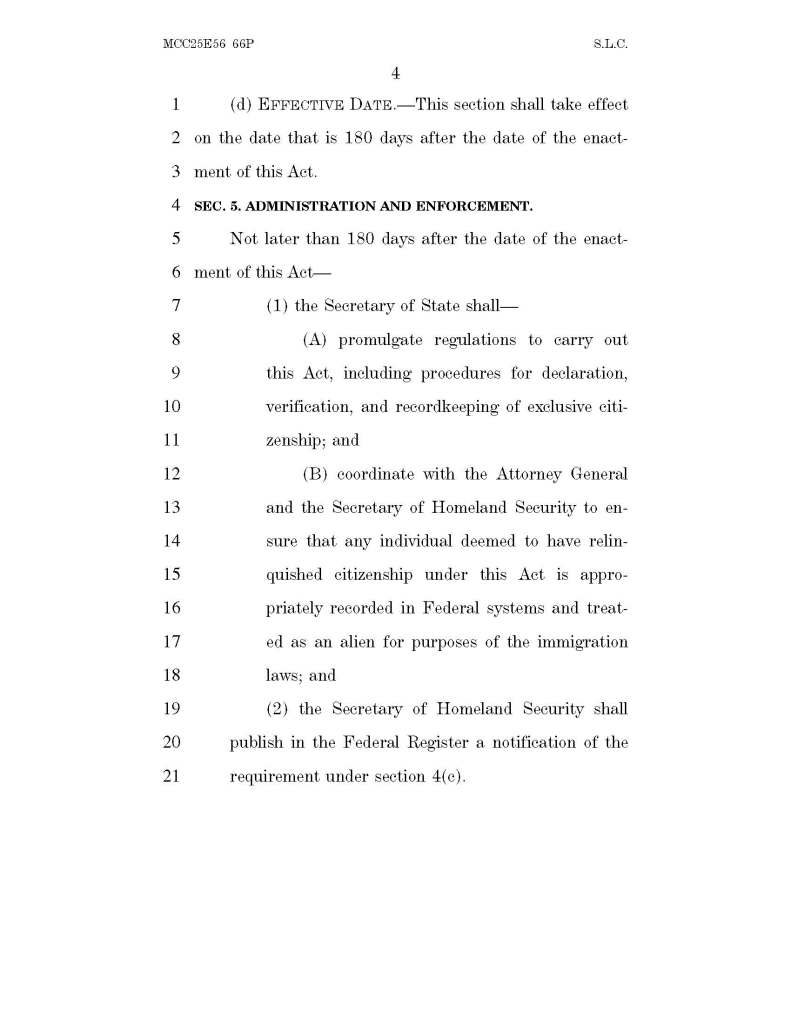
Section 4 takes effect 180 days after enactment. Exclusive-Citizenship-Act-of-20…
5. Administration and Enforcement
Within 180 days of enactment:
5.1 Responsibilities of the Secretary of State
- Establish regulations for declaration, verification, and recordkeeping related to exclusive citizenship.
- Coordinate with DHS and the Attorney General to ensure that individuals deemed to have relinquished U.S. citizenship are:
- recorded appropriately in federal systems, and
- treated as aliens under U.S. immigration law. Exclusive-Citizenship-Act-of-20…
5.2 Responsibilities of the Secretary of Homeland Security
- Publish in the Federal Register notice of the renunciation requirement for dual citizens. Exclusive-Citizenship-Act-of-20…
6. What the Bill Would Require in Practice
6.1 For Existing Dual Citizens
They must, within one year:
- Submit a written renunciation of their foreign citizenship, or
- Submit a written renunciation of U.S. citizenship.
Failure to do so results in a statutory presumption of voluntary loss of U.S. citizenship under INA §349(a).
6.2 For Future Naturalizations Abroad
Any U.S. citizen who naturalizes in another country automatically loses U.S. citizenship under the “deemed relinquishment” provision.
6.3 Federal Registry
The bill directs coordination among federal agencies to create an integrated system recording individuals who are deemed to have relinquished U.S. citizenship and classifying them as foreign nationals for immigration purposes.
7. Constitutional and Legal Context (Factual Overview)
The following Supreme Court precedents govern loss of citizenship in U.S. law:
Afroyim v. Rusk (1967)
Held that Congress cannot strip citizenship without the citizen’s voluntary intent. Citizenship under the Fourteenth Amendment cannot be taken away without “the assent of the citizen.”
Vance v. Terrazas (1980)
Reaffirmed Afroyim. The government must prove, by a preponderance of the evidence, that a person intended to relinquish U.S. citizenship.
The act alone (e.g., voting abroad, swearing an oath) is insufficient without proven intent.
The bill’s mechanism treats:
- Inaction after the one-year deadline, and
- Voluntary acquisition of foreign citizenship
as statutorily deemed voluntary relinquishment, which differs from how courts have required intent to be demonstrated.
8. Administrative Capacity (Factual Data)
- Estimated renunciation backlog: over 30,000 cases.
- Approximate annual processing capacity: ~5,000 renunciations per year.
These figures describe the existing operational volume of U.S. consular services.
9. Dual Citizenship and Current U.S. Law
- Dual citizenship remains legal in the United States.
- No changes have occurred in current law because the Exclusive Citizenship Act of 2025 has not been enacted.
- Americans may continue to hold multiple citizenships under existing statutory and constitutional provisions.
10. Legislative Status and Likelihood of Enactment (Factual)
- The bill was introduced by one senator and referred to committee.
- It has not received bipartisan sponsorship.
- Legislative forecasting models estimate the probability of passage at approximately 3%.
- Many well-known Americans currently hold dual citizenship (e.g., First Lady Melania Trump, with U.S.–Slovenia dual citizenship).
11. International and Diplomatic Considerations (Factual)
- Several countries do not permit renunciation of their citizenship.
- Many countries confer citizenship automatically at birth through jus sanguinis (citizenship by parentage).
- These laws may make compliance with this bill impossible for some individuals.
12. Historical References (Factual)
- During World War II, the U.S. government conducted “loyalty questionnaires” for incarcerated Japanese Americans, including questions requiring renunciation of allegiance to Japan.
- These procedures categorized respondents as “loyal” or “disloyal,” with consequences including segregation and, in some cases, deportation.
13. Related Recent Legislative and Executive Actions (Factual)
- Rep. Randy Fine (R-FL) has introduced legislation proposing to bar dual citizens from serving in Congress.
- Presidents have periodically discussed or pursued policies affecting naturalization and citizenship loss; any removal of citizenship typically occurs only through judicial action.
- An executive order to restrict birthright citizenship is currently pending judicial review.
14. Tax Implications (Factual Description of Existing Law)
Under current U.S. tax law:
- Individuals who lose U.S. citizenship may fall under the covered expatriate rules if they:
- have a net worth of $2 million or more, or
- meet the 5-year income-tax liability threshold ($206,000 for 2025, inflation-adjusted), or
- are not fully tax-compliant for the prior 5 years.
Consequences include:
- A mark-to-market exit tax on worldwide assets.
- A 40% tax on future gifts or bequests to U.S. persons (paid by the U.S. recipient).
The bill itself does not modify tax law, but its deemed-loss provisions would trigger these existing rules for individuals who fall into expatriate classifications.
15. Populations Potentially Affected (Factual Categories)
If enacted, the bill would apply to:
- Naturalized citizens who retain their original citizenship.
- U.S.-born individuals who acquired a second citizenship at birth through their parents.
- Foreign-born children of a U.S. citizen parent.
- Individuals who automatically acquire a spouse’s citizenship through marriage.
- Individuals who naturalize abroad after enactment.
A bit more information, much of it explained above in a general form, but what would it mean to Americans with Potuguse citizenship…

Conclusion: Factual Impact on Americans Who Hold Portuguese Citizenship
If the bill were enacted as written, U.S. citizens who also possess Portuguese citizenship—whether obtained by birth, descent, marriage, or naturalization—would be subject to the following requirements:
1. One-Year Deadline to Choose Citizenship
American citizens with Portuguese nationality would have one year to either:
- renounce Portuguese citizenship through Portuguese authorities, or
- renounce U.S. citizenship through procedures set by DHS.
2. Consequences of Not Renouncing
Those who do neither within the one-year period would, under the bill’s language, be automatically treated as having voluntarily relinquished U.S. citizenship. This designation would classify them as foreign nationals for immigration purposes and require visas to enter the United States.
3. Future Acquisition of Portuguese Citizenship
Americans seeking to obtain Portuguese citizenship in the future—through descent, residency, or marriage—would automatically lose U.S. citizenship at the moment of naturalization under Portuguese law.
4. Categories of Americans Potentially Affected
The bill would apply to:
- U.S. citizens born to Portuguese parents who automatically acquired Portuguese citizenship by descent;
- U.S. citizens naturalized in Portugal;
- U.S. citizens born in Portugal who naturalized in the United States but retained Portuguese nationality;
- Individuals who automatically receive Portuguese citizenship through marriage or lineage under Portuguese law.
5. Interaction With Existing U.S. Tax and Immigration Rules
If an affected individual relinquished or was deemed to relinquish U.S. citizenship, existing expatriation tax rules—not modified by the bill—could apply depending on income, net worth, and compliance history. Those who relinquish U.S. citizenship would thereafter require visas for U.S. travel and would lose access to voting rights and federal programs restricted to citizens.
If you would like to learn about this issue and take action, we invite you to take a look at the PALCUS Site
Here is a copy of the bill…

 Novidades - The Islands and the Diaspora