

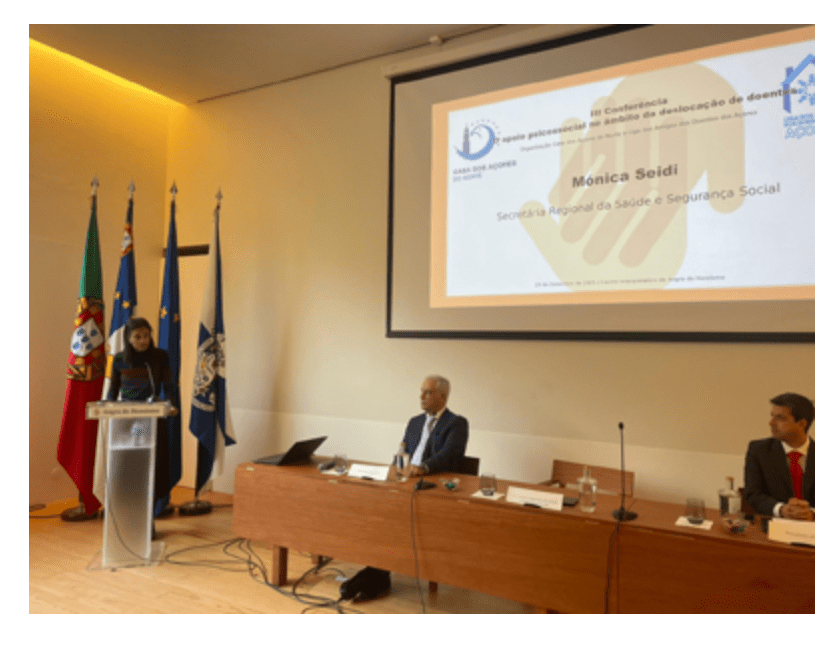
The Azores’ Regional Secretary for Health and Social Security, Mónica Seidi, attended the opening session of the Third Conference on Psychosocial Support for Traveling Patients, held at the Interpretive Center of Angra do Heroísmo.
Organized by the Casa dos Açores do Norte in partnership with the Liga dos Amigos dos Doentes dos Açores, the conference served as a space for reflection and exchange—where technical approaches to care intersect with empathy, proximity, and a sense of belonging.
According to a statement released by the Regional Government, Seidi used her remarks to highlight key public policies developed by the Azorean Executive to support patients who must travel for medical care, underscoring “the strengthening of proximity in health services.”
Among the measures cited was a significant increase in the deployment of healthcare professionals to islands without hospitals. Between 2019 and November 2025, such deployments rose by 23 percent, amounting to approximately 380 missions.
Despite “this effort to bring care closer to local populations,” Seidi acknowledged that the realities of an archipelagic region also require movement in the opposite direction, making it “essential to transport patients from islands without hospitals to those with hospital facilities.”
In that context, the Regional Secretary revealed that since 2021, some 43,000 Azorean patients and 29,000 companions have traveled to hospitals on Terceira, Faial, and São Miguel islands—an effort representing an investment of roughly four million euros in daily allowances.
Seidi also praised the Liga dos Amigos dos Doentes dos Açores as a partner of the Serviço Regional de Saúde, emphasizing not only its clinical involvement but also the social support it provides to patients—a component she described as “decisive to the overall success of care for traveling patients.”
Regarding referrals outside the Region, Seidi noted that since 2021 more than 25,000 patients and 22,000 companions have been transferred primarily to Lisbon, but also to Porto and Coimbra. These transfers account for an investment of approximately 24 million euros in daily allowances paid by the Regional Government, with an additional 5.3 million euros allocated under the Special Supplement for Oncology Patients (CEDO).
“More than numbers, we are talking about users of the Regional Health Service,” Seidi said. “They are at the center of our action and political decision-making.”
She added that support for patients traveling to mainland Portugal follows a hybrid model, combining a government-run service in Lisbon with a protocol established in Porto through an “excellent partner,” the Casa dos Açores do Norte.
Finally, Seidi announced that a competitive tender is underway under Portugal’s Recovery and Resilience Plan (PRR) to develop a new digital platform for traveling patients. The goal is to eliminate paper travel credentials and modernize and streamline the entire process.
In Correio dos Açores-Natalino Vieiros, director
Translated into English as a community outreach program by the Portuguese Beyond Borders Institute (PBBI) and the Modern and Classical Languages and Literatures Department (MCLL), in collaboration with Bruma Publication and ADMA (Azores-Diaspora Media Alliance) at California State University, Fresno. PBBI thanks Luso Financial for sponsoring NOVIDADES.

 Novidades - The Islands and the Diaspora