

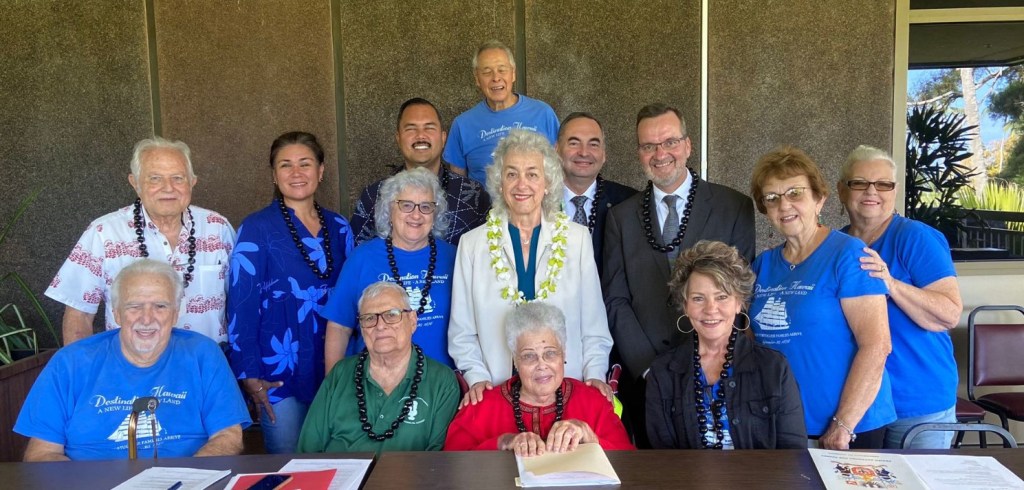
The Government of the Azores has formally established the Casa dos Açores do Havai (House of the Azores in Hawaii), reinforcing the global network of Casas dos Açores and affirming—through an act rich in historical and strategic resonance—the enduring presence of an Azorean community that bridges the Atlantic and the Pacific.
“This moment transcends administrative formality,” affirms Regional Secretary for Communities Paulo Estêvão. “It expresses a forward-looking vision rooted in identity and memory, and in the Azores’ capacity to project themselves as a living archipelago with global reach.”
For many Hawaiians of Azorean descent—and for others who recognize themselves in this shared island condition—the Azores are often described as the Hawaii of the Atlantic: volcanic lands shaped by the elemental dialogue between earth and sea, endowed with striking natural beauty and forged through coexistence with nature. Both archipelagos are defined by resilience, by the ocean as a central axis of life, and by communities that, over centuries, learned to transform isolation into openness. This profound affinity between two island worlds now offers a singular opportunity for cooperation grounded not only in shared history, but in a common vision of sustainability, knowledge, and cultural identity.
The Casa dos Açores do Havai was officially recognized through the signing of a cooperation protocol on December 19, in Hilo, on the island of Hawaiʻi (Big Island). It becomes the twentieth Casa dos Açores worldwide and the third in the United States, following California (1977) and New England (1985). The protocol was signed by Regional Secretary for Agriculture and Food António Ventura, representing the President of the Azores Government, José Manuel Bolieiro, in the presence of Regional Director for Communities José Andrade.
This new Casa is the result of an initiative led by descendants of Azoreans from Hawaiʻi, Maui, Oʻahu, and Kauaʻi, under the leadership of university professor Marlene Andrade Hapai. It crowns a year of sustained engagement by the Regional Secretariat for Parliamentary Affairs and Communities and fulfills a long-held aspiration—recognized since the 1980s—finally granting institutional presence in the Pacific to one of the most remarkable expressions of the Azorean diaspora.
Between 1878 and 1913, more than 14,000 Azoreans emigrated to Hawaii, most of them to work on sugarD††sugar cane plantations. They carried with them their language, faith, communal values, and a distinctly insular way of inhabiting the world. Alongside their labor, they brought traditions that would endure across time and distance, most notably the Festas do Espírito Santo—perhaps the highest expression of solidarity, sharing, and collective organization in Azorean culture—as well as musical practices, culinary heritage, and a deeply ingrained ethic of resilience and integration.
Today, some 12,000 kilometers from the Azores, the Hawaiian archipelago is home to tens of thousands of Azorean descendants, many of whom also trace roots to Madeira. Their enduring emotional bond with their islands of origin attests to a diaspora that did more than integrate: it took root without dissolving, preserving essential elements of its cultural identity across generations.
The creation of the Casa dos Açores do Havai affirms a broader and more ambitious vision—that of an Azorean world extending far beyond its geographic boundaries. From North and South America to Bermuda, Brazil, Uruguay, Canada, and the United States, Azorean communities form a continuous human geography spanning both the Atlantic and the Pacific. This world is not merely a legacy of the past; it is a living network of people, institutions, and cultural practices that constitutes a strategic asset for the future.
Within this framework, cooperation between the Azores and Hawaii holds genuinely transformative potential: through the sharing of knowledge between volcanic island territories; the valorization of the ocean as a space for science, sustainability, and economic innovation; the promotion of responsible, identity-based tourism; educational and youth exchanges; cultural diplomacy; and the international affirmation of communities that transform insularity into strength and culture into cohesion.
The Casa dos Açores do Havai thus embraces a mission that goes beyond safeguarding memory. It is conceived as a meeting ground between past, present, and future—capable of converting cultural heritage into concrete cooperation and strategic vision.
This ambition finds tangible expression in the decision by the Azorean community to build, with its own resources, the Saudades Cultural Center, scheduled to open in 2026. The future headquarters of the Casa dos Açores will rise on a plot of approximately 4,000 square meters, representing an estimated investment of two million dollars and standing as a powerful testament to the vitality, commitment, and dynamism of this community.
Following the establishment of the Casa dos Açores do Havai, several groups of Hawaiians are already planning visits to the Azores, renewing emotional bonds, fostering heritage tourism, and opening new avenues for cultural, scientific, and economic collaboration between institutions and communities.
Over the past four years, the Government of the Azores has supported the creation of four new Casas dos Açores—in Apiacá (2022), Coimbra (2024), Belo Horizonte (2025), and now Hilo (2025)—consolidating a network that embodies a fundamental principle: to be Azorean is to belong simultaneously to an archipelago and to a global community.
The Casas dos Açores are associations that represent emigrant communities and their descendants, dedicated to preserving Azorean identity and strengthening cultural, social, and economic ties with the Autonomous Region of the Azores through structured cooperation.
With the Casa dos Açores do Havai, the Azores once again affirm themselves as an archipelago with a past, a present, and a future: a people of islands who crossed oceans carrying their traditions with them—and who, generation after generation, have kept those traditions alive, luminous, and forward-looking.
Adapted from a Press Release
Translated into English as a community outreach program by the Portuguese Beyond Borders Institute (PBBI) and the Modern and Classical Languages and Literatures Department (MCLL), in collaboration with Bruma Publication and ADMA (Azores-Diaspora Media Alliance) at California State University, Fresno. PBBI thanks Luso Financial for sponsoring NOVIDADES.

 Novidades - The Islands and the Diaspora