


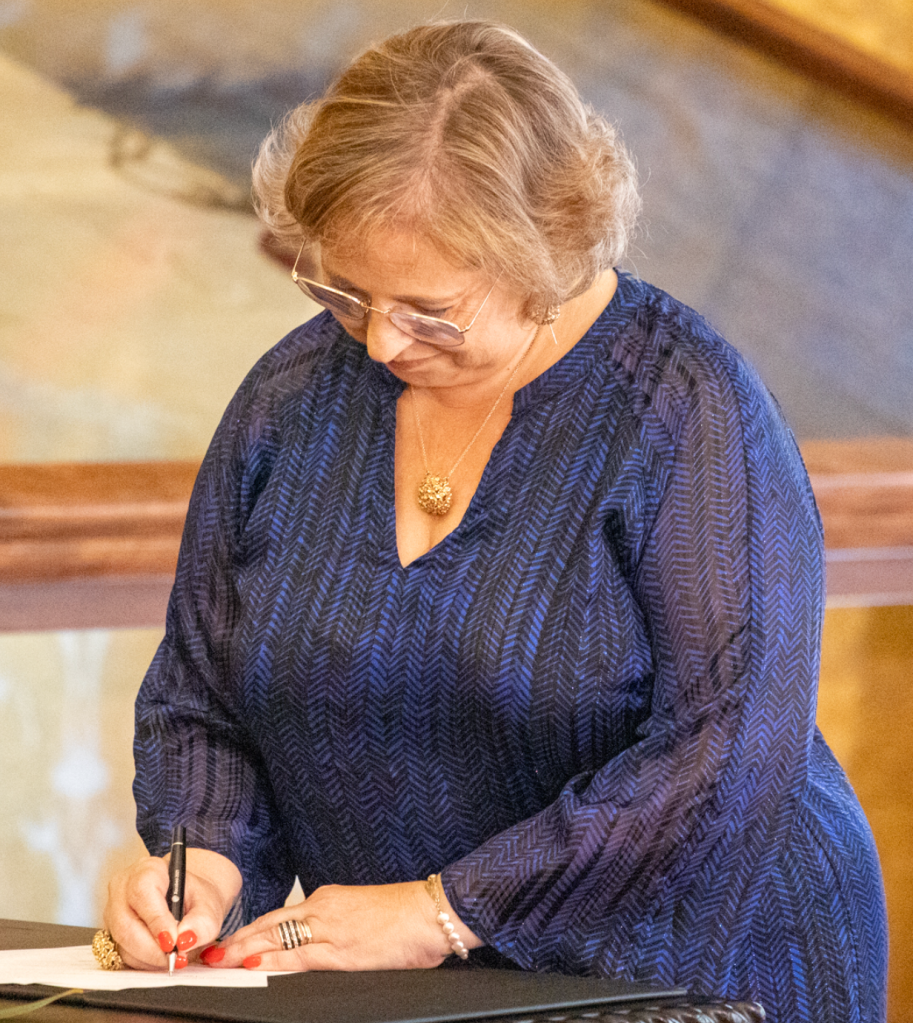
The Mayor of Angra do Heroísmo, Fátima Amorim, offers a positive assessment of 2025, a year she describes as one of “intense work.” In an interview with Correio dos Açores, the mayor highlights improvements in air and maritime accessibility to Terceira Island as one of the municipal executive’s main priorities and struggles throughout the year. Looking ahead to 2026, Fátima Amorim identifies the creation of jobs for young people, the construction of housing for Terceiran families, and the continuation of the Municipal Market project as the main challenges. The mayor also stresses that the current term aims to carry forward the work developed by the previous administration, of which she was a member as a councilor.
Correio dos Açores – What assessment do you make of the year now ending, and in which sectors were there the greatest advances and investments by the municipality?
Fátima Amorim (Mayor of Angra do Heroísmo) – The assessment I can make of 2025 is that it was a year of intense work within the municipality and at City Hall.
We had public works underway throughout the municipality, with a very significant investment by the city under the Recovery and Resilience Plan (PRR). I am not speaking only about PRR Housing and the renovation of residences that were municipal property, but also about PRR Culture, with the restoration of three churches. Although these churches are not municipal property, contracts were established with the relevant entities to make their restoration possible, given that we are a World Heritage city. Some of these buildings had been in ruins since the 1980 earthquake, and their recovery was made possible through this cultural program.
Another important aspect has been the investments and applications we submitted under PO 2030, which enabled funding in areas such as civil protection and water infrastructure.
I would also like to highlight the recovery of the municipal road network, which has required significant investment, even though it continually needs further intervention.
One aspect I consider less positive concerns air and maritime accessibility to Terceira. Especially at this time of year—but also at other times—we would like to have better options so that we could attract more tourism, which is economically important for us.
We have been working intensively on issues related to employment, the economy, and education. In this regard, we have a business incubator, StartUp Angra, which has been very positive for incubating organizations, especially those led by young people.
We invested in a scholarship program that allows many of our young people to study at various universities in Portugal. Our goal is for them to return to the island and find qualified, well-paid jobs here.
To that end, we are preparing, in partnership with the Angra do Heroísmo Chamber of Commerce and Industry, the expansion of a business center more closely linked to workshop and technical activities. We also plan to expand StartUp Angra to attract more companies, as well as the Business Center, to draw more investment. These are areas we are working on intensively, along with education, which was also a priority this year.
Overall, I consider it to have been a relatively positive year, with the exception of issues related to transport to the territory, since these generate economic impacts. If we do not have these routes available, fewer people will reach Terceira, and we have private investors who invested in tourist accommodation and are seeing occupancy rates below the expectations they had set.
Are you continuing the work of the previous administration?
I was already part of the previous administration; I served as a councilor, and of course I am continuing the work that had been underway over the past years. At the same time, I am introducing some changes that are necessary.
This is an evolving process. Naturally, there can be—and there are—some adjustments. We have a project underway worth more than two million euros that is very important to us: the Angra Municipal Market, which is a continuity project.
There are other initiatives that were included in the electoral platform. In terms of the economy and employment, we will introduce some new measures, but we can never forget all the work that was done in previous terms. The last term was very positive and promoted Angra outside the Region and even within it. That work must continue, and I am very proud to have contributed to it.
Which objectives were not achieved, and what constraints prevented their completion?
One objective that was not achieved earlier is precisely related to the market, due to issues concerning the project and its initial acceptance by some entities. As a result, the entire plan had to be reformulated.
This project has been discussed for several years and is a necessity for our community. It is now finally being realized, but it was not possible to carry it out in previous terms.
Another action that must be continued, because it was not completed 100%, is the construction of new housing in the municipality. We have a plan to launch the construction of 40 new homes, mainly for young people and middle-class families. This ambition was to be financed through the PRR, but it will now be carried out under the term that began in October.
What concerns or gaps do you believe still persist in the municipality?
One of the main gaps is housing. When I speak of this, I mean housing for everyone, whether social housing or housing for young people—it must serve all types of resident families.
Another concern we intend to keep addressing has to do with young people and their return after completing higher education. If we are investing in the qualification of this age group through scholarships, it is important to ensure there are jobs so that these students can return and find qualified employment aligned with their training, along with a home to live in. Therefore, we need to find solutions to support our companies economically so that it becomes possible to create qualified, fairly paid jobs.
To this end, we are developing a way to expand our industrial park to accommodate more businesses.
Considering the Municipal Budget for 2026, what room for maneuver exists to move toward the defined objectives?
The 2026 budget amounts to €50.6 million. This figure is still heavily influenced by PRR funding for housing and culture, as well as PO 2030, because the municipality’s own funds are approximately €35 million. With these additional funds, we reach €50.6 million, which will allow us to pursue the objectives we have set.
The priorities are municipal access roads, housing—with the construction of new homes—and issues related to expanding the industrial park, the Business Center, and StartUp Angra in order to create more jobs and stimulate economic growth.
We also want to continue promotion efforts, mostly carried out through a partnership with the Angra do Heroísmo Chamber of Commerce and Industry. This allows us to reach new markets by participating in trade fairs at both national and international levels, projecting us to the world—something that is important for tourism.
What are the municipality’s main ambitions and priorities for 2026?
The main ambitions are related to housing and youth employment. Housing for all is a goal already set out in our investment plan, and we have also received indications from ministers that this is a necessary priority. For younger people, it is essential to create more jobs.
What message would you like to leave for the community?
First of all, I would like to wish that 2026 be an excellent year for everyone—a year of good health for all families across the archipelago, and especially for our residents here.
I also hope it will be a period that brings more peace to the world. We know very well that we are living amid many wars, and we must see whether we can help bring greater calm.
Finally, I leave a message of optimism: together, we must build a world that is much better for families, both economically and in terms of housing. May we be more supportive of one another, always looking to those beside us, paying attention to those who need our support and help.
Therefore, I leave a message of solidarity, happiness, and unity among all. These are values that are important to emphasize at this time of year—and throughout the entire year.
Diogo Simões Pires is a journalist for Correio dos Açores, Natalino Viveiros-director
Translated into English as a community outreach program by the Portuguese Beyond Borders Institute (PBBI) and the Modern and Classical Languages and Literatures Department (MCLL), in collaboration with Bruma Publication and ADMA (Azores-Diaspora Media Alliance) at California State University, Fresno. PBBI thanks Luso Financial for sponsoring NOVIDADES.
 Novidades - The Islands and the Diaspora