

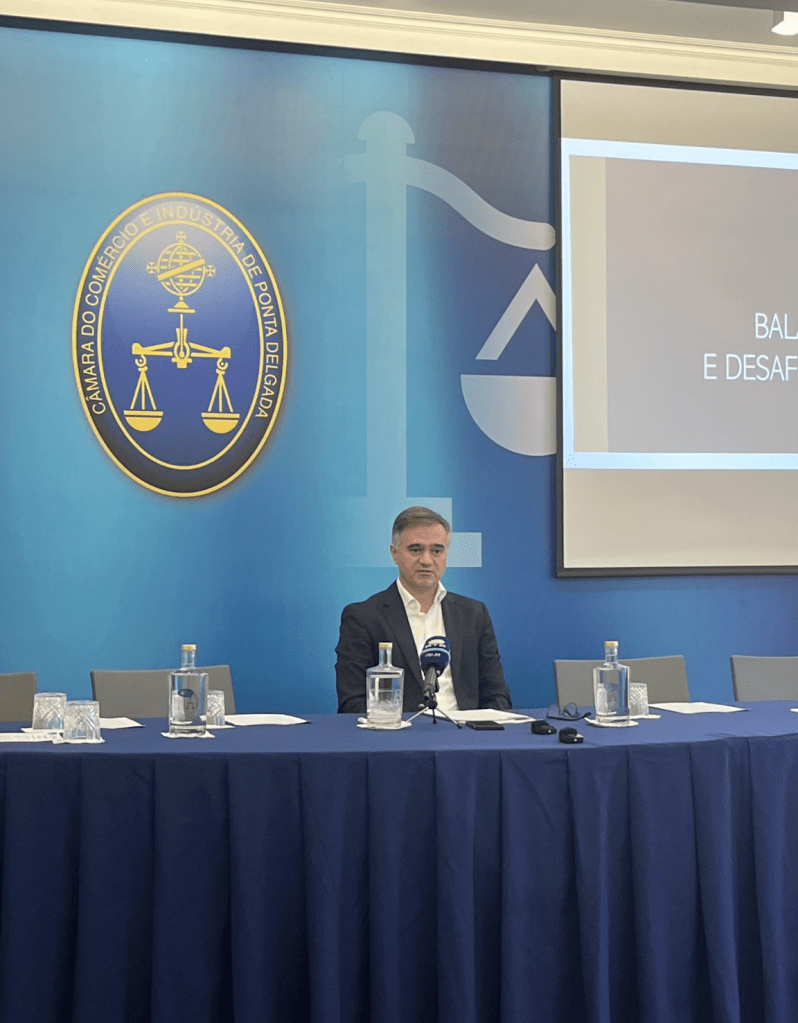
The Board of the Ponta Delgada Chamber of Commerce and Industry (CCIPD) presented yesterday its review of activities for 2025.
In a statement, the CCIPD said that the year now ending was demanding for the Azorean economy, marked by uncertainty and structural constraints, but also a year in which the Chamber of Commerce clearly and responsibly assumed its institutional role in defending businesses, employment, and the economic development of the Region.
The year 2025 was marked by signs of an economic slowdown, persistent weaknesses in air and maritime connectivity, a significant increase in business costs, and operational difficulties within the public sector. In this context, the Ponta Delgada Chamber of Commerce and Industry strengthened its engagement with the Regional Government, the Government of the Republic, and regulatory bodies and strategic operators, maintaining a constructive stance grounded in technical expertise and oriented toward solutions.
According to the statement, air and maritime accessibility constituted a central priority of the Chamber’s action. The CCIPD repeatedly warned about the instability of air service, excessive market concentration, the impact of seasonality, and the economic risks associated with the loss of connectivity for the islands.
It also defended the need for a stable, predictable, and diversified strategy capable of responding to the needs of residents, businesses, and the tourism sector. In this context, the Chamber publicly expressed its opposition to the announced cessation of Ryanair’s operations in the Azores as of March 2026, as it considers this scenario a serious and structural risk to the region’s air connectivity and the destination’s competitiveness. The potential loss of air capacity would have widespread impacts across the entire economy, weaken tourism operations—particularly in winter—and jeopardize years of market development and external promotion.

Signs of a Tourism Slowdown
In maritime transport, the Chamber of Commerce and Industry of Ponta Delgada adopted clear positions regarding the constraints observed throughout the year, advocating for a revision of the current model, greater operational predictability, and structural solutions that respect the principles of territorial cohesion. Regarding internal mobility, it also emphasized the need to adapt land transport to the new labor market paradigm, characterized by differentiated schedules, shift work, and greater flexibility in the organization of economic activity.
Tourism, as a structuring sector of the Azorean economy, has been subject to continuous monitoring. The analyzed data show signs of slowing demand, a decline in overnight stays during key periods, and rising operating costs. The Chamber warned of insufficient investment in tourism promotion and a lack of predictability in destination management, calling for an integrated strategy that aligns accessibility, external promotion, and quality of the tourism offer.
It also highlighted the need to reinforce investment in the qualification of the tourism product, particularly in the maintenance and enhancement of hiking trails and natural and thermal infrastructures, and stressed the importance of clarifying and implementing the reopening of the Ferraria thermal baths as a distinctive asset with high potential for the Azores Destination.
Urban safety was also identified as a critical factor, as perceptions of insecurity can affect city life, economic activity, and the image of the Azores as a safe destination. In the areas of commerce and urban centers, the Chamber focused on economic revitalization and social cohesion. Throughout the year, it developed campaigns encouraging local consumption and promoted urban animation initiatives, strengthening the connection between families, schools, communities, and traditional commerce.
In the labor market, the Chamber adopted firm and responsible positions, also warning about the negative impact of the abusive use of medical leave, which directly affects productivity, business organization, and the availability of human resources.
The CCIPD expressed its opposition to the pilot project of a four-day workweek in the Regional Public Administration, considering the measure misaligned with the Region’s economic and social reality. It also advocated concrete responses to work–family balance, such as opening Saturday daycare centers, and warned that the housing shortage is a major obstacle to retaining workers.
While recognizing the positive contribution of immigration to addressing labor shortages, the Chamber emphasized that sustainable integration depends on the availability of adequate housing for both the local population and those who choose to live and work in the Azores. The statement reaffirmed the Chamber of Commerce’s active role in developing vocational education and workforce qualifications. It advocated stronger alignment between training and businesses’ real needs as an essential condition for increasing productivity, employability, and the competitiveness of the regional economy.
Challenges for the Coming Year
Looking ahead to 2026, the Chamber identified demanding challenges: rising contextual costs, high construction costs, instability in the tourism sector, pressure on public finances, the gradual end of PRR funding, and the execution of the Community Support Framework. These challenges are compounded by excessive bureaucracy in the Regional Public Administration, the need for greater digitalization of the State and SMEs, and persistent payment delays—factors that continue to penalize business cash flow and economic confidence.
In an unstable international context and amid weaknesses in regional policy, ensuring predictability, accountability, and effectiveness in public action is even more important. The Chamber of Commerce will continue to assume its role with independence, technical rigor, and institutional responsibility, defending realistic public policies oriented toward results and aligned with the economic and social reality of the Azores.
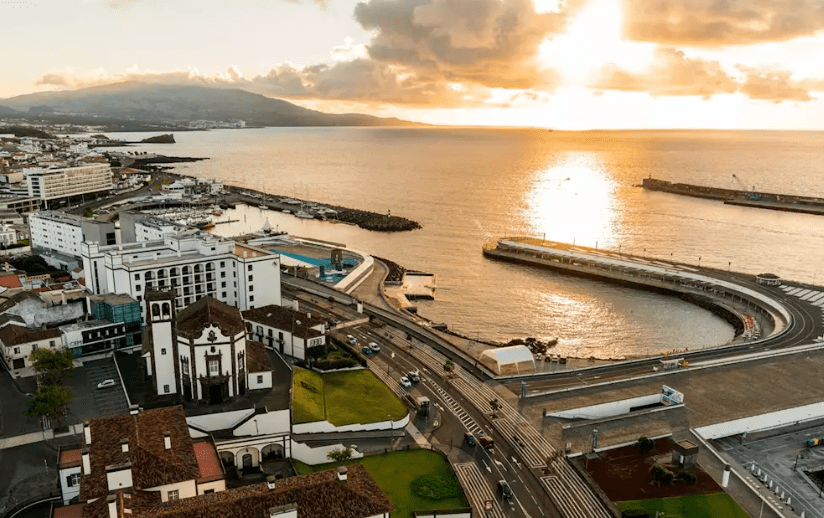
Within this framework, the Board places a strong commitment and expectations on the implementation of the Ponta Delgada Historic Center Revitalization Plan. This is a structuring project that combines continuous urban animation, business capacity-building, digital transformation, public space qualification, and professional governance, aimed at restoring economic vitality, attractiveness, and centrality in the heart of the city, strengthening local commerce, social cohesion, and urban quality of life.
This plan represents a concrete vision for the future of Ponta Delgada and the effective contribution of the Ponta Delgada Chamber of Commerce and Industry to the economic and urban development of the municipality.
Asked which factor represents the greatest concern, the President of the CCIPD stated that “it is precisely the slowdown in the tourism sector, because tourism has a very strong multiplier effect in any economy—and obviously also in the Azorean economy.”
“We have been witnessing this slowdown since August, especially in the following months, and a difficult low season is approaching. This is nothing we did not already warn about in May when we took office. And the departure of Ryanair must be remembered: it will not only impact the low season but also the high season, given the company’s size and its position as the largest passenger carrier in Europe,” he said.
Asked whether the promotion carried out by Visit Azores has been failing, Gualter Couto stated that “governments are primarily responsible for two matters: accessibility and promotion. I would add a third, no less important, related to the qualification of the offer, such as the status of trails and thermal baths. We do not have enough to keep them closed without knowing when they will reopen. These are the responsibilities of the Government, because businesses have done everything within their reach—investing in accommodation quality, tourism animation offerings, and workforce training. From the business side, the work has been done.”
“When one of these government responsibilities fails, everything can collapse like a house of cards, and the situation becomes very complicated. In tourism, statistics indicate that it already accounts for nearly 20% of the Autonomous Region of the Azores’ GDP and GVA. This means one in every five euros comes from tourism. If we fail in what is currently our golden goose, it is obvious that this will have repercussions across the entire economy,” he continued.
PRR Execution and the Risk of Declining Tourism
On one hand, Gualter Couto continued, “we are concerned about the execution of both PRR programs and the Community Framework. We cannot fail to execute the Community Framework, under penalty of not having the same conditions in a subsequent framework—or even of an interruption, which we believe is unthinkable. But beyond execution, we are also concerned about what happens the day after the PRR ends. We are equipping the Azores with various infrastructures that will later need to be maintained, which will inevitably entail additional costs for the regional budget.”
For the President of the CCIPD, tourism has “multiplier effects across all other sectors.” He noted that even the growth seen in the agro-industrial sector—which still carries significant weight in the Azores—depends on tourism, as increased guest numbers drive consumption of regional products locally, reducing the need for exports. “If tourism declines or slows at this level, other sectors will need to reinforce their exports,” he warned.
Porto de Leixões Continues to Face Problems
Asked about the constraints at the Port of Leixões, Gualter Couto said that operations are “far from being regularized,” with ongoing problems in receiving vessels and dispatching cargo.
“Everything is being handled manually. Our information is that operations are still not fully functional, and there is no indication when they will be. They are manually dispatching one ship to Madeira and one to the Azores alternately. The ship that arrived after the disruptions carried a load well below capacity because it was unable to operate properly,” he explained.
According to the CCIPD President, another ship destined for the Azores, scheduled for dispatch over the weekend, was not dispatched, so it will now arrive after the New Year. “We are not expecting stock shortages, but we are expecting a significant reduction in shelf inventories.”
For Gualter Couto, this problem must be resolved in 2026, “otherwise it will be extremely serious.” He added: “The entire system was changed against the advice of operators, turning what was a regularized system into complete chaos. The Port of Leixões, the largest port in the country, currently lacks the capacity to receive more containers and is also unable to clear them because customs services have changed their electronic management system and cannot process dispatches. What we know is that they are dispatching manually, but at a trickle.”
“There is clearly a problem at the moment. I want to believe it will be resolved at the beginning of 2026, because this is not only an issue of supplying the autonomous regions but also one of import and export for the entire country,” he concluded.
Frederico Figueiredo is a journalist for the newspaper Correio dos Açores, Natalino Viveiros, director
Translated into English as a community outreach program by the Portuguese Beyond Borders Institute (PBBI) and the Modern and Classical Languages and Literatures Department (MCLL), in collaboration with Bruma Publication and ADMA (Azores-Diaspora Media Alliance) at California State University, Fresno. PBBI thanks Luso Financial for sponsoring NOVIDADES.

 Novidades - The Islands and the Diaspora