

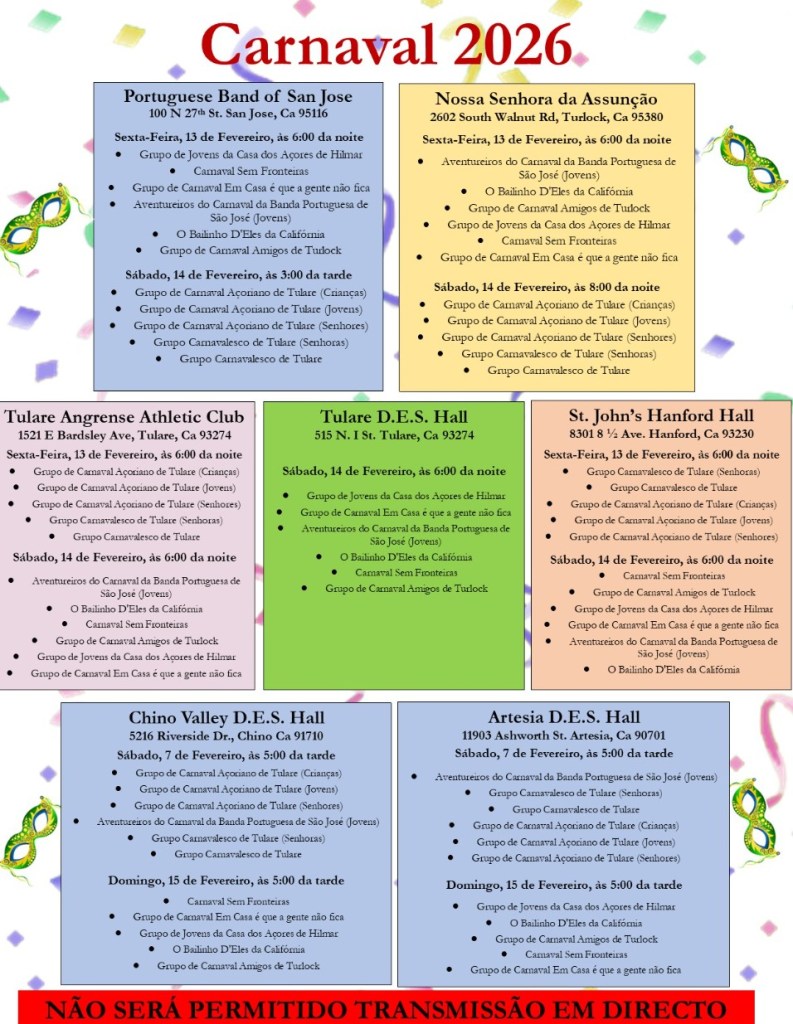
Every February, long after the Atlantic has been crossed and recrossed by generations of emigrants, the spirit of Terceira’s Carnaval resurfaces in California halls, community clubs, and D.E.S. buildings. In 2026, the calendar once again fills with bailinhos and danças—satirical, musical, theatrical forms born on Terceira Island and lovingly re-created across the Central Valley, the Bay Area and Southern California. The attached schedule reads like a living itinerary of devotion—San Jose, Turlock, Tulare, Hanford, Chino, Artesia—each stop another affirmation that culture survives because people carry it.
Historically, Terceira’s Carnaval has never been mere festivity. The bailinho is community theatre—improvised yet disciplined, comic yet incisive—where verse, song, costume, and choreography converge to comment on the world at hand. In the Azores, these performances emerged as winter rituals of wit and resilience, a way to laugh together at hardship, power, and the intimate dramas of island life. When Azoreans migrated to California, they brought this art form not as nostalgia, but as practice. Portuguese halls became stages; kitchens became workshops; the language remained the working instrument of humor, satire, and song.
That inheritance is vividly present in 2026. Youth groups rehearse late into the night; seamstresses and carpenters volunteer their craft; musicians tune by ear; elders correct a rhyme or a step. The result is a living archive—performed, not shelved. Yet this year’s Carnaval also invites reflection. Language fluency has become the most delicate challenge. Newcomers often arrive with Portuguese shaped by contemporary realities, while many in the audience—especially younger generations—understand less than they feel. At the same time, the older generation, once the backbone of the audience, is thinning: some have passed on; others remain at home, limited by mobility, listening from afar.
This tension does not diminish the celebration—it clarifies its urgency. A bailinho can still land a joke without every word being caught; rhythm, gesture, and melody speak across gaps. But language matters. It is the hinge of satire, the muscle of memory. The community’s response has been patient and hopeful: contextual introductions, careful explanations, rehearsals that teach by repetition and care, children learning lines phonetically until meaning blooms. What emerges is not loss, but adaptation—Portuguese sustained by attention, not policed by purity.
Above all, Terceira-style Carnaval in California is a collective act. Credit belongs to the performers who risk the stage; to directors and musicians; to cooks, drivers, and stagehands; to hall boards and volunteers; to parents who ferry costumes and courage; and to the audiences who show up, laugh, and recognize themselves. It belongs, too, to those watching from home, after the event (live broadcasts aren’t allowed), whose absence is felt and whose presence is remembered in every refrain.
The 2026 schedule reads like a map drawn in pencil, not stone—each date a gathering rather than a guarantee. Twelve or eighteen years from now, no one can say what halls will be open to this tradition, which voices will still rise, or how the language will sound in our mouths. And so this Carnaval asks something simpler and more demanding: that the community be fully here. That the community savors the moment while it is still warm, inhabits the tradition with our bodies and our laughter, sings and applauds. The bailinho does not ask for permanence—it asks for presence. After the curtains close and the costumes are folded away, we may reflect. For now, thankfully, the community dances, listens, and lives it.
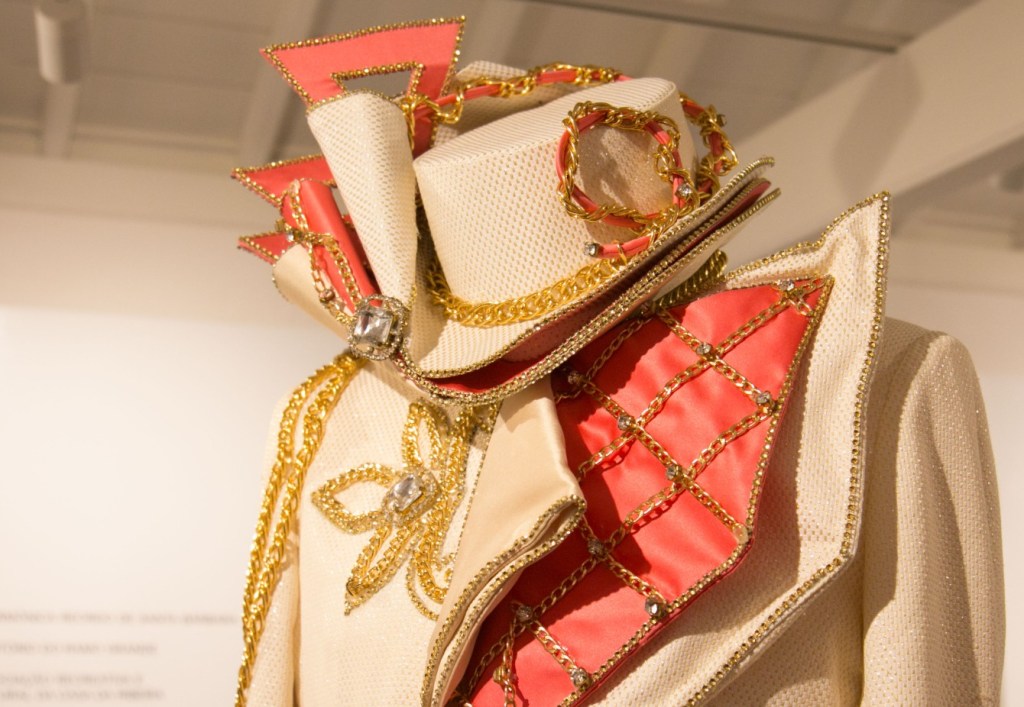
The top picture is from the Carval Museum “Hélio Costa” in Lajes, Terceira, Azores.
 Novidades - The Islands and the Diaspora