

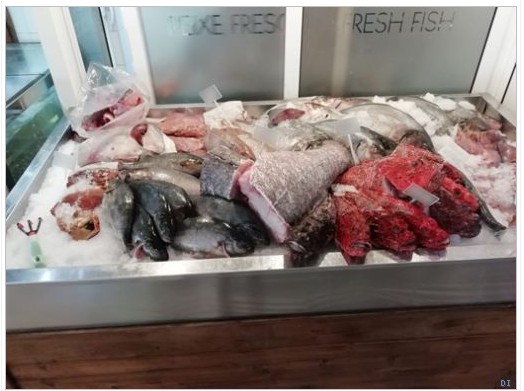
Since January 1, it has not been possible to transport fish and other fresh food products by air from five islands in the Azores due to the lack of X-ray equipment that complies with European standards. The information was communicated to traders two days in advance and is causing concern among businesspeople and politicians. On Tuesday, SATA Air Açores informed traders that, from Thursday onward, it would no longer be possible to screen wet cargo, such as fish and other fresh food, at airports on five islands.
This is due to the amendment of European Union Regulation No. 2015/1998 of November 5, which requires dual-view X-ray equipment, which has not yet been installed on the islands of Graciosa, São Jorge, Flores, Faial, and Santa Maria. SATA expects the situation to be resolved “by the end of the first quarter of 2026,” but until then recommends that wet cargo be sent “by boat to the nearest island that complies with the regulation.”
The situation was reported on Wednesday by the Azores Fish Traders Association (ACPA) in a statement published on social media. “The ACPA calls on the competent authorities to find urgent solutions, preventing several islands from being effectively excluded from air transport of fish, with serious economic and social consequences at the beginning of 2026,” the statement reads. Traders criticized SATA’s “late communication”. They warned of an “abrupt drop in the flow of fresh fish,” the existence of “direct losses for fishermen, traders, exporters, and industry,” and the “threat to the continuity of markets and commercial contracts.”
“Fish is a highly perishable product and air transport is not a luxury, it is an essential condition for the sustainability of the fishing economy in the Azores,” they stressed.
Yesterday, the Ponta Delgada Chamber of Commerce and Industry (CCIPD) and the PS/Azores warned in a press release of the economic impacts of these limitations. The business association expressed its “deep concern,” stressing that the limitations have “a direct impact on the distribution of regional production, in a sector where the speed of air transport is crucial for preserving product quality, fulfilling commercial contracts, and ensuring the competitiveness of companies.”
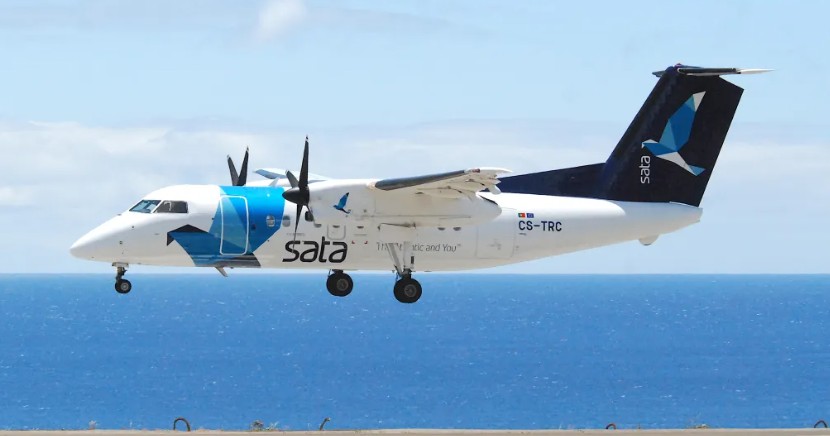
The airports of São Jorge and Graciosa are managed by SATA Gestão de Aeródromos, and the airports of Faial, Flores, and Santa Maria by ANA – Aeroportos de Portugal. The business association considered that these limitations are “a reflection of the lack of structured and timely investment by the entities directly responsible for the management of airport infrastructure and the operation of air cargo transport.”
The business leaders emphasized that the European regulation has been “in force for several years” and already imposed on airport management entities “the obligation to ensure that airports have the equipment and technical conditions necessary to comply with European safety standards.”
“The lack of fully effective solutions for WET [wet] cargo, combined with the late communication of the restrictions now in force, weakens companies’ planning capacity and exacerbates uncertainty in a context already marked by high context costs and heavy dependence on air transport,” they warned. The CCIPD called on “the competent authorities, in conjunction with airport and air transport operators, to find effective solutions to ensure the transport of fish and other perishable products without compromising safety or disproportionately penalizing companies and island territories.”
The PS/Azores also warned of the “serious economic and social impacts” of restrictions on air cargo shipments, demanding that the Regional Government provide “urgent clarification and solutions that protect exporters and regional cohesion.”
“We are talking about islands that depend almost exclusively on air transport to ensure the distribution of fish and other fresh goods. Removing this possibility, from one day to the next and without any prior dialogue, is a serious blow to the local economy and regional cohesion,” said Socialist deputy José Ávila. The PS/Azores submitted a request to the Regional Government, demanding explanations and calling for rapid intervention by SATA and the competent authorities to identify technical and operational solutions that would enable the reestablishment of air cargo transport.
“The Regional Government cannot ignore this situation. It is its responsibility to ensure that no island is left behind and that safety rules do not become a factor of inequality and penalization for those who already face greater constraints,” José Ávila stressed. A source from the Regional Secretariat for Tourism, Mobility, and Infrastructure said that “it is in talks with ANA and SATA” and that “it is making every effort to ensure that the situation is resolved as quickly as possible.”
In Diário Insular-José Lourenço-director
Translated into English as a community outreach program by the Portuguese Beyond Borders Institute (PBBI) and the Modern and Classical Languages and Literatures Department (MCLL), in collaboration with Bruma Publication and ADMA (Azores-Diaspora Media Alliance) at California State University, Fresno. PBBI thanks Luso Financial for sponsoring NOVIDADES.

 Novidades - The Islands and the Diaspora