

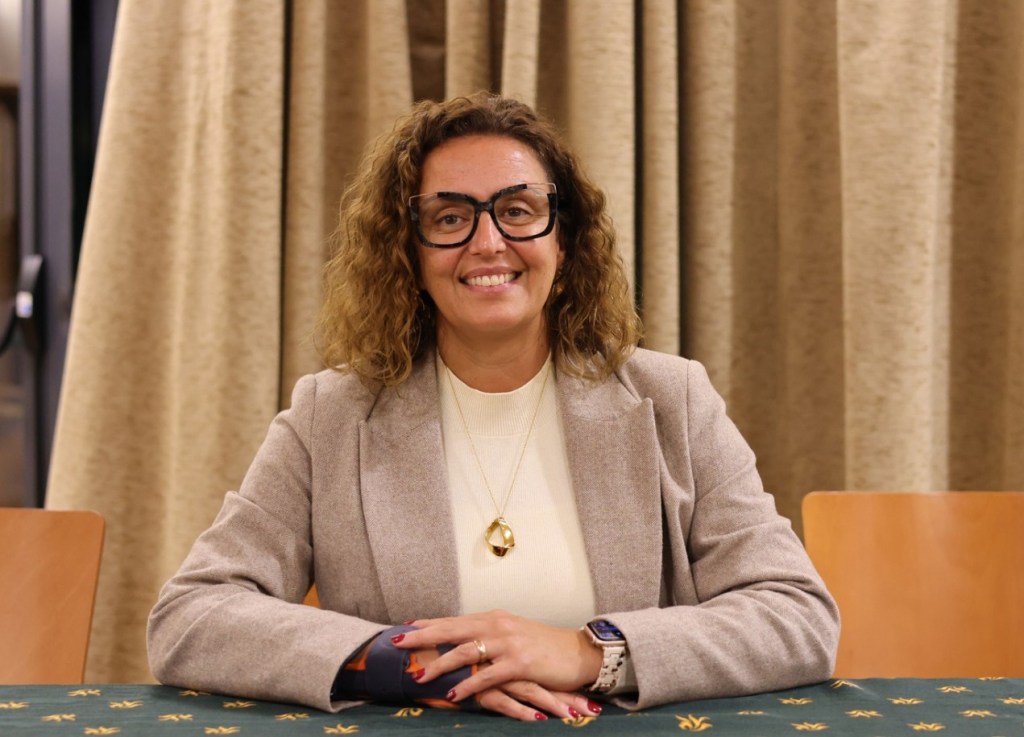
The Mayor of Madalena Looks Back on 2025 and Outlines the Challenges Ahead
The Mayor of the Municipality of Madalena, Catarina Manito, offers an assessment of 2025, a year she describes as both “challenging” and marking the “end of a cycle.” Speaking to Correio dos Açores, she highlights the executive’s main priorities as the upgrading of the school system, water supply, and housing. Looking ahead to 2026, she identifies the resolution of the Madalenagir situation, economic development, and support for local entrepreneurs as the municipality’s major challenges. The mayor also underscores the importance of continuing the municipality’s strategic initiatives, ensuring investment and quality of life for the population.
Correio dos Açores – How do you assess the year that is now coming to an end, and in which sectors were the greatest advances and investments made by the municipality?
Catarina Manito (Mayor of the Municipality of Madalena) – We are talking about a year that represents the closing of a cycle. It was a year in which the mandate came to an end and culminated in the municipal elections, in which I emerged victorious together with this team project.
The year 2025 was challenging; it was a year of change, during which we became more deeply involved and continued to develop our work, particularly with regard to what are the main measures of this executive, this team, and this municipality: the upgrading of the school infrastructure, the water supply to the population, and housing—an issue that concerns us all, but which is particularly pressing in the municipality of Madalena, the only one in the Azores that has grown in this regard.

Which objectives were not achieved, and what constraints prevented their realization?
We face constraints and growing pains that are common to many other municipalities. Our difficulties are also related to the lack of labor, the shortage of available contractors, and public tenders that sometimes receive no bids. I believe these are problems that are characteristic and shared by several municipalities in the Azores and even across the country.
There is much that was not completed, but those items are part of this municipality’s platform and intentions for this new term. Therefore, we cannot say they were left undone; rather, we can say they are yet to be implemented.
The points I mentioned—upgrading the school infrastructure, water supply, and housing—are indeed fundamental to our development, and that is where our focus must remain.
The challenges faced by a municipality of our size are always the common obstacles: lack of funding, access difficulties, and other issues that tend to be similar across many municipalities.
What concerns or gaps do you believe still persist in the municipality?
The municipality of Madalena is experiencing strong expansion and growth, with a very robust, dynamic economic profile that is in constant development.
The business community, which continues to modernize and seek growth, has required us—particularly through initiatives such as the application for digital neighborhoods—to accompany and support them. That is precisely the role of public institutions and municipalities. We must walk side by side with them, ensuring they have the conditions needed to develop their economic activities. This is what Madalena has sought to do.
We will continue to strengthen this daily partnership with our business owners, because we are truly a territory where it is good to live, invest, and visit. It is the municipality’s responsibility, through its investment instruments, to empower and provide local entrepreneurs with the capacity to continue growing and investing.

Considering the Municipal Budget for 2026, what room for maneuver exists to move toward the defined objectives?
All the objectives that have been defined rely largely on funding obtained through applications to European and community funds, particularly under the PO 2030 program, which we hope to secure. This includes, notably, the upgrading of the school infrastructure, which will receive the largest share of PO 2030 funding—nearly 3 million euros—as well as approximately 2.5 million euros allocated to water supply.
These are truly two fundamental pillars, and we see the program as the main source of funding, as it must be.
What are the municipality’s main ambitions and priorities for 2026?
First and foremost, we want to resolve once and for all the problem and situation involving Madalenagir, restoring the assets to the public domain and definitively settling the lease contract.
This is one of the main objectives we hope to see resolved at the very beginning of the year, because once this situation is settled, we will have greater capacity to make our own investments and to continue moving forward alongside our people, always fostering the economic and social growth of this municipality.
What challenges do you foresee for the coming year?
One of the challenges is ensuring that we can keep pace with—and even strengthen—the economic development of this municipality. We have carried out significant work in promoting this territory in terms of its wine production, given that we are the Azores’ capital of vineyards and wine.
However, I believe that the main challenges in the coming years—not only in the next one—are, in fact, housing and water supply.
What message would you like to leave with the community?
I would like to leave a message of hope, solidarity, encouragement, and resilience, because that is what characterizes this community and the spirit of this team. Together with our community, we want to continue developing this municipality economically and socially—a municipality that fills us with pride.
Diogo Simões Pires is a journalist for Correio dos Açores-Natalino Viveiros, director.
Translated into English as a community outreach program by the Portuguese Beyond Borders Institute (PBBI) and the Modern and Classical Languages and Literatures Department (MCLL), in collaboration with Bruma Publication and ADMA (Azores-Diaspora Media Alliance) at California State University, Fresno. PBBI thanks Luso Financial for sponsoring NOVIDADES.

 Novidades - The Islands and the Diaspora