

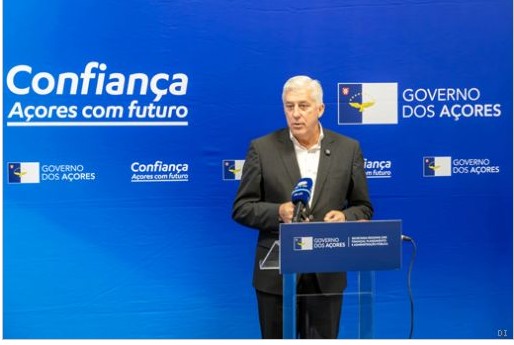
On Monday, the Regional Secretary for Finance, Planning, and Public Administration, Duarte Freitas, argued that the Regional Budget cannot sustain the “permanent bleeding” of spending in the health sector. At a press conference in Ponta Delgada, the minister stated that a “management effort” is needed within the Regional Health Service.
“From 2019 to 2025, there has already been an increase of more than €250 million. We are spending €250 million more on health than we did in 2019. This is an effort made by the Regional Budget. There must be a global effort in the management of the Regional Health Service, so that we can achieve some efficiency gains and contain the situation, so that there is not a tendency towards underfunding every year,” he said. According to Duarte Freitas, the Region “is almost in a state of financial exhaustion in terms of being able to finance the Regional Health Service,” despite the “extraordinary effort” made in 2025 to settle hospital debts. “What we did was to ensure that regional suppliers had their debts in arrears for more than 90 days settled, and that happened,” he stressed.
Regarding other supplier debts, Duarte Freitas argued that the political route will be pursued. “There is a hospital in the Azores that owes more than six million euros to the Air Force. Some of this debt dates back to 2012. It is clear that the debts owed by hospitals in the Azores to the Air Force, at the institutional level, to entities of the Republic, will have to be managed and negotiated in political terms,” he stressed. The press conference focused on a comparison between the region’s financial situation under the PSD/CDS-PP/PPM coalition governments and under the PS executives. The regional secretary for finance maintained that public investment is increasing and that regional public debt is growing more slowly.
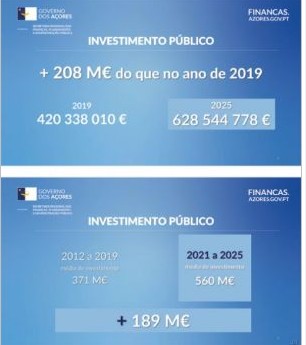
“In 2025, regional public investment reached particularly significant levels (€628.5 million), exceeding the amount recorded in 2019 by more than €208 million. The execution rate of the 2025 Investment Plan was 76.2%, above the average execution rate from 2012 to 2019,” said the minister. “The coalition governments invested, on average, around €190 million more per year than the socialist governments. Those who did worse have no authority to criticize those who do better,” he said.
According to Duarte Freitas, “the Azores have fully met the objectives set out in the implementation of the Community Funds, the Recovery and Resilience Plan (PRR), and Azores 2030, ensuring the correct application of available resources, in line with the Region’s strategic priorities.”
Another indicator mentioned by the regional secretary was Gross Domestic Product (GDP). “Data recently released by INE confirm the robustness and dynamism of the Azorean economy, with Gross Domestic Product growth above the national average. According to the INE, the Azores’ GDP grew by 2.3% in 2024, exceeding the national average of 2.1%. Also from 2021 to 2024, again according to INE, there was a convergence between the Azores and Portugal (4.8% for the Azores and 4.5% for the country’s average),” he said. “This performance places the Azores among the regions of the country with the highest economic growth, at a time when Portugal is considered, by the international press, the Economy of the Year,” he pointed out.
Between 2012 and 2019, Duarte Freitas noted, “there was no convergence, but rather a divergence, in that, over these years, the national GDP grew by 1% and that of the Azores by only 0.7%.”
“GDP growth between 2012 and 2019 totaled €802.5 million, with an average of €114.6 million per year. Let’s compare: from 2021 to 2024, there was a growth of €1,378.8 million, with an annual average of €459.6 million. We are therefore growing, in nominal terms, and with controlled inflation, at a rate four times higher than what happened from 2012 to 2019,” he said.
Regional debt
The regional secretary responsible for finance addressed the growth of debt, “which has been so much in vogue.”
“It should be remembered that those who accuse us of increasing debt at a rate of €1 million per day are responsible for 360 days of that growth. Let’s explain once and for all: 145.3 million in commercial debts from Health, as of December 31, 2020, were assumed and paid by the coalition governments, with the option of transforming commercial debt into financial debt; €19.2 million assumed from Sinaga; €173.8 million assumed from SATA; €7.8 million from Santa Catarina; €14.5 million from Lotaçor,” he listed. “If we add these figures (€360.6 million) to the gross debt (Maastricht optics) from 2012 to 2020, we see an effective average annual growth of €202.4 million, compared to an effective average growth of €157.1 million per year from 2021 to 2024. In other words, the Azores economy is growing at four times the rate, while debt is growing at a rate 25% lower than under previous governments,” he said.
Duarte Freitas emphasized that “alongside economic growth, there has been significant progress at the social level, with a sharp decrease in the risk of poverty” and set as a goal for this year “full compliance with the PRR.”
Regional Finance Law
Another ongoing process is a possible revision of the Autonomous Regions Finance Law. The regional secretary also hopes that, at the end of the negotiations, this will translate into an additional €250 million per year. “What the Portuguese State plans to transfer to the autonomous regions in 2026, in addition to what is in the Autonomous Regions Finance Law – we are talking about an extra €225 million for the Azores and €125 million for Madeira – these figures are reasonable and should form the basis for negotiation. I would say that the basis for negotiation would be around €250 million (…) That amounts to €400 million from the State Budget, not very different from what the State Budget has already allocated for 2026,” he told reporters.
In October, Prime Minister Luís Montenegro announced the formation of a joint working group, with representatives from the governments of the Republic, the Azores, and Madeira, to begin the process of revising the Finance Law of the Autonomous Regions.
Montenegro, after a Council of Ministers meeting attended by José Manuel Bolieiro and Miguel Albuquerque, secured a commitment from the regional governments “so that we can each have the conditions to fulfill our tasks, with a sense of responsibility, with a sense of financial sustainability, but also of national construction for the future of Portugal.”
In Diário Insular, José Lourenço-director.
Translated into English as a community outreach program by the Portuguese Beyond Borders Institute (PBBI) and the Modern and Classical Languages and Literatures Department (MCLL), in collaboration with Bruma Publication and ADMA (Azores-Diaspora Media Alliance) at California State University, Fresno. PBBI thanks Luso Financial for sponsoring NOVIDADES.

 Novidades - The Islands and the Diaspora