

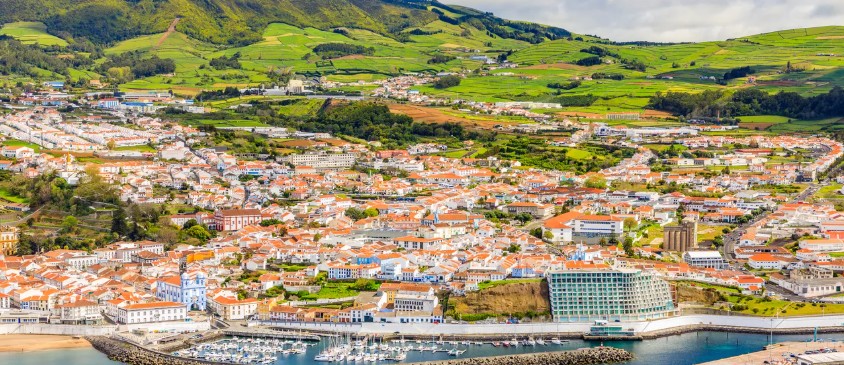
The Angra do Heroísmo Chamber of Commerce and Industry (CCIAH) argues that the region “cannot continue to postpone a structural change in its economic paradigm.”
For the body representing entrepreneurs, it is necessary to place “the economy, competitiveness, and wealth creation at the center of public decisions.”
In a press release, the CCIAH expresses “satisfaction and appreciation for the clarity, depth, and sense of responsibility demonstrated both in the recent public statement by Professor João Teixeira and in the statements by the Regional Secretary of Finance, Duarte Freitas, on the economic and financial situation of the Autonomous Region of the Azores.”
“The CCIAH believes that these public positions are particularly relevant because they unequivocally confirm the diagnoses and concerns that we have been consistently, publicly, and substantiatedly raising over the last few years, warning of the limits of the current regional development model and the growing risks associated with the sustainability of public finances,” it continues.
According to the Chamber of Commerce, the current context is marked by a scarcity of resources, pressure from current expenditure, and the “predictable reduction in EU funds in the next European financial framework.”
The CCIAH points out that the “fragility of regional public accounts” is being felt in the real economy: “Through delays in payments to companies, the creation of a climate of greater uncertainty and some mistrust in the already fragile private business fabric, which, faced with an unpredictable horizon, ends up holding back investments that could be made and that are essential for economic growth and job creation,” it describes.

The body presents proposals for the Azorean economy, such as the “need to refocus the regional development model on the private economy, reducing the Region’s excessive dependence on the public sector,” or the “enhancement of productive investment, with a special focus on exporting, innovative, and value-added sectors.”
Other ideas include “promoting a competitive regional fiscal policy that rewards those who invest, create jobs, and generate wealth in the Azores”; strengthening the efficiency and rationality of public administration; and “diversifying the regional economic base, strategically investing in the maritime economy, agro-industry, the digital economy, value-added tourism, and the internationalization of Azorean companies.”
From the CCIAH’s point of view, a “financially sustainable model of autonomy is needed, one that is less dependent on external transfers and more based on its own capacity to generate revenue.”
“It was in this context that, last September, the CCIAH held a press conference entitled ‘The Future of the Region’, where these ideas were presented,” the press release states.
“The CCIAH Board reaffirms its total willingness to in a constructive, collaborative, and demanding manner, continue to actively contribute to the definition and implementation of a new regional development model that promotes competitiveness, values productive investment, ensures the efficiency of the State, and guarantees sustainable, socially balanced autonomy oriented toward the prosperity of future generations of Azoreans,” it adds.
At a press conference earlier this week, Regional Finance Secretary Duarte Freitas argued that GDP (Gross Domestic Product) is growing in the Azores, as is investment, and that debt is increasing at a slower rate than under socialist governments, but he pointed to a “permanent bleeding” of spending in the health sector.
“From 2019 to 2025, there has already been an increase of more than €250 million. We are spending €250 million more on health than we did in 2019. This is an effort made by the Regional Budget. There must be a global effort in the management of the Regional Health Service, so that we can achieve some efficiency gains and contain the situation, so that there is not a tendency towards underfunding every year,” he said.
On the subject of debt, he added that “if we add these figures (€360.6 million) to the gross debt (Maastricht optics) from 2012 to 2020, we see an effective average annual growth of €202.4 million, compared to an effective average growth of €157.1 million per year from 2021 to 2024.“
”In other words, the Azores economy is growing at a rate four times higher, while debt is growing at a rate 25% lower than under previous governments,” he stressed.
PS deputy Carlos Silva presented different figures: “Contrary to what was stated by the Secretary of Finance, the Region’s public debt has grown rapidly and at a much higher rate than in the past. If we compare the third quarter of 2025 with the same period in 2020, according to data from the Bank of Portugal, we see that the debt has increased by around €1.5 billion, which amounts to an annual average of €300 million.”
In an interview with Diário Insular, economist and professor at the University of the Azores João Teixeira outlined three steps to curb the imbalance in regional public finances: “We have to create leeway in the regional budget (…) This involves containing expenditure, strengthening transfers under the revision of the Autonomous Regions Finance Law, and reflecting on whether or not we can give up so many taxes, with the application of the 30% tax reduction we have in relation to the mainland, in corporate income tax, VAT, and personal income tax,” he said.
In Diário Insular-José Lourenço, director.
Translated into English as a community outreach program by the Portuguese Beyond Borders Institute (PBBI) and the Modern and Classical Languages and Literatures Department (MCLL), in collaboration with Bruma Publication and ADMA (Azores-Diaspora Media Alliance) at California State University, Fresno. PBBI thanks Luso Financial for sponsoring NOVIDADES.

 Novidades - The Islands and the Diaspora