

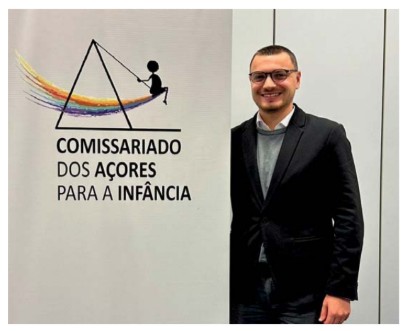
The Azores Commission for Children, a regional body created in 2016 and operating under the authority of the Regional Government, has as its mission the defense and promotion of children’s rights. Its responsibilities include raising awareness, informing, and providing training on those rights, as well as on children’s needs and interests, contributing to the prevention of all forms of abuse and to the development of responses and solutions.
You were recently appointed President of the Azores Commission for Children. What concrete priorities are you bringing to the institution, given its specific mission?
As I begin my mandate, I have defined as a priority the strengthening of the preventive and pedagogical nature of the Azores Commission for Children (CAI). There are subtle prejudices deeply embedded in society—such as ageism—that continue to affect how we view children and young people. It is essential to deconstruct this perspective and to promote a culture that truly values childhood and protects children’s right to participation. At the same time, I believe it is urgent to address the growing problem of technological and behavioral addictions, particularly online gambling, which, according to the 2024 ICAD study, has tripled in the Region among young people aged 13 to 18.
Another priority is to restore fairness in the public perception of the Child and Youth Protection Commissions (CPCJ). These are structures that work under enormous pressure and complexity and are too often made the scapegoat of the system. I intend to contribute to their social recognition, the improvement of their working conditions, and the appreciation of their members, by raising awareness among municipalities, public bodies, and society at large. I have already begun this work, having met in early December with the CPCJ of Praia da Vitória and the Mayor. During the month of January, I plan to visit other CPCJs and meet with the mayors of each municipality.
At the same time, I want to foster within Azorean society a culture of vigilance regarding all forms of violence against children and young people, and to promote institutional responsibility among public and private organizations that work with children. The CAI’s mission is the defense and promotion of children’s rights, and it is tasked with raising awareness, informing, and providing training on those rights, as well as on children’s needs and interests, contributing to the prevention of any form of abuse and to the construction of responses and solutions.
Reports indicate that a very significant share of referrals to the CPCJs result from exposure to domestic violence. How has this situation evolved in recent years, and how do you interpret this centrality?
Exposure to domestic violence continues, year after year, to be the main risk situation identified by the CPCJs. The 2024 Evaluation Report on CPCJ Activities once again confirms this pattern. Exposure to behaviors that compromise a child’s well-being—largely associated with domestic violence—is the most frequently reported and diagnosed category.
Whenever a child is exposed to domestic violence, notification of the Public Prosecutor’s Office is mandatory, as is intervention to promote and protect the child’s rights. This responsibility falls, subsidiarily, to Entities with Competence in Childhood and Youth Matters, to the Child and Youth Protection Commissions, and to the Courts. However, the persistence of this phenomenon shows that we still face an enormous challenge in prevention. For this reason, it is never excessive to invest in societal awareness, family education, and the training of entities operating in the field. The CAI has sought to develop initiatives in this direction and will continue to monitor the implementation of the IV Regional Plan for the Prevention and Combat of Domestic Violence, coordinated by the Regional Directorate for the Promotion of Equality and Social Inclusion, assessing its results and any aspects that require adjustment.

If you had to take an “X-ray” of childhood in the Azores, what are the three risk situations that concern you most?
If I had to highlight three priority areas of concern, I would place exposure to domestic violence first, due to its prevalence and the profound impact it can have both on parental capacity and on children’s overall development.
Second, sexual crimes and harassment—both in physical spaces and in the digital environment—represent a growing threat. The evolution of digital platforms and the ease of access to children make these situations particularly complex and demanding in terms of prevention and response. In this area, there is still a long road ahead, beginning with families, who must be even more aware of the dangers circulating on the Internet.
Third, the consumption of drugs and alcohol, as well as dependence on online gaming, are increasingly present problems affecting families and young people. In this regard, the CAI’s 2026 Activity Plan will include a webinar aimed at addressing the social and technological changes that affect family dynamics.
These phenomena coexist with other factors that exacerbate risk: absenteeism and school dropout, social and family vulnerabilities, and lack of parental supervision and support.
In several parishes there are programs aimed at families in which addictive behaviors are a reality. Are we reaching children who live with parents who are dependent on substances, or is there still a group outside the radar?
The Region today has a broad network of public entities, private social solidarity institutions (IPSS), and community structures that work daily in prevention, social support, and child protection. These entities have been strengthening their capacity to identify the impacts that addictive behaviors have on family dynamics and, in particular, on children’s well-being. Local authorities, through parish councils and proximity services, also play a decisive role in this work of identification and follow-up.
However, it is important to acknowledge that this reality is marked by high complexity. There are still families that remain partially or totally outside the institutional radar, whether due to extreme vulnerability, social isolation, or fear of seeking help. Although fieldwork today is more attentive and coordinated than in the past, there remain contexts where intervention is particularly difficult, especially when addictions coexist with poverty, mental health problems, and family disintegration.
This is precisely why it is essential to strengthen integrated, continuous, and specialized responses capable of acting in high-risk contexts. The creation of a regional task force on addictions represents an important opportunity to improve coordination across sectors and ensure that children do not become invisible when adult problems dominate the focus of intervention.
Is the coordination between the Commission and the Regional Directorate for the Prevention and Combat of Addictions sufficient? Is there a lack of a specific program for children of dependent parents?
The CAI does not exercise oversight over public entities, but it closely monitors policies and practices that directly affect the lives of children and young people. When it identifies areas for improvement, it seeks to raise awareness and contribute constructive recommendations. It is in this spirit that we observe the work of the Regional Directorate for the Prevention and Combat of Addictions.
Addictions—whether related to alcohol, illicit substances, or behavioral patterns—have a profound impact on the lives of children who live in such contexts. They require responses designed specifically for them, not merely as by-products of interventions aimed at adults. We know that a regional task force on addictions currently exists and that the creation of an Observatory has been announced to collect up-to-date scientific knowledge, identify gaps, and improve public policies. The CAI will follow this process closely, as it is essential.
In addition, allow me to address a fundamental issue regarding alcohol consumption, particularly in the context of summer festivals and popular celebrations. The law in force is clear in establishing that the provision, sale, and consumption of alcoholic beverages by minors in public and publicly accessible spaces is prohibited. Despite this unequivocal legal framework, reality shows that, at many of these events, the sale of alcohol to minors continues to occur recurrently, often with a level of social permissiveness that contributes to normalizing noncompliance.
Whenever alcohol is sold to minors, the law is being violated. This is not a minor lapse, but a clear infraction that requires a response. It is therefore imperative to strengthen inspections and concrete action by the competent authorities at summer festivals and festivities, ensuring the identification of offenders and the application of legally prescribed measures whenever situations of illicit sale or consumption of alcohol are detected.
Regarding bullying and cyberbullying, do many cases reach the CPCJs, or is there underreporting?
Schools, as entities with competence in childhood and youth matters, are the first and main arena for prevention, identification, and intervention in situations of bullying and cyberbullying. The Regional Program for the Prevention and Combat of Bullying and Cyberbullying itself recognizes this central role by adopting a structured approach that prioritizes awareness, prevention, and early action in the school environment, involving the entire educational community.
In most situations, when clear procedures and active multidisciplinary teams exist, schools are able to intervene appropriately, preventing cases from escalating into risk contexts that would justify CPCJ intervention. One of the central objectives of the regional program is precisely to act upstream, before the situation becomes more severe.
In this sense, I consider it essential to strengthen the role of the CPCJs within a preventive and pedagogical framework, in coordination with schools. The Commissions should develop proximity-based projects, namely awareness-raising actions in school settings, helping to clarify the distinction between situations of risk and situations of danger, and empowering students, families, and professionals to intervene in a more informed and timely manner.
When, despite this preventive and intervention work, situations reach a level of severity that exceeds the school’s capacity to respond, the CPCJs intervene as a subsidiary structure within the protection system. It is also worth noting that, according to the 2024 Regional CPCJ Activity Report, educational institutions are—immediately after law enforcement agencies—among the entities that most frequently report risk situations, demonstrating a strong sense of responsibility and institutional coordination.
What changes do you hope to see in schools with the Regional Program for the Prevention and Combat of Bullying and Cyberbullying?
This Regional Program, which resulted from a resolution of the Regional Assembly, represents an important opportunity to consolidate and enhance the work already being carried out in schools, introducing greater coherence, standardized procedures, and systematic evaluation. I hope to see clear progress in the identification and referral of cases, in the definition of action pathways that are well known throughout the school community, and in the strengthening of continuous training for teachers and operational staff.
Is the Azorean protection system prepared to respond to crimes and abuses that occur in the digital world?
The child and youth protection system today faces particularly demanding and sensitive challenges. In addition to already well-known issues such as mental health problems and addictive behaviors affecting children and young people, we are also increasingly dealing with crimes of sexual abuse that occur in the digital environment. This reality profoundly changes how risk manifests itself and how intervention must be conceived.
In the Azores, there are established competencies to deal with child sexual abuse and other forms of violence that occur in digital spaces. The work carried out by law enforcement agencies, particularly the Criminal Investigation Police, has been absolutely fundamental, both in criminal investigation and in coordination with the Public Prosecutor’s Office and protection structures. This effort deserves recognition, especially in a context where digital crime is becoming increasingly complex.
However, it is important to recognize that these issues require constant updating of the system. Technological evolution is very rapid and presents ongoing challenges to frontline entities—schools, IPSS, Social Security teams, and other services on the ground—as well as to the CPCJs, which are often the first to receive an alert.
These are highly challenging and emotionally demanding matters that cannot be addressed in isolation. They require networked work, close coordination between justice, security, education, health, and social protection, and an institutional culture that values prevention, reporting, and timely intervention.
The CAI has sought to give visibility to these emerging challenges, namely through the promotion of spaces for reflection and sharing, such as the webinar dedicated to sexual crimes against children in the digital environment that took place last November and was attended by around one hundred participants.
If you could choose only two urgent legislative or public policy changes to strengthen child protection in the Azores, what would they be and why?
The first priority would be the creation of specialized responses for children and young people with neurodevelopmental disorders, significant behavioral and emotional disturbances, and other complex mental health needs. This is currently a serious gap in the Region. The existing CACI structures are oriented only toward adults and are already operating at full capacity, leaving many young people without continuity of support, especially during adolescence.
The second measure would be the strengthening and harmonization of regulations governing the use of mobile phones and other digital devices in school settings, building on the work already developed by several organizational units in the Region, many of which have implemented restrictive measures with positive results in terms of school climate and student interaction. This regulation should be accompanied by a structured strategy of digital education and awareness, aimed not only at students but also at families, promoting responsible use of technology.
What message would you leave to neighbors and families who often witness serious situations but hesitate to report them? Can you guarantee protection for those who report?
The law is clear. Anyone who becomes aware of a situation that puts a child’s life, physical or psychological integrity, or freedom at risk must report it. It is a legal and ethical duty. Without this attitude, many children would remain invisible to the system and continue to suffer in silence. No entity, including the CAI, can guarantee protection for those who report. However, our country is a state governed by the rule of law, with law enforcement agencies, the Public Prosecutor’s Office, and courts whose responsibility is to protect those who comply with the law.
Rui Leite Melo is a journalist for the newspaper Diário dos Açores, under the direction of Paulo Viveiros.

Translated into English as a community outreach program by the Portuguese Beyond Borders Institute (PBBI) and the Modern and Classical Languages and Literatures Department (MCLL), in collaboration with Bruma Publication and ADMA (Azores-Diaspora Media Alliance) at California State University, Fresno. PBBI thanks Luso Financial for sponsoring NOVIDADES.

 Novidades - The Islands and the Diaspora