

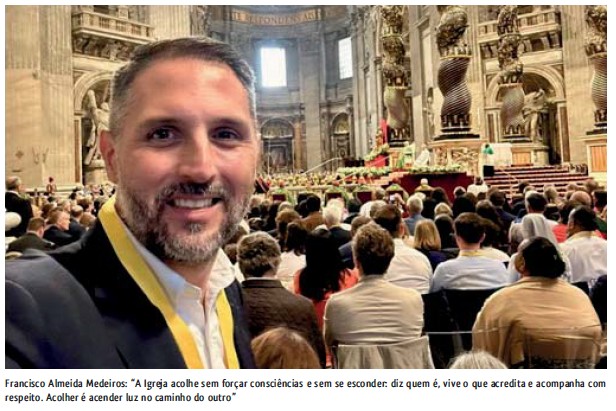
Interview with Francisco Almeida Medeiros
In this interview, Francisco Almeida Medeiros, recently appointed to coordinate the pastoral service for Interreligious Dialogue and Ecumenical Relations of the Diocese of Angra, reflects on dialogue as a necessary response to the profound social and cultural changes taking place in the Azores.
In an increasingly plural territory—marked by the presence of Christians from other denominations, believers of various religions, and people with no religious affiliation—Medeiros advocates for a Church unafraid of difference, attentive to people, and committed to a synodal style of listening, proximity, and service, rooted among the people.
Throughout the conversation, he emphasizes the importance of understanding concrete realities, building bridges through dialogue, and investing in the formation of pastoral agents. He stresses that ecumenism and interreligious dialogue are evangelical imperatives, not merely sociological options. The interview also highlights the role of parishes as spaces of welcome and integration, the centrality of Christian witness lived through prayer and service, and the promotion of unity as a daily path toward peaceful coexistence, social harmony, and fidelity to the Gospel.
What does this pastoral service for Interreligious Dialogue and Ecumenical Relations mean to you in the current context of the Diocese of Angra?
Within the territory of the Diocese of Angra, much has changed in recent years, and this is visible in everyday life. Today we encounter many Christians from other denominations, believers of other religions, and also people with no religious affiliation.
The 2021 Census data, confirmed by lived experience on the ground, show that around seven thousand immigrants from ninety-six different nationalities now reside in the Azores.
I interpret this very simply: when society changes, the Church cannot respond with fear or distance. It must respond with attentiveness to people, respect, and service. Ecclesially, this calls for a synodal style—listening, drawing close, and walking alongside those who are near us. A Church rooted among the people.
What are the main priorities you identify for this mandate?
Three priorities.
First, to know the reality. We must understand which communities exist and how they are organized, so that we are not working blindly.
Second, to build bridges. Dialogue begins with simple contact and then with what matters most: listening. Sometimes a phone call accomplishes more than ten meetings.
Third, formation. Without clear criteria, dialogue becomes distorted: either we retreat out of fear, or we blur everything indiscriminately.
That said, I want to emphasize that pastoral orientations come from the Bishop. The Commission exists to serve and to help implement the path discerned by the Prelate.
How does this Commission coordinate with the Catholic Institute of Culture?
The Catholic Institute of Culture, directed by Monsignor José Constância, has its own mission in the areas of culture and formation. The Commission is one of four bodies within that Institute. This provides us with a solid working framework for two essential tasks: preparing formation programs and materials for communities, and developing a more accurate reading of on-the-ground realities.
There is also an important dimension here: this work is not limited to organizing meetings. It has an educational aspect, helping to refine language, reduce prejudice, and create conditions for more humane coexistence.
What specific challenges does ecumenical and interreligious dialogue pose in an insular context like that of the Azores?
On islands, everything is closer. That facilitates encounter, but it also makes things more demanding: words linger, and misunderstandings can endure.
For this reason, dialogue must be grounded in respect, prudence, and continuity—without confusing everything and without losing one’s identity.
In island contexts, either we build bridges or we remain each on our own shore.
What differences and complementarities exist between ecumenical dialogue and interreligious dialogue in pastoral work?
Ecumenism takes place among Christians. It begins with baptism and faith in Jesus Christ and seeks a more visible unity.
Interreligious dialogue, by contrast, involves people of other religions and aims at respect, cooperation, and peace, without artificial blending.
The complementarity is straightforward: both forms of dialogue educate us to see the other as a person, not as a threat. In a plural society, that already goes a long way, because where there is respect, the possibility of communion and social peace can grow.
How can this dialogue avoid being seen merely as a sociological issue rather than an evangelical demand?
By keeping it connected to what is essential: prayer, the Word, and service. When dialogue flows from these sources, it bears fruit; when it arises only from a sense of “social correctness,” it becomes hollow.
It is helpful to recall what Pope Leo XIV said at the opening of this week’s extraordinary Consistory in the Vatican: mission is not carried out through proselytism, but through attraction. In other words, not by pressure, but through witness.
Good manners are important, but for a Christian, they are not enough. One must serve and allow that service to speak. It is not about pushing anyone, but about showing—through one’s life—that the Gospel brings life and healing.
This also has practical consequences in how we view those around us: dignity has no labels. The question that helps us maintain good judgment is this: what kind of witness do we give when we build walls where Christ calls us to open paths?
What pastoral opportunities arise from the presence of Christians from other denominations and believers of other religions in the Diocese of Angra?
It compels us to know our own faith more deeply and helps us purify our language of labels and prejudices. It also opens space for collaboration in caring for the most vulnerable—particularly migrants and fragile families, who often arrive with courage but also with loneliness and hardship.
In such situations, the Gospel does not ask for debates; it asks for hands willing to help. It reminds us that parishes are not private clubs, but houses with open doors, where every person should be able to find welcome and hope.
How can the Catholic Church promote welcome and integration without losing its identity?
Through truth and charity. Identity is not lost by welcoming; it is lost when we stop living coherently.
The Church welcomes without forcing consciences and without hiding who she is. She states her identity clearly, lives what she believes, and accompanies others with respect.
To welcome is to light a lamp on another’s path. And one thing is certain: those who arrive do not need a judge; they need humanity—a brother or sister, a community that cares and integrates.
What role can Azorean parishes play in this new multicultural and multireligious context?
The simplest and most effective role: to be close. To know the territory, recognize needs, build ordinary relationships, and be attentive to those who have arrived and those who are alone. And to bring all of this into prayer—for peace and for unity.
Migrants and vulnerable families are not “a category.” They are people with names and stories. And the first way to proclaim the Gospel is to welcome well.
How important is the formation of pastoral agents for ecumenism and interreligious dialogue?
It is decisive. Without formation, either we retreat out of fear or we advance without discernment and confuse everything.
Formation is not about unloading theory; it is about providing practical criteria—knowing what the Church seeks, where the boundaries lie, and how to speak with respect without abandoning identity.
Those without criteria often build walls without realizing it, compromising both charity and witness.
What expectations did you bring to the national meeting dedicated to this area, and what specific contribution can the Azorean reality offer?
The meeting took place on January 8. I went hoping to clarify priorities and good practices, and I came away with a clear conviction: this field only gains substance when it moves from “correct discourse” to concrete gestures.
There will be a national meeting on February 3, in Coimbra, marking the seventh anniversary of the signing of the Document on Human Fraternity, with online transmission. Further details will be shared in due course.
I believe the Azorean reality offers a simple contribution: in small communities, dialogue is always with concrete people and demands continuity. Here, no one dialogues “because it is fashionable,” but because we encounter one another every day.
The Week of Prayer for Christian Unity remains a central moment in this journey. How can it be lived more concretely in communities?
Through communal prayer. Where other Christian communities exist, through an invitation to join. Or through an act of charity connected to the Week.
Unity is not decreed; it is practiced—in language, in prayer, and in service. And then it is sustained. It is not an event; it is a good habit.
The 2026 motto emphasizes unity in one body and one Spirit. How can this message be translated into the daily life of the Diocese?
Through a simple rule: if the way I speak divides, then I am not serving the Gospel.
I recall another insight from Pope Leo XIV, also shared at the opening of this week’s extraordinary Consistory: unity attracts, division disperses. Words that wound push people away; words that build draw them closer.
The Church always chooses closeness. Because without respect there is no dialogue, and without dialogue coexistence deteriorates.
What actions are planned for this year’s celebration of the Week of Prayer for Christian Unity?
Materials have been prepared: a message explaining the motto and a guide for the octave. The aim is that each parish or pastoral unit, as well as each vicariate, hold at least one moment of prayer for unity between January 18 and 25.
There will also be an important diocesan moment: the Ecumenical Prayer Service on Sunday, January 25, 2026, at 3:00 p.m., in the Chapel of the Hospital of the Holy Spirit in Ponta Delgada, with the presence of our Bishop.
The unity we pray for begins where I am: in my words, my attitude, my neighbor. In the end, that is what matters.
On January 25, come. Come with an open heart—to pray and to walk together. This is the synodality we seek: not a method for specialists, but a way of being Church, with Christ at the center, in communion, attentive to one another, and walking together also with our brothers and sisters from other Christian denominations.
António Pedro Costa for Correio dos Açores-Natalino Viveiros, director
Translated into English as a community outreach program by the Portuguese Beyond Borders Institute (PBBI) and the Modern and Classical Languages and Literatures Department (MCLL), in collaboration with Bruma Publication and ADMA (Azores-Diaspora Media Alliance) at California State University, Fresno. PBBI thanks Luso Financial for sponsoring NOVIDADES.

 Novidades - The Islands and the Diaspora