

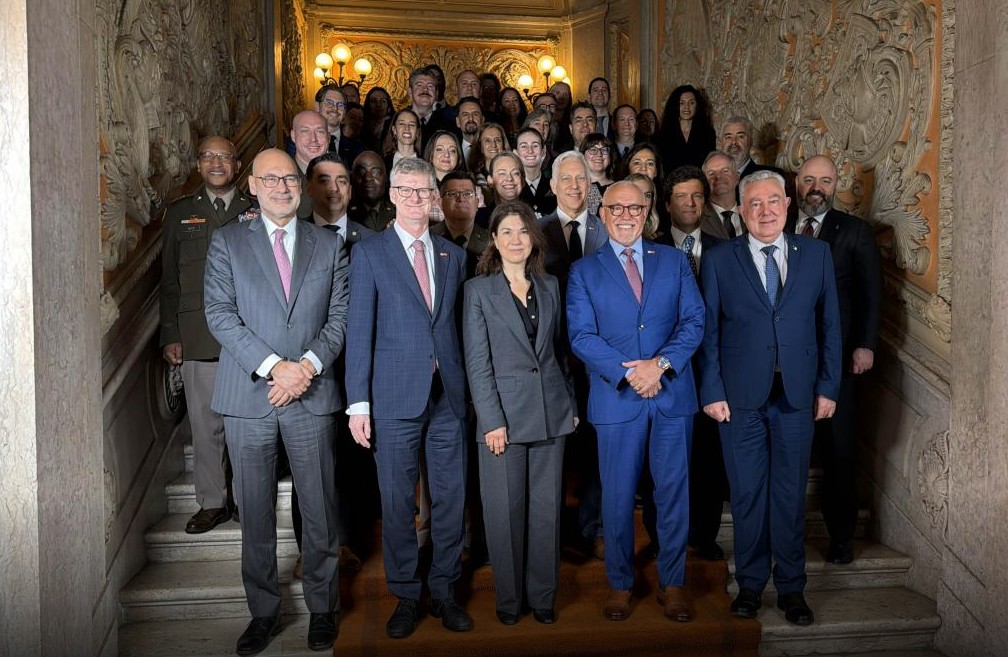
Cooperation between Portugal and the United States in defense, security, the economy, and science emerged stronger following the 52nd session of the Permanent Bilateral Commission, held in Lisbon, with renewed emphasis on the strategic role of the Azores in the transatlantic relationship.
The meeting brought together high-level delegations from both countries and marked the 30th anniversary of the Defense Cooperation Agreement, widely regarded as a cornerstone of the Luso-American partnership in the Atlantic. Participants underscored the maturity of bilateral relations and the political alignment between Lisbon and Washington at a time of evolving geopolitical challenges.
Among the commitments announced was a deepening of cooperation in defense and security, alongside efforts to strengthen economic ties. Officials also expressed their intention to create a CEO Forum, designed to bring together public and private leaders to identify barriers to trade and encourage bilateral investment.
The session also highlighted Portugal’s accession to the Artemis Accords—an international, U.S.-led initiative establishing principles for peaceful and cooperative space exploration—as well as the integration of the Portuguese Armed Forces into the U.S. State Partnership Program through collaboration with the Illinois National Guard. The move is aimed at enhancing military interoperability and improving civil-military coordination.
The Azores featured prominently throughout the discussions, with both governments reaffirming their commitment to expanding cooperation in the region, not only in defense and security, but also in economic development and civil society engagement, including through the U.S. Consulate in Ponta Delgada.
Artur Lima, Vice President of the Azores Regional Government, took part in the meeting and emphasized the strategic importance of the Lajes Field for Atlantic defense. He also highlighted the role of military forces based there in search-and-rescue missions. On labor issues, Lima highlighted the Regional Government’s efforts to protect workers and thanked U.S. authorities for their support during the recent federal government shutdown.
Lima also noted growing interest from American entities in investing in the Azores, particularly in the space sector, scientific research, and technological infrastructure. He singled out the planned spaceport on Santa Maria as a project with significant strategic potential and emphasized the importance of scientific research conducted in the region—especially in marine science—calling for stronger international cooperation in this field.
In closing, participants highlighted the connection of two Google subsea fiber-optic cables to the Azores, describing the development as a decisive factor in positioning the region within the global digital economy and reinforcing its geostrategic centrality in the Atlantic.
In Açores9-Paulo Melo, director
Translated into English as a community outreach program by the Portuguese Beyond Borders Institute (PBBI) and the Modern and Classical Languages and Literatures Department (MCLL), in collaboration with Bruma Publication and ADMA (Azores-Diaspora Media Alliance) at California State University, Fresno.
 Novidades - The Islands and the Diaspora