

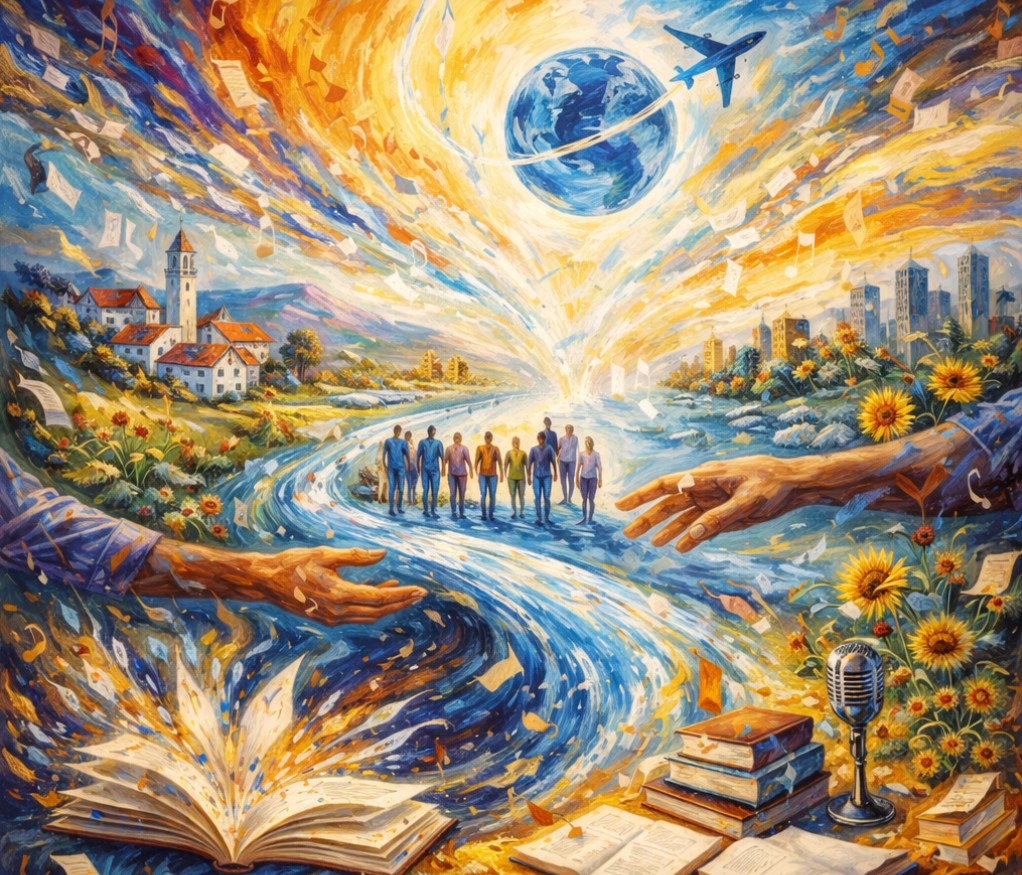
To prestar contas is not merely to present figures. It is to place one’s work in the open, to say: this is what we tended, this is what we carried, this is what we refused to let disappear. In 2025, the Portuguese Beyond Borders Institute at Fresno State shaped a year that read less like a ledger and more like a living manuscript—written in voices, crossings, and patient acts of cultural care.
Memory stood at the center. Over the course of the year, PBBI collected 63 oral histories, each one a fragile and luminous fragment of lived experience. Thirty-one were integrated into the Institute’s ongoing oral history archive; thirty-two were added to the Tulare–Angra Sister City Collection, deepening a transatlantic dialogue rooted in migration, labor, faith, endurance, and belonging. These were not interviews alone, but acts of listening—moments when history spoke in the first person and refused to be reduced to footnotes.
Around this archive of voices unfolded a wide constellation of encounters. PBBI organized 29 cultural sessions, presentations, and debates, offered both in person and online, spanning the full ecology of culture. Books and poetry shared space with music and memory; ancestral traditions conversed with innovation and contemporary thought. Agriculture and land stewardship met business and entrepreneurship; history crossed paths with migration studies, social justice, and artistic creation. These sessions formed a mosaic of inquiry—where the rural and the urban, the island and the valley, the inherited and the emerging could meet without hierarchy.
Conferences expanded this dialogue into sustained collective reflection. Filaments of the Atlantic Heritage, with 15 sessions, traced the currents that bind the Azores, Portugal, and the diaspora—cultural, historical, and imaginative. The Global Village Conference (LAEF) added another 17 sessions, situating Lusophone experiences within broader global conversations on identity, mobility, and intercultural understanding. Together, these gatherings affirmed the Atlantic not as a distance to be crossed, but as a shared intellectual and cultural space.
Publishing remained one of PBBI’s most visible acts of continuity. Through Bruma Publications, without partners, Letras Lavadas, Poética, Editora Dois Caminhos, and Moonwater Editions, the Institute released 14 books in 2025, each one an invitation to slow reading and deep engagement. Alongside this, Filaments, PBBI’s literary magazine, published three editions, offering a bilingual home for poetry, fiction, essays, and creative nonfiction that speak from—and back to—the diaspora.
The Institute’s commitment to public culture was expressed daily online. Novidades—The Islands and the Diaspora published 1,073 pieces, including news, interviews, op-eds, and essays that documented island life and diasporic realities with urgency and care. Filamentos—Arts and Letters added 923 works, ranging from poetry and fiction to chronicles, interviews, and reflective essays—proof that artistic expression remains one of the most resilient forms of cultural continuity.
Education, finally, took the form of embodied experience. In 2025, nine students participated in PBBI exchange programs, not as brief visits but as month-long internships immersed in professional and cultural life. Five students traveled from Fresno State to the Azores, and four came from the Azores to Fresno State, engaging directly with institutions, communities, and workplaces. These exchanges offered hands-on professional experience alongside cultural immersion—students learned not only in classrooms, but in archives, cultural organizations, municipal settings, agricultural landscapes, and creative spaces. They returned carrying more than credits: they carried context, responsibility, and a deeper sense of belonging to a shared Atlantic story.
Seen together, the work of 2025 forms a quiet but resolute statement. Culture was not treated as ornament, nor memory as nostalgia. Instead, PBBI–Fresno State affirmed culture as labor, memory as duty, and exchange as transformation. In prestar contas, the Institute accounted not only for what it achieved, but for what it continues to protect: voices not yet silenced, bridges not yet broken, and futures still being written—across oceans, generations, and languages.

 Novidades - The Islands and the Diaspora