

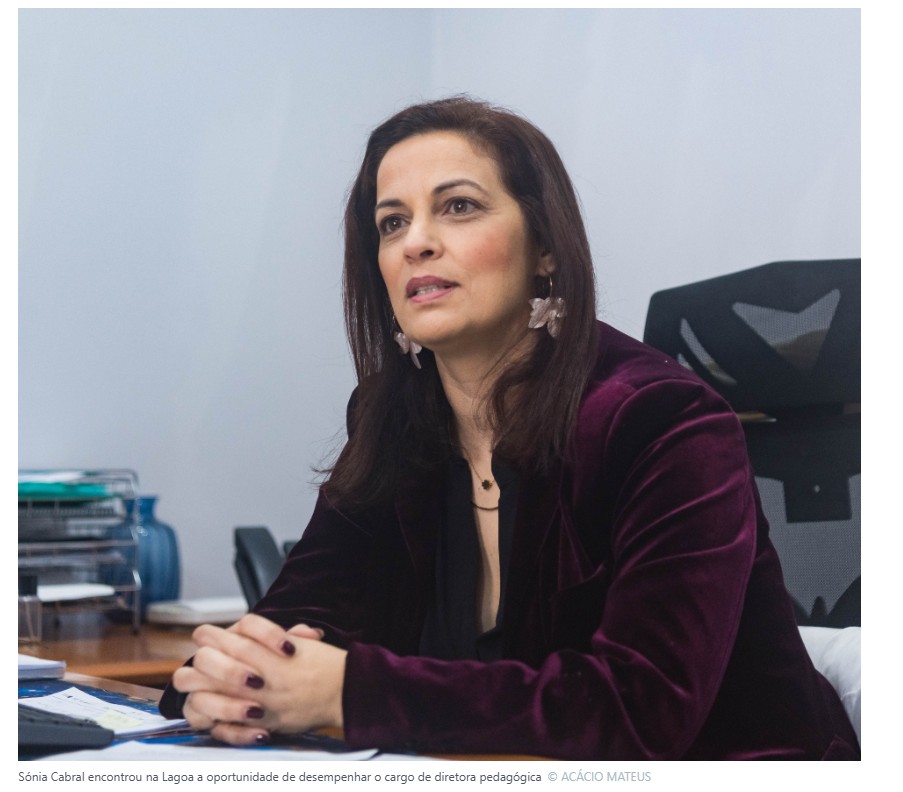
The pedagogical director of Inetese—the Technical Education Institute of Lagoa—argues for the full recognition of vocational education, rejecting the stigma often attached to it and pointing to the strong employment outcomes of her students across the region.
Sónia Cabral was born in Santo António, in the municipality of Ponta Delgada, on January 1, 1981. She is the current pedagogical director of Inetese. Her professional path has been guided by an early vocation: from a young age, she knew her future lay in teaching English. True to that calling, she earned a degree in Portuguese and English from the University of the Azores, beginning a career in education that now spans nearly two decades.
Her trajectory is deeply rooted in community life. A Scout from ages six to twenty-two, Cabral developed values of service and leadership early on. She also demonstrated a competitive, team-oriented spirit as a five-a-side football player in Santo António, where she became a regional champion with Casa do Povo de Santo António during the 2002/2003 season.
For 19 years, she worked at Casa do Povo de Santo António, accompanying several generations of young people through the Youth Community Center. In 2010, she embraced the challenge of vocational education in Vila Franca do Campo, testing her endurance as she balanced classroom teaching with social intervention work.
In 2020, in the midst of the pandemic, Cabral experienced one of the most significant moments of her personal life: becoming a mother to a daughter. The experience brought new challenges and deepened her resilience, forcing her to balance motherhood with the demands of a world in flux.
At Inetese since 2015, her career has been one of steady growth. After nearly a decade as an instructor, she assumed the role of pedagogical director two years ago. The position reflects a natural progression—one that brings together hands-on experience and the sensitivity of someone who educates and cares, now charged with guiding the institution’s future.
DL: How have you managed motherhood alongside professional life?
It isn’t easy. If we want to continue doing good work at school, professionally, we often end up bringing some of that work home. In the early days, when I got home, my focus was entirely on my daughter—I felt I had to draw a clear line. I still try to keep that approach. Even though my responsibilities are now much greater and I often fall asleep with anxiety, I only turn to institutional work after she is asleep.
DL: It’s a challenge that requires you to “care” for many more children. How many students are currently under your responsibility?
It is indeed very demanding, but also deeply rewarding when we meet the goals we set. At the moment, we have 97 students at the Lagoa campus. I am also the pedagogical director of the Angra do Heroísmo campus, on Terceira Island, where we have three classes totaling 48 students. Altogether, we are responsible for the educational paths of 145 young people.
DL: What are the biggest challenges in pedagogical management?
The greatest challenge is the constant need to balance human resources with pedagogical demands and a legal framework that is continually evolving. Recently, vocational schools shifted from the oversight of the Regional Directorate of Education to the Regional Directorate of Professional Qualification and Employment. That transition created a kind of administrative limbo, which has been a steep learning process. I assumed these responsibilities alone almost two years ago, and it has been a journey of accountability and affirmation.
DL: Does the fact that public schools in the region also offer vocational programs threaten the survival of institutions like Inetese?
Vocational schools have a distinct identity. We are much closer to the business community and place a strong emphasis on practical training—something that continues to be valued. Still, if a nearby secondary school offers the same program, students may not feel the need to transfer to Inetese, and that does affect us. It’s essential that policymakers finally recognize vocational schools as a central pillar of education, not merely a supplement. For years, we were treated as the “poor relation” of the system. The prejudice that vocational education is only for students with fewer abilities must end.
DL: Do you feel that perception is changing within the community?
Yes, I believe a shift has begun. We see it in demand: this year, our Educational Action and Health Assistant programs reached full capacity, with several applicants turned away. People are starting to understand the value of vocational education. We have clear success stories—students who went directly from here to university, and even a former student who, after earning a degree, returned to Inetese as an instructor. That proves this path opens real doors to the future.
DL: Lagoa continues to have one of the highest dropout rates. How does that reality affect the school?
It challenges us daily, but it also reinforces our social role. We work actively to prevent dropout through practical methodologies. We try to “hold on” to students by showing them that school isn’t just theory and hours seated in a classroom. Beyond the hands-on components of each program, we organize activities, field trips, and invite accomplished professionals to speak and motivate our students.
DL: Is the school’s future in Lagoa secure?
The school’s growth and strong demand allow us to look to the future with confidence. Our partnership with the Municipality of Lagoa has been fundamental in ensuring our permanence. We have an excellent relationship—the facilities belong to the municipality—and that collaboration has been crucial to our development.
DL: What investments have been made to improve educational quality?
Through the Recovery and Resilience Plan, we acquired state-of-the-art resources: a computer lab with 25 workstations and interactive boards in every classroom. In the health area, we have a fully equipped practical training room—with articulated beds, mannequins, and other advanced tools—so technical instruction mirrors real hospital settings as closely as possible. And since we’ve reached our physical capacity, we’re expanding into the digital space with the Qualifica.IN initiative, which will offer online training for both employed and unemployed learners starting in February.
DL: Mental health is widely discussed today. How does the school address this issue?
It must be taken seriously and actively worked on. We have students with significant anxiety who give up easily when faced with obstacles. The role of leadership, instructors, and staff is crucial here. Sometimes support is as simple as a hug or a word of encouragement. I’m also concerned about mobile phone dependence; I give explicit instructions that phones are not allowed during class. All our decisions are guided by students’ well-being.
DL: What are your main goals for 2026?
Our goal is to sustain the growth we’ve achieved. It’s a challenge, given the declining number of students due to low birth rates. We want to maintain high pedagogical standards, strengthen local partnerships, and ensure that our students continue on successful paths—whether entering the workforce or pursuing further education.
In Diário da Lagoa, Clife Botelho-director
Translated into English as a community outreach program by the Portuguese Beyond Borders Institute (PBBI) and the Modern and Classical Languages and Literatures Department (MCLL), in collaboration with Bruma Publication and ADMA (Azores-Diaspora Media Alliance) at California State University, Fresno. PBBI thanks Luso Financial for sponsoring NOVIDADES.

 Novidades - The Islands and the Diaspora