

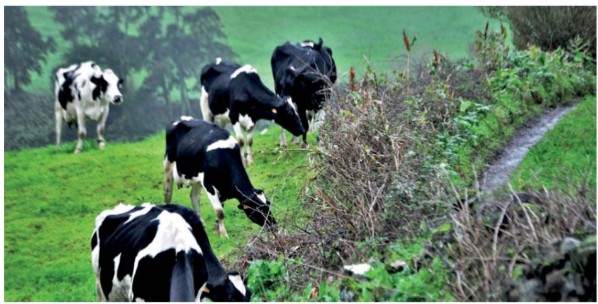
Cattle slaughter in the Azores declined in the first eleven months of 2025, with the steepest reductions recorded on the islands of Pico and São Jorge, according to new data released by the Serviço Regional de Estatística dos Açores (SREA).
From January through November, a total of 66,786 head of cattle were slaughtered and approved for public consumption in the region’s slaughterhouses, yielding 16,049,348 kilograms of carcass weight. Compared with the same period in 2024, this represents a 6.8% decrease in the number of animals—or 4,858 fewer head—and a 3.6% decline in total weight, according to the SREA’s Agricultural Statistics – November 2025 report.
By island, São Miguel remained the main hub of cattle slaughter, accounting for 32,352 animals and 7,453,158 kilograms, posting a slight year-over-year increase in weight of 0.8%. Terceira followed with 18,597 head and 4,585,753 kilograms, a marginal decline of 1.1%.
Elsewhere, Faial recorded 4,686 cattle and 1,256,594 kilograms, marking a 2.0% increase. In contrast, sharper downturns were seen on Pico, where slaughter fell to 5,528 animals and 1,377,224 kilograms—a drop of 22.4%—and on São Jorge, which registered 3,098 head and 723,732 kilograms, down 19.4%.
Smaller islands also posted declines. Santa Maria reported 725 cattle and 205,067 kilograms (-9.5%), Graciosa 1,142 head and 281,452 kilograms (-7.8%), Flores 630 animals and 161,610 kilograms (-7.9%), and Corvo 28 cattle totaling 4,758 kilograms, a drop of 27.3%.
In the swine sector, the SREA reported 64,562 pigs slaughtered between January and November, producing 5,822,939 kilograms. While the number of animals declined marginally (-168 head), total weight increased by 4.8% year over year.
Once again, São Miguel led production with 41,948 pigs and 3,789,327 kilograms (+5.6%), followed by Terceira with 11,399 animals and 977,764 kilograms (-0.3%). Notable gains were recorded on Faial, which reached 2,839 pigs and 242,673 kilograms (+49.7%), and on Corvo, where slaughter rose to 57 animals and 7,488 kilograms, a surge of 148.9%. Flores increased to 598 head and 61,985 kilograms (+10.9%), while São Jorge climbed to 2,515 pigs and 251,237 kilograms (+6.0%). By contrast, Santa Maria fell to 1,160 animals and 82,689 kilograms (-17.5%), and Pico declined to 2,651 pigs and 273,654 kilograms (-7.0%).
In industrial poultry production, chicken slaughter totaled 4,236,931 kilograms over the same period, a 0.5% increase compared with the previous year. Production remained heavily concentrated on São Miguel, with 3,455,281 kilograms (flat year over year), and Terceira, which recorded 781,650 kilograms, up 2.6%.
In Diário dos Açores-Paulo Viveiros, director
Translated into English as a community outreach program by the Portuguese Beyond Borders Institute (PBBI) and the Modern and Classical Languages and Literatures Department (MCLL), in collaboration with Bruma Publication and ADMA (Azores-Diaspora Media Alliance) at California State University, Fresno. PBBI thanks Luso Financial for sponsoring NOVIDADES.

 Novidades - The Islands and the Diaspora