


As Portugal holds a nationwide presidential election, the head of the Azorean regional government, José Manuel Bolieiro, used Election Day to argue that the country’s next President should appoint an Azorean to serve as the state’s top representative in the islands.
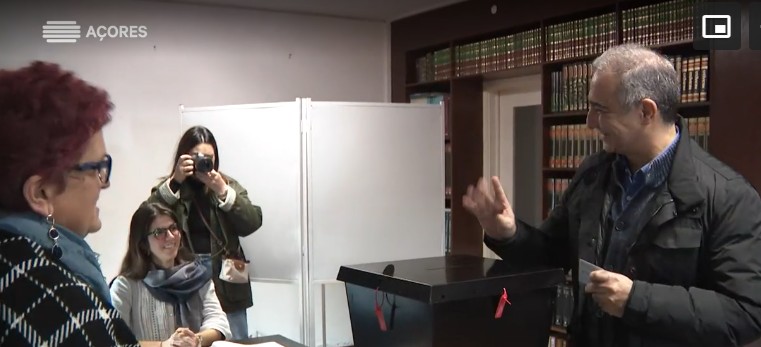
Bolieiro cast his ballot Sunday morning in Ponta Delgada, the largest city in the Azores, and said the election comes at a time of heightened global uncertainty. He warned that Portugal’s next President will face what he described as a period of “international instability,” requiring calm leadership and a strong sense of democratic responsibility.
Speaking after voting, Bolieiro emphasized the need for political leaders to contribute to “serenity, peace, and civic responsibility,” both within Portugal and on the international stage. He also noted that the presidential campaign had been unusually long and said that, if no candidate wins an outright majority, a runoff election would prolong the political season.
Bolieiro, who also leads the Azorean branch of Portugal’s center-right Social Democratic Party, PSD/Açores, reiterated his long-standing position that the Representative of the Republic in the Azores should be someone from the region itself.
The comments were reported by RTP Açores.
Understanding Portugal’s System: President vs. Regional Autonomy
For American readers, Portugal’s political structure may seem unfamiliar. Portugal is a semi-presidential republic, meaning the President is elected by popular vote but shares executive power with a prime minister and parliament.
In addition, Portugal has two autonomous regions—the Azores and Madeira—each with its own elected regional government and parliament. These regions enjoy broad self-government, particularly in areas such as health, education, and regional development.
However, the Portuguese state maintains a constitutional presence in the islands through a figure known as the Representative of the Republic, who is appointed by the President of Portugal, not elected locally.
What Does the Representative of the Republic Do?
The Representative of the Republic functions somewhat like a federal overseer, though with limited executive power. The role includes:
- Formally appointing the regional government after elections
- Signing and promulgating regional laws
- Ensuring that regional legislation complies with Portugal’s Constitution
- Acting as the symbolic presence of the Portuguese state in the region
The office does not govern day-to-day regional affairs but plays an important constitutional and ceremonial role—especially during moments of political transition.
Historical Context: A Sensitive Post in the Azores
The position has long been politically sensitive in the Azores.
Until 2006, the role was known as Minister of the Republic, a title many islanders felt carried echoes of centralized control from Lisbon. A constitutional revision that year renamed the post Representative of the Republic, reducing its powers and emphasizing respect for regional autonomy.
Despite that change, most Representatives of the Republic appointed to the Azores over the decades have been from mainland Portugal, often senior judges or legal scholars with no direct personal ties to the islands. While legally uncontroversial, this has repeatedly sparked debate within the region about symbolic distance, democratic legitimacy, and local understanding.
Azorean leaders across the political spectrum—including Bolieiro—have argued that appointing an Azorean to the post would:
- Better reflect the spirit of autonomy enshrined in the Constitution
- Strengthen trust between regional institutions and the state
- Affirm that autonomy is not merely administrative, but also cultural and political
Why It Matters Now
Because the President of Portugal personally appoints the Representative of the Republic, the outcome of the presidential election has direct consequences for the Azores. Bolieiro’s remarks underscore a broader regional expectation: that the next President will acknowledge the maturity of Azorean self-government by choosing someone rooted in the islands.
For U.S. readers, the debate mirrors familiar tensions between federal authority and local representation—a reminder that even in long-standing democracies, questions of autonomy, identity, and symbolic power remain deeply consequential.
Today at 1:30 PM

 Novidades - The Islands and the Diaspora