

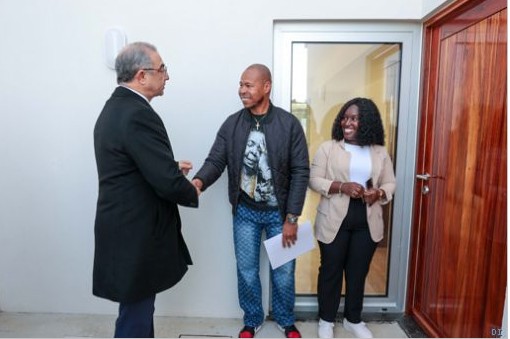
Thirteen new housing units were delivered on Tuesday in the parish of São Brás under a rent-to-own scheme, an investment financed by Portugal’s Recovery and Resilience Plan (PRR). According to José Manuel Bolieiro, the program has now reached “cruising speed” in the housing sector.
“Not long ago, it was perhaps more risky—and even understandable—to worry that we might miss milestones and targets or fail to fully use the PRR funds allocated to us,” Bolieiro said, referring to the regional task force overseeing PRR implementation in the Azores. “The reality is that, thanks to a joint effort and internal reorganization, we are now fully meeting milestones and targets across several areas, including housing.”
Without directly naming previous Socialist Party administrations, the regional president highlighted what he described as “years of absence of investment to increase housing supply,” as well as the “intense and difficult bureaucracy” that the current coalition government has worked through “quietly” since taking office in 2021.

Bolieiro noted that construction of the 13 homes began in February 2024, shortly after snap regional elections. “Political crises and instability do not help—they hinder,” he warned. “It’s important for everyone to understand that. Thinking it has no impact is a mistake. This is not just media noise on television, radio, newspapers, or among politicians. It disrupts the lives of everyone.”
According to Bolieiro, the work now underway allows the region to “look ahead with confidence and momentum.” He said the Azores currently have 767 housing solutions in progress, representing an investment of €65 million, including rehabilitation projects, new construction, and the allocation of housing lots. Support for self-build housing will increase by 25% in 2026, raising the grant available to families to €21,000, in addition to the land provided.
Emphasizing that housing is a top priority for his government, Bolieiro pledged that once the PRR concludes, the Regional Government will continue public investment in housing supply, seeking to adopt “new construction techniques to deliver housing more quickly and contain high inflationary costs in the construction sector.”

“We are fully aware of the need and the urgency,” he said. “We are entirely committed to acting—by expanding housing options and controlling the financial burden on families—so that more people can access decent housing.”
The 13 homes delivered—eight two-bedroom units, four three-bedroom units, and one four-bedroom unit—represent a total investment of €2.4 million (including VAT), financed by the PRR. Monthly rents range from €360.79 to €511.88, and tenants may exercise the option to purchase after one year of renting.
According to Bolieiro, the homes will house 42 people, “all of whom are employed, with the exception of one young student and one retired elderly woman.” “These families are working and therefore deserve a housing opportunity,” he said. “I trust they will take good care of what will one day be their own.”
Praia da Vitória Mayor Vânia Ferreira said the investment aims to reverse the municipality’s housing shortage and “effectively contributes to keeping families in a rural parish, fostering development and strengthening social dynamics in the area.”

In Diário Insular, José Lourenço-director–Photos from DI and the Municipality of Praia da Vitória.
Translated into English as a community outreach program by the Portuguese Beyond Borders Institute (PBBI) and the Modern and Classical Languages and Literatures Department (MCLL), in collaboration with Bruma Publication and ADMA (Azores-Diaspora Media Alliance) at California State University, Fresno. PBBI thanks Luso Financial for sponsoring NOVIDADES.

 Novidades - The Islands and the Diaspora