

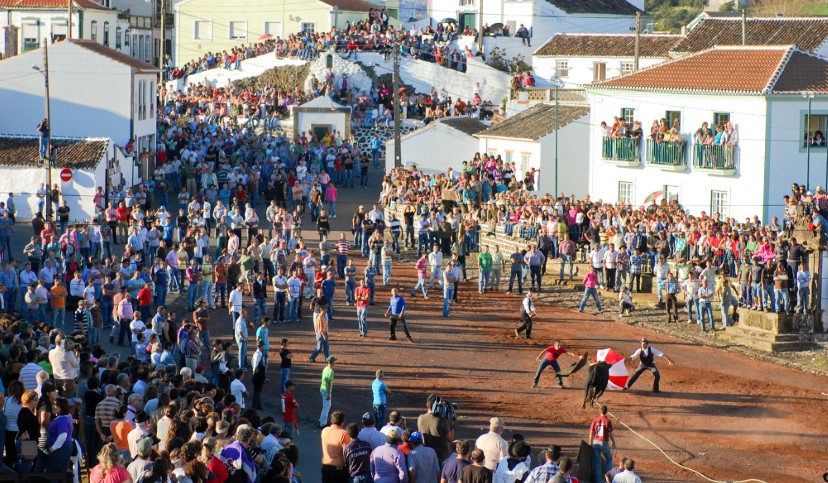
The Angra do Heroísmo Police Division (DPAGH) of the Public Security Police (PSP) has confirmed it is reviewing the policing model for touradas à corda events, without specifying whether it intends to reduce the number of officers deployed, while rejecting “any scenario involving the usurpation of functions.”
Last week, DI (Diário Insular) reported that the PSP was considering reducing the number of officers per tourada à corda, with civilians being tasked with traffic control on some streets. The Independent Police Officers’ Union (SIAP) raised concerns about the legality of the measure, arguing that it could amount to an usurpation of police functions.
In a written response to DI, the Angra do Heroísmo Police Division confirmed that it “is analyzing the implemented model” of policing that “has been adopted at various events, including bullfighting spectacles.”
“The policing models adopted for different types of events are continually evaluated in order to allow for efficient management of resources, always prioritizing the safety of people and public order, as well as strict compliance with the legislation in force. Any analysis carried out also takes into account experience acquired over time, changes in context, and the availability of resources,” the statement said.
Meetings with Municipalities
The PSP will now “verify and analyze the current scenario with the municipalities and identify any needs or possibilities to meet the intended objectives,” particularly with regard to “the potential capacity to provide road-signage resources and equipment to the promoters of the touradas.”
A meeting has already taken place with the Angra do Heroísmo City Council, and another meeting is scheduled for this week with the Praia da Vitória City Council.
“Only after the intentions have been communicated to these entities, and after they have expressed their views on what is proposed by the DPAGH, can a decision be made,” the PSP stated.
The Angra do Heroísmo Police Division is also “considering the involvement of other public or private entities that are directly or indirectly related to the organization of touradas à corda and that may be necessary to assist in the decision-making process, such as parish councils, festival committees, bullfighting associations, among others.”
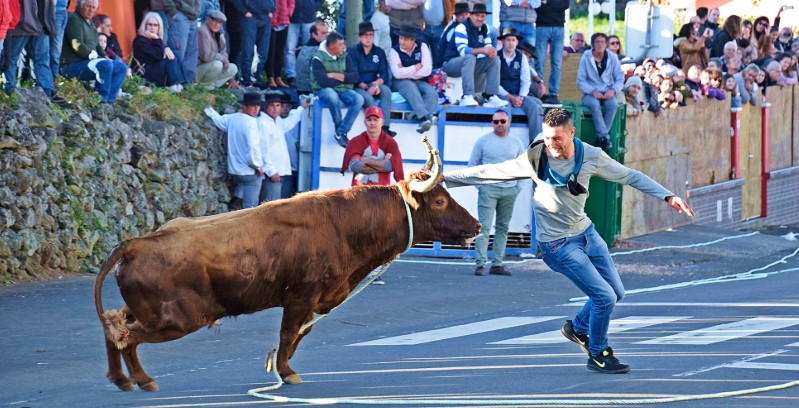
Regarding the criticism raised by the Independent Police Officers’ Union, the DPAGH “rejects any scenario of usurpation of functions.”
“Public security and the maintenance of public order will continue to be exclusive and non-transferable responsibilities of the Security Forces,” it emphasized.
While noting that it respects the role of trade union structures in both public and internal debate, the Angra do Heroísmo Police Division stated that “the definition of the police deployment and the distribution of operational resources are technical and command matters, framed by law and by the PSP’s mission. There is no usurpation of functions at issue, but rather the efficient management of available resources, always within the legal framework.”
According to information obtained by DI, one option under consideration is to deploy only one supervisor and two PSP officers at each tourada à corda (three officers at larger events), with secondary access points being controlled by civilians using barricades.
In its response to DI, the DPAGH did not specify numbers but assured that event safety would not be compromised.
“Whenever an event is authorized, policing is scaled proportionally to the identified risk. Safety is not assessed on the basis of mere quantitative considerations, but rather from a global perspective of planning and resource management, and subject to compliance with the applicable legal and safety conditions,” it stressed.
Specifically regarding touradas à corda, the Angra do Heroísmo Police Division stated that it is analyzing “the full harmonization of the legal provisions set out in Chapter XIII of the legal regime governing activities subject to licensing by municipal councils in the Autonomous Region of the Azores, which establishes the legal framework applicable to the holding of touradas à corda in the Azores, as well as other applicable legislation, including the Highway Code and related regulations.”
“Based on the knowledge acquired over the years, the aim is to achieve more effective involvement by event promoters with regard to the signage adopted and installed before, during, and after the event, as legally defined in Articles 57 [parking and vehicle circulation], 57-A [alternative routes and parking reservations], and 75 [promoter responsibility] of the regulations,” the division explained.
According to the Angra do Heroísmo Police Division, although signage has been provided in previous seasons, “it can and should be reinforced.”
In Diário Insular-José Loureço, director. Images from Casa Agrícola José Albino Fernandes.
Translated into English as a community outreach program by the Portuguese Beyond Borders Institute (PBBI) and the Modern and Classical Languages and Literatures Department (MCLL), in collaboration with Bruma Publication and ADMA (Azores-Diaspora Media Alliance) at California State University, Fresno. PBBI thanks Luso Financial for sponsoring NOVIDADES.

 Novidades - The Islands and the Diaspora