

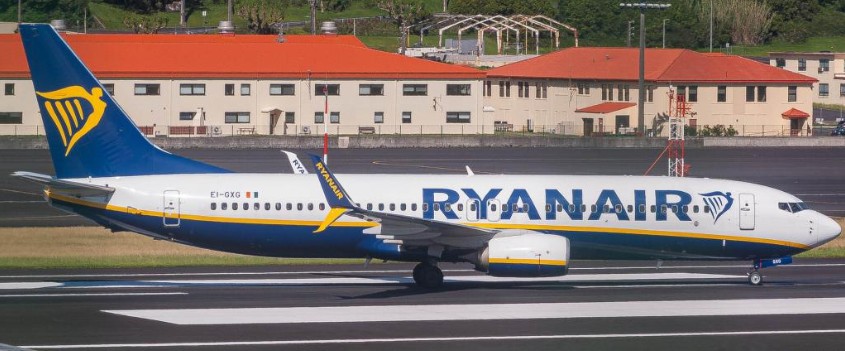
The president of the Angra do Heroísmo Chamber of Commerce and Industry (CCIAH) says Ryanair’s departure from the Azores had been foreseeable for three years—and that the region failed to get ready for it.
“The exit, in fact, already happened three years ago when Ryanair cut its Azores operations by 75%. We should all have realized then that this was the path the airline was going to take,” Marcos Couto said. “Unfortunately, that didn’t happen. We didn’t prepare properly, and now we’re seeing that trend come to fruition.”
Ryanair reiterated on Tuesday that it will stop flying to the Azores as of March 29. In statements to Lusa, a source from the Regional Secretariat for Tourism, Mobility and Infrastructure said talks with the low-cost carrier were still ongoing. Ryanair CEO Michael O’Leary, however, insisted the decision was final, citing airport fees and European environmental taxes.
Couto dismissed Ryanair’s justification as “entirely misleading,” arguing that airport fees are not an issue at Lajes Airport, which is managed by the Regional Government and has “much lower fees than the others.”
“The problem has to do with how the airline views Portugal and its global reorganization,” he said. “The Azores, as the weakest link, end up being penalized.”

As for the potential impact on regional tourism, Couto acknowledged public concern but noted that overnight stays in tourist accommodations have “increased significantly” over the past three years, despite Ryanair’s reduced presence. “The space left by the airline was filled by other carriers, namely SATA and TAP,” he said.
He also stressed that the year-over-year decline in overnight stays recorded between September and November cannot be attributed to Ryanair, since the airline maintained its operations in the region during that period.
Couto underscored that Ryanair’s current weight in passenger traffic to the Azores “is no longer very significant.”
“Ryanair carries 12% of passengers to the Azores and 7% of tourists. That’s the airline’s share of the regional market since 2023, after it scaled back its presence,” he said.
Rather than focusing on the visibility Ryanair brings to the Azores, Couto argued, the Regional Government should concentrate on making the destination more attractive to other airlines and on leveraging the networks of TAP and SATA.
“We have a structural problem related to how we promote ourselves and to the lack of funding for promotion—an area that is as crucial to the Azores’ economy as tourism, in a market that is globally competitive,” he said.
In Diário Insular-José Lourenço-director
Translated into English as a community outreach program by the Portuguese Beyond Borders Institute (PBBI) and the Modern and Classical Languages and Literatures Department (MCLL), in collaboration with Bruma Publication and ADMA (Azores-Diaspora Media Alliance) at California State University, Fresno. PBBI thanks Luso Financial for sponsoring NOVIDADES.


 Novidades - The Islands and the Diaspora