

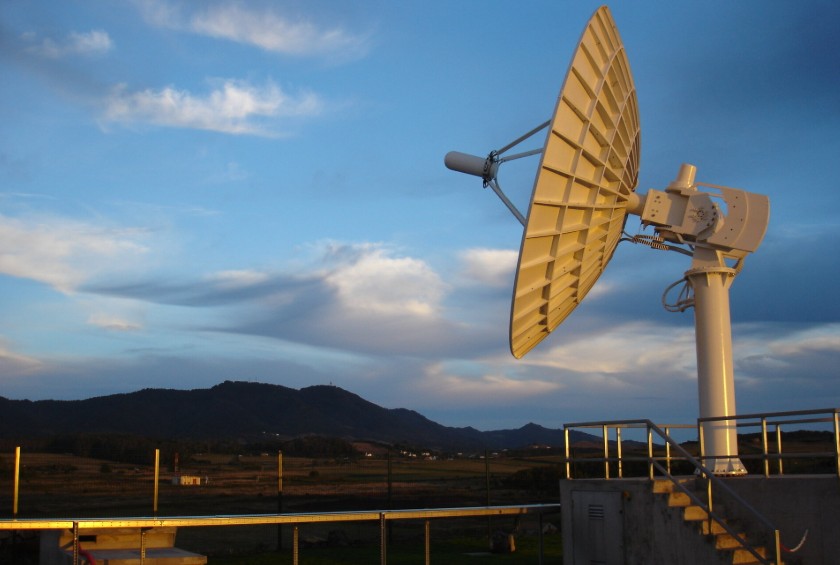
The RAEGE station on Santa Maria Island is developing a new project, SOLAR-Az, to strengthen space weather monitoring—solar phenomena that can disrupt satellite communications, electrical grids, and air navigation.
In an interview with Correio dos Açores, astrophysics and space-weather researcher Valente Cuambe explained that the Sun operates on roughly 11-year activity cycles. During peak periods, sunspots can trigger solar flares and coronal mass ejections, releasing charged particles that can damage satellites, disrupt power networks, and pose risks to aircraft and even astronauts.
Given these hazards, Cuambe argues for the strategic importance of establishing observatories in the Atlantic to monitor such events and provide actionable data to authorities—helping mitigate or prevent accidents.
What Is SOLAR-Az?
SOLAR-Az is an initiative led by the RAEGE station in Santa Maria designed to contribute to the monitoring of space weather. While public attention often focuses on extreme meteorological events within Earth’s atmosphere, Cuambe notes that far less attention is paid to phenomena occurring just beyond it.
“There is a direct interaction between the Sun and the Earth,” he said. “We want to underscore the importance of observing that interaction.”
A key gap, according to Cuambe, is the lack of space-weather observatories in the mid-Atlantic. While stations exist across the Americas and parts of Europe, the Atlantic remains largely uncovered, limiting data quality. SOLAR-Az proposes installing instruments to close that observational gap.
The project is linked to e-CALLISTO, a global network of low-cost radio interferometers that observe the Sun across frequencies ranging roughly from 10 MHz to 1.6 GHz, tracking solar activity in real time.
When solar activity intensifies, powerful flares can trigger coronal mass ejections—bursts of charged particles that, if directed toward Earth, can damage satellite electronics. Because aviation relies heavily on satellite-based navigation and communications, disruptions could leave aircraft effectively “blind” in controlled airspace.
“The question is straightforward,” Cuambe said. “Is it important to monitor these effects or not?”
SOLAR-Az aims to provide timely information to aviation authorities, maritime operators, and other agencies to help reduce risks and prevent incidents. While similar monitoring exists elsewhere, this would be a first for Portugal—and particularly for the Azores.
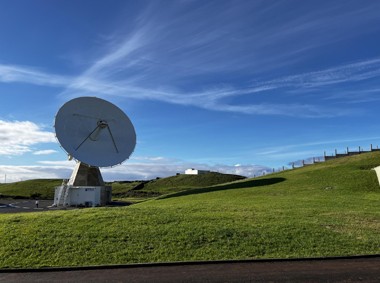
What Does RAEGE Do?
RAEGE’s core mission is observing Earth’s dynamics from space. Using ground-based antennas pointed at distant, seemingly fixed cosmic sources—often supermassive black holes—the station tracks tectonic plate movement, variations in Earth’s rotation, sea-level changes, and gravitational anomalies.
This work relies on VLBI (Very Long Baseline Interferometry), a technique that links antennas across vast distances to simulate a single, enormous telescope. Tiny delays in signal arrival times allow scientists to calculate distances between stations and detect subtle movements of Earth’s crust—even millisecond variations in the length of a day.
RAEGE also operates a superconducting gravimeter to measure global variations in gravity, contributing to models of Earth’s irregular shape, known as the geoid.
What’s Next?
Beyond SOLAR-Az, the team has submitted a new project proposal—still under review—to expand its research scope and collaborate with other institutions, including Portugal’s IPMA. The goal is to integrate geophysics, meteorology, and solar physics to study extreme events and their impacts.
There are also plans for collaboration across Macaronesia, potentially creating a regional research network.
Above all, Cuambe says the ambition is to build scientific capacity in the Azores—retaining local talent and developing research and engineering at a regional level.
“Too many Azorean scientists and engineers leave because opportunities are limited,” he said. “We want to help change that—by building something here that produces knowledge and technology for the region and beyond.”
José Henrique Andrade is a journalist for Correio dos Açores-Natalino Viveiros, direcrtor
Translated into English as a community outreach program by the Portuguese Beyond Borders Institute (PBBI) and the Modern and Classical Languages and Literatures Department (MCLL), in collaboration with Bruma Publication and ADMA (Azores-Diaspora Media Alliance) at California State University, Fresno. PBBI thanks Luso Financial for sponsoring NOVIDADES.


 Novidades - The Islands and the Diaspora