

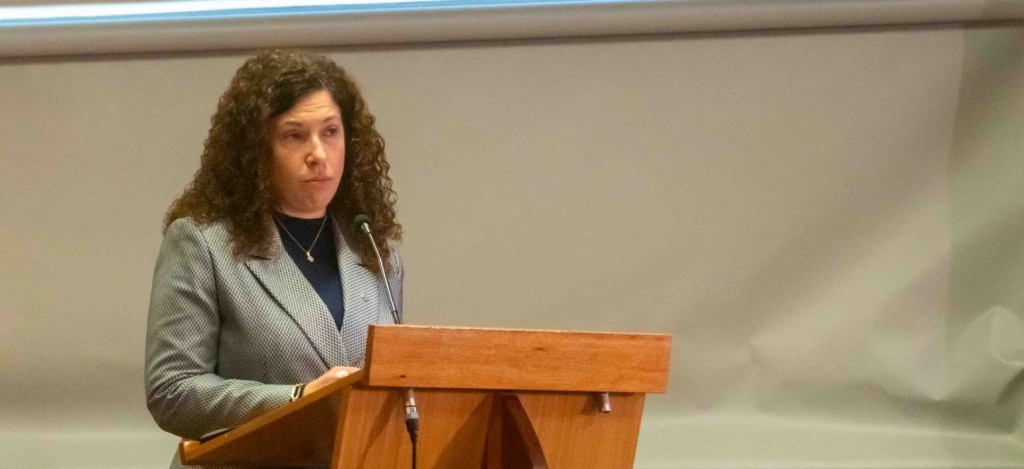
Speaking at a seminar on maritime transportation, Vânia Ferreira, Mayor of Praia da Vitória, argued that the Azores’ freight transport system must, above all, guarantee reliability and predictability for both businesses and consumers.
Addressing the maritime transport seminar promoted by the Câmara do Comércio e Indústria de Angra do Heroísmo, held Friday at the Auditorium of the Praia da Vitória Vocational School, Ferreira stressed that every “company or consumer must be able to count on a clear delivery date for their goods.”
“We cannot remain at the mercy of the constant risk of supply disruptions or of losses caused by delays in exporting goods,” she said. “Our vision is clear: the Azores need a maritime freight transport model that delivers predictability and reliability. This, in our view, must be the central focus of the debate.”
According to the mayor, local and regional economic development depends on a transport network that ensures the smooth circulation of goods. “That should be self-evident,” she noted. “Yet at times it seems to be blurred by other interests. That is the sense we get from the complaints we continue to receive. As a perception, it may not be entirely fair—but the sheer volume of complaints leads us to this conclusion.”
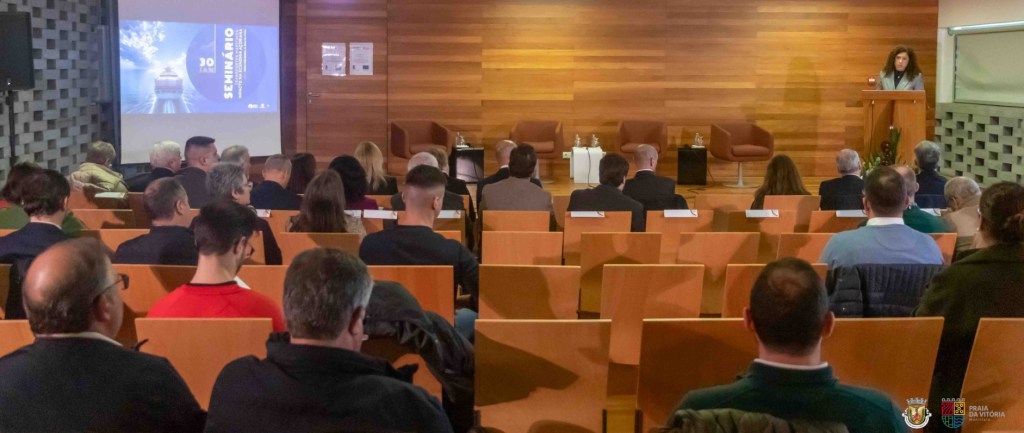
Ferreira raised a series of questions that, she said, demand serious technical evaluation: “Is it necessary to reinforce routes? To introduce new compensation mechanisms to offset the costs imposed by our archipelagic reality? To expand the number of operators, benefiting from healthy competition?” She also pointed to potential solutions such as strengthening inter-island cabotage and adopting a model that allows containerization and palletized cargo to coexist. “In other words, a system that does not always require containers to reach every destination, with the added costs that entail. These possibilities must be assessed and tested by specialists. Political leadership must gather input and make decisions. But I want to be clear once again: in our view, those decisions must be guided by a single overriding objective—the reliability of the system. I insist on this point because I believe it has been the Achilles’ heel of maritime freight transport in the Azores.”
Highlighting the announced expansion of the Praia da Vitória port quay, which will give it multi-purpose capabilities, the mayor argued that the project should prompt a broader rethinking of the maritime transport model. “In Praia da Vitória’s case, where we have infrastructure that is clearly underutilized, it seems undeniable that using it as a central cargo hub for the central island group could represent an opportunity—or even a viable solution,” she said.
On passenger maritime transport, Ferreira called for a balanced strengthening of connections and renewed her demand for more cruise ship calls at Praia da Vitória. “We believe it makes perfect sense for the Azores to present themselves to the cruise market as a destination with two access points for cruise ships. Regional promotion should reflect that reality. We do not accept centralized visions of traffic flows—neither for freight nor for passengers, particularly in the cruise sector. This is a demand we renew to the Azores Government and to Portos dos Açores, and one we will continue to raise whenever appropriate,” she concluded.
From Press Release
Translated into English as a community outreach program by the Portuguese Beyond Borders Institute (PBBI) and the Modern and Classical Languages and Literatures Department (MCLL), in collaboration with Bruma Publication and ADMA (Azores-Diaspora Media Alliance) at California State University, Fresno. PBBI thanks Luso Financial for sponsoring NOVIDADES.


 Novidades - The Islands and the Diaspora