

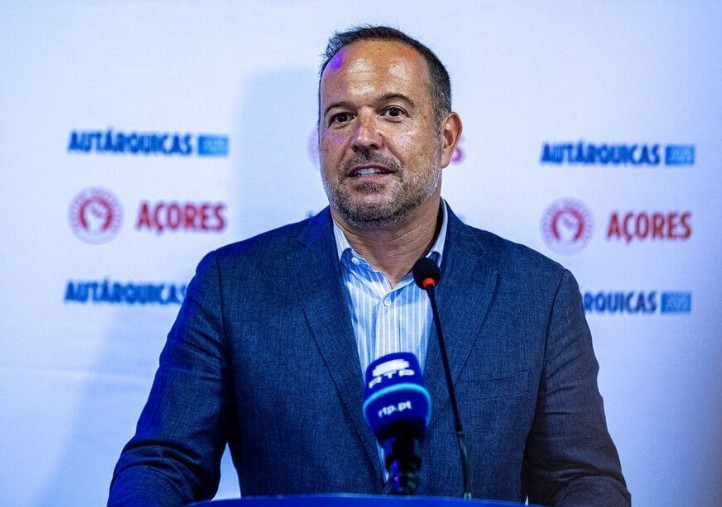
The president of the Azores Socialist Party, Francisco César, said on the island of São Jorge that the region’s persistent problems in air and maritime cargo transport are not unavoidable, but instead stem from a lack of competence, poor organization, and an outdated transport model. He accused the Regional Government of the Azores of losing credibility by focusing almost exclusively on what it describes as a state of “financial calamity” in the public accounts.
Speaking on the sidelines of a visit to the Compre Bem supermarket, César argued that “it is unacceptable to treat as a fatality something that can be solved,” stressing that disruptions in the transport of goods penalize families and businesses on a daily basis and drive up the cost of living across the Azores.
“The systematic delays in maritime cargo, the high costs, and the constant problems with air freight are not inevitable,” César said. “They are the result of poor political choices, lack of organization, and the persistence of a maritime cargo transport model that does not work and has not been reviewed for more than 20 years.”
As a solution, the socialist leader proposed the introduction of two dedicated cargo aircraft: one to serve inter-island routes—an earlier promise he says the government has abandoned—and another to guarantee air cargo transport between the Azores and mainland Portugal. “With two cargo planes and a serious overhaul of the maritime freight model, it would be possible to reduce costs, increase predictability, and directly ease the cost of living for people,” he said.
César also accused the Regional Government of failing to govern, arguing that it has become consumed by managing the financial crisis rather than addressing structural problems. “This is a government absorbed by the so-called calamity of the public accounts, one that fails to solve problems, postpones decisions, and has lost credibility with Azoreans,” he said.
According to the president of PS Açores, the lack of political focus has tangible consequences in everyday life. “While the government limits itself to putting out financial fires, families pay more at the supermarket and companies accumulate costs that jeopardize their operations,” he said.
César insisted that the proposed solutions are financially feasible and accused the executive of lacking both priorities and strategic vision. “Amid so many millions, it would be possible to set aside one or two million euros to ensure an air cargo plane,” he said. “What’s missing is not money—it’s organization, competence, and political will.”
He concluded by arguing that lowering the cost of living should be a central priority of governance. “Accepting these problems as an inevitable destiny is to give up on governing,” César said. “There are alternatives, there are solutions, and they involve changing models, managing better, and restoring credibility to government action.”
In Diário dos Açores, Paulo Viveiros-director
Translated into English as a community outreach program by the Portuguese Beyond Borders Institute (PBBI) and the Modern and Classical Languages and Literatures Department (MCLL), in collaboration with Bruma Publication and ADMA (Azores-Diaspora Media Alliance) at California State University, Fresno. PBBI thanks Luso Financial for sponsoring NOVIDADES.

 Novidades - The Islands and the Diaspora