

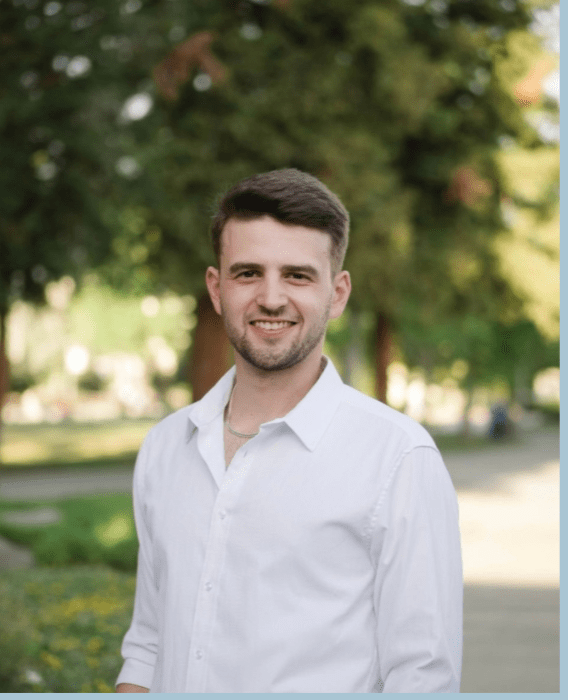
Zachary Jacob Santos was born on March 19, 2003, in Turlock, California. Named after an uncle, he carries “Jacob” as his middle name—a small but meaningful link within a family defined by closeness and continuity. Some of his earliest memories center on weekends spent at his grandparents’ home, where cousins gathered for sleepovers and family time. These early experiences reveal how central family has always been in Zach’s life, shaping both his sense of belonging and his understanding of community.
That sense of connection extended beyond the household and into the Portuguese-American world of festas. From a young age, Zach attended Portuguese festas where he encountered others who shared similar cultural backgrounds and life experiences. These gatherings became formative spaces where identity, celebration, and memory intertwined. Zach recalls the joy of attending festas and the lasting impressions they left on him—moments of shared culture that remain among his most vivid and meaningful memories.
Zach’s family story begins in the early 1970s, when his grandparents emigrated from the Azores, specifically São Jorge, to the United States. His grandmother was pregnant with his father when they arrived. While Zach was never given a detailed explanation for the move, he understands that his grandparents were seeking better opportunities and a different future than what was available to them in the Azores. They settled in California’s Central Valley, drawn in part by family connections and by the region’s agricultural landscape and warm climate, which felt familiar and reminiscent of island life.
One of the most significant challenges Zach’s grandparents faced upon arriving in the Central Valley was the language barrier. His father, raised speaking only Portuguese at home, encountered difficulties when he entered the American school system. Over time, he not only learned English himself but also became a bridge for his parents and extended family, helping them navigate a new linguistic and cultural environment. This responsibility placed considerable pressure on him, as he balanced his own adaptation with the task of teaching others. Eventually, Zach’s grandparents became fluent enough in English to communicate comfortably with their grandchildren.
Zach represents the second generation of his family born in the United States. His father is Portuguese-American, while his mother, who is from California, has roots in northern and northwestern Europe, including the United Kingdom. Although both parents hoped Zach would learn Portuguese, consistent language practice proved difficult. Once his grandparents became fluent in English, Portuguese was used less frequently at home, limiting Zach’s exposure to the language during his formative years.
Despite this, Zach has maintained a strong connection to his Portuguese heritage through cultural practices rather than language fluency. Festas continue to play a central role in his life, and he remains deeply attached to them. Food is one of the most vivid expressions of this connection—especially sopas, his favorite dish, as well as octopus soup. In addition, Zach is actively working to reconnect with the language by taking Portuguese courses at Fresno State and practicing with family members when possible.
In the summer of 2025, Zach and his family—his parents and grandparents—plan to travel to the Azores for several weeks. They will visit São Jorge, São Miguel, and Terceira, making the trip particularly meaningful. His parents have not returned to the Azores since 2000, and his grandparents have been away even longer. Zach describes his family’s view of the Azores as similar to Hawaii, noting the shared qualities of climate, environment, and natural beauty. For the entire family, the journey represents a long-awaited reconnection with place and memory.
Growing up in the Portuguese-American community of the Central Valley, Zach experienced a world where “everyone knows everyone.” He describes a tight-knit network where family ties and social connections overlap, often leading to long conversations when people meet unexpectedly in public. These connections become especially visible at festas, which draw Portuguese-Americans from across California. Zach also observes that while the community fluctuates in size, institutions like Fresno State play an important role in sustaining cultural exchange, particularly through study-abroad programs that allow students to visit the Azores and deepen their understanding of their heritage.
Zach speaks enthusiastically about festas, describing them as vibrant celebrations that blend religious tradition, cultural expression, and social life. Often associated with the Feast of the Holy Spirit or patron saints, these events include church services, parades, music, dancing, silent auctions, and even bull-related activities. Festas take place primarily in the spring and summer and are held throughout the Central Valley, including in cities such as Selma, Modesto, Visalia, and Turlock.
One of Zach’s most memorable—and humorous—stories involves a festa where he danced so intensely with a partner that he tore his ACL. Although the injury was serious and painful at the time, he now recalls it as a chaotic and unforgettable moment that captures the energy of festas. When asked about Portuguese celebrations, this story was the first example he shared, illustrating for outsiders how lively, unpredictable, and joyful these gatherings can be.
Zach expresses deep pride in being part of the Portuguese-American community. He credits his father as a major influence, describing him as hardworking and principled. Zach believes these values have shaped his own work ethic and moral outlook, teaching him the importance of helping others both within and beyond the community. While he continues to explore what it truly means to be Portuguese-American, he sees this search not as uncertainty but as an ongoing process. He believes that visiting the Azores will help him better understand his family’s past and strengthen his appreciation for a culture that has quietly but powerfully shaped his life.
These are student projects at California State University, Fresno. Novidades will publish these regularly. These oral history interviews are being archived at Fresno State.
Vision
LEGACY envisions a future in which the lived experiences of diverse communities are preserved, honored, and made accessible as part of the shared historical record. Rooted at Fresno State, LEGACY seeks to ensure that personal narratives—often excluded from traditional archives—are recognized as essential to understanding our past, present, and future. Through memory, voice, and story, LEGACY affirms that history is not only written in documents, but carried in lives.
Mission
LEGACY is an oral history archive and storytelling project at the Portuguese Beyond Borders Institute (PBBI) @ Fresno State. Its mission is to collect, preserve, and publish oral histories that document migration, labor, culture, identity, resilience, and belonging across generations and communities.
By recording and sharing these stories, LEGACY transforms individual memory into public knowledge, strengthens connections between the university and the community, and contributes to a more inclusive and human-centered historical record. LEGACY publishes curated narratives drawn from oral histories collected by PBBI @ Fresno State, ensuring that voices too often unheard are not only preserved, but amplified.
 Novidades - The Islands and the Diaspora