

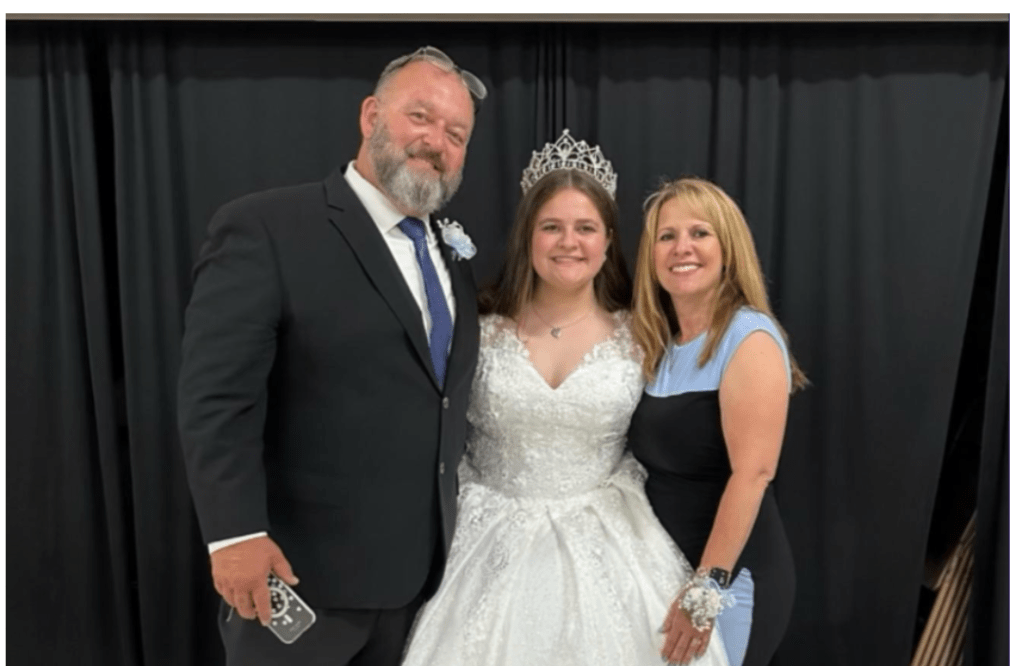
Kaitlyn Nicole Da Silva is more than a name—it is a narrative shaped by migration, memory, and inheritance. Her middle name, Nicole, honors her great-grandfather Nicholas, who was Italian rather than Portuguese, signaling from the outset the layered and transnational nature of her family history. Even her surname, Da Silva, carries an unexpected story. While in the Azores, specifically on the island of Pico, her great-grandfather traveled to register the birth of her grandfather. Portuguese authorities required him to adopt the surname “Da Silva,” arguing that there were already too many families on the island with the surname “Oranges.” The name was not chosen but assigned—an administrative decision that would go on to define generations. What began as bureaucracy became legacy.
Kaitlyn was born on January 24, 2006, in Fresno, California. Though her life has unfolded in the Central Valley, her emotional and cultural roots stretch across the Atlantic to Portugal. From an early age, family and tradition shaped her worldview. Some of her earliest memories are of religious festivals—walking with neighbors, holding oversized rosaries, and participating in collective rituals that blended faith and community. These moments were not merely celebratory; they were formative, grounding her in a shared cultural rhythm.
Her family’s migration story reflects a broader Portuguese-American experience. Her father emigrated from Pico in 1971, initially settling in New York with relatives who sponsored his arrival. Despite the opportunities the city offered, the family longed for a quieter, rural life. They eventually moved west to California’s Central Valley, where farming offered both familiarity and possibility. Agriculture had long defined both sides of Kaitlyn’s family: her mother’s relatives raised sheep and cattle, while her father’s family cultivated taro root and yams. These agricultural traditions extended back several generations, reinforcing values of labor, endurance, and connection to the land.
Growing up, Kaitlyn learned that her family arrived in the United States with very little. Stories passed down from her grandfather—such as living in homes without indoor plumbing—became lessons in resilience rather than hardship alone. These narratives instilled gratitude, humility, and pride in a lineage shaped by perseverance. Though she did not live through those early struggles, their memory formed an ethical compass that continues to guide her.
Portuguese identity has always been central to Kaitlyn’s life. Even as a child, she actively participated in cultural traditions. She spent long hours in the kitchen with her Ava, learning to prepare traditional foods such as linguiça, fish stews, and handmade bread. Portuguese was spoken in the home, even if imperfectly, forming a hybrid linguistic world where traditional expressions mixed with American adaptations. Terms like mingi and affectionate names for grandparents became part of a living, evolving cultural language.
Although Kaitlyn did not grow up speaking fluent Portuguese, she was constantly surrounded by it. She often understood conversations spoken by her parents, even if she struggled to respond. Enrolling in Portuguese classes later in life deepened her appreciation for the language and its emotional power. Looking back, she wishes her father had taught it to her more explicitly, recognizing now how language connects identity, memory, and belonging. Relearning Portuguese has become a form of cultural recovery—an effort to reclaim a voice inherited but once distant.
Food has also served as a powerful vessel of cultural memory. Meals were never just about nourishment; they were moments of teaching, storytelling, and preservation. Ava cooked from memory, passing down recipes learned from previous generations. Each dish carried history, emotion, and continuity. Yet for Kaitlyn, the festa stands as the most vivid expression of Portuguese identity. Rooted in Catholic tradition and communal celebration, festas embodied faith, culture, and belonging. As a child, she was honored to serve as both Little Queen and Big Queen—roles that symbolized pride, responsibility, and visibility within the community.
The Portuguese festa in Easton, just outside Fresno, remains a cornerstone of community life. It is a gathering place for generations of families who come together to celebrate faith, heritage, and mutual support. Kaitlyn credits these experiences with shaping her sense of identity and purpose. The community’s support extended beyond tradition; she even received a college scholarship from the Portuguese hall, reinforcing the enduring role of collective care.
Faith and family have consistently anchored Kaitlyn’s life. Catholicism, central to her Portuguese culture, has deeply influenced her worldview. Whether through attending Mass or participating in religious rituals during festas, faith has offered strength and continuity. Growing up in a large, close-knit, religious household provided a sense of security and moral grounding that remains with her.
At the same time, Kaitlyn is acutely aware of cultural change. She has witnessed declining participation in festas and a gradual erosion of Portuguese language use in some households. Assimilation and Americanization exert a powerful pull. While cultural blending can be enriching, it also risks diluting traditions that once defined entire communities. Observing these shifts has prompted her to reflect on her own responsibility in preserving cultural heritage.
Language, she believes, is central to that preservation. If given the chance, she would ask her father to teach her Portuguese from the beginning. Language, for her, carries ancestors, emotion, and continuity. Speaking it is a way of bringing the past into the present, of participating in a tradition that transcends geography and time.
When she reflects on her life as a whole, Kaitlyn sees a mosaic: her name, her family’s migration, meals prepared with love, religious rituals, festas, and language. Together, they form a complete portrait of a young Portuguese-American woman shaped by both struggle and joy. As she moves forward, she understands that cultural preservation rests in everyday acts—attending festas, cooking traditional food, learning the language, and telling stories to younger generations.
In a world where identity often feels fluid or uncertain, hers is clear. Kaitlyn Nicole Da Silva carries with her a lineage of farmers, immigrants, and devoted family members. Her roots are in the Azores, her life in California, and her heart in the traditions that bind them together. She does not merely inherit Portuguese culture—she lives it. And that, she believes, is something to be proud of.
These are student projects at California State University, Fresno. Novidades will publish these regularly. These oral history interviews are being archived at Fresno State.
Vision
LEGACY envisions a future in which the lived experiences of diverse communities are preserved, honored, and made accessible as part of the shared historical record. Rooted at Fresno State, LEGACY seeks to ensure that personal narratives—often excluded from traditional archives—are recognized as essential to understanding our past, present, and future. Through memory, voice, and story, LEGACY affirms that history is not only written in documents, but carried in lives.
Mission
LEGACY is an oral history archive and storytelling project at the Portuguese Beyond Borders Institute (PBBI) @ Fresno State. Its mission is to collect, preserve, and publish oral histories that document migration, labor, culture, identity, resilience, and belonging across generations and communities.
By recording and sharing these stories, LEGACY transforms individual memory into public knowledge, strengthens connections between the university and the community, and contributes to a more inclusive and human-centered historical record. LEGACY publishes curated narratives drawn from oral histories collected by PBBI @ Fresno State, ensuring that voices too often unheard are not only preserved, but amplified.
 Novidades - The Islands and the Diaspora