

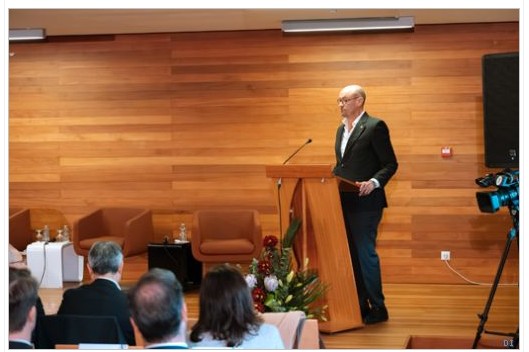
The Port of Praia da Vitória should function as a “privileged gateway to the Azores, particularly for the Central and Western island groups,” argued Marcos Couto, president of the Chamber of Commerce and Industry of Angra do Heroísmo, at the opening of a seminar on maritime transport organized by the business association.
Couto warned that the long-announced expansion of the port has yet to materialize, delaying the region’s broader development. “This is not a local or island-specific issue,” he said. “It is a matter of regional economic efficiency. Ignoring this central role means wasting a clear competitive advantage.”
Speaking at the event held on Friday, Couto stressed that none of the proposed improvements will be possible without an urgent clarification of both the maritime transport model and the port management framework the Azores intend to adopt. “It is always easier to place blame on external entities,” he said, “but the truth is that we have failed to do our part—deciding which model we want, how we want it, and when we want it. In other words, making the rules of the game clear.”
According to Couto, studies have been completed, conclusions have been drawn—and even “conclusions of conclusions” exist—but decisive action remains absent. “No model is perfect,” he added, “but indecision is the worst model of all.”
The business leader also criticized what he described as unfair competition among ports within the same region and under the same government oversight. “It is unacceptable,” he said, “that unloading a grain ship at the Port of Praia da Vitória costs €15,000 more than at other Azorean ports, due entirely to an archaic, outdated, inefficient, and indefensible management model.” Such indecision, he warned, creates unpredictability, penalizes operators, and undermines economic and social development—not only on Terceira Island, but across the Azores.
Also addressing the seminar was Vânia Ferreira, mayor of Praia da Vitória, who argued that the Azores need a freight transport system that prioritizes reliability above all else. “Every user of the service must have certainty that their cargo will arrive according to their needs,” she said.
Given Praia da Vitória’s underutilized infrastructure, Ferreira suggested that the port’s use as a central cargo hub for the Central Group of islands represents a clear opportunity that should not be overlooked.
For her part, Berta Cabral, the Regional Secretary for Tourism, Mobility, and Infrastructure, said the system has been evolving gradually. “Reforming a system that must continue operating and meeting daily needs requires a surgical, progressive approach, with careful consideration,” she said.
Cabral explained that the regional government conducted a pragmatic study focused on practical issues and moved quickly to implement a new operational model. “Today we already have concrete results,” she noted, citing weekly port calls on all islands, additional port equipment, and operational adjustments.
In practice, she said, a new model is already in place. “Scenario two has been implemented, and we are now moving steadily and safely toward an optimized mixed model.”
Speaking to reporters, Cabral confirmed—echoing remarks made at the same seminar by Sancha Costa Santos, president of Portos dos Açores—that the public tender for the construction of the multi-purpose pier at the Port of Praia da Vitória, budgeted at €40.3 million, could be concluded within the next few months.
“The Port of Praia da Vitória is one of our priority projects for 2026 and beyond,” Cabral said. “It will be submitted under the Sustainability program, within the framework of PO 2030. At the government’s request, Portos dos Açores is developing the entire project so it can move forward using European Union funds available under the current financing cycle.”
In Diário Insular, José Lourenço-director
Translated into English as a community outreach program by the Portuguese Beyond Borders Institute (PBBI) and the Modern and Classical Languages and Literatures Department (MCLL), in collaboration with Bruma Publication and ADMA (Azores-Diaspora Media Alliance) at California State University, Fresno. PBBI thanks Luso Financial for sponsoring NOVIDADES.


 Novidades - The Islands and the Diaspora