

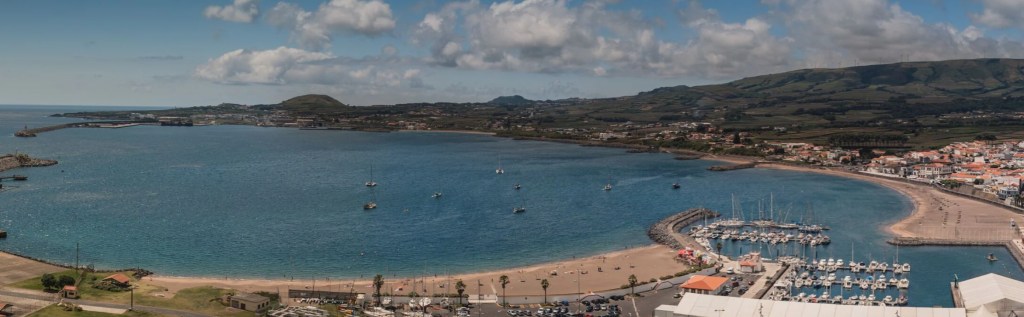
Ana Paula Vitorino, chair of the board of Portugal’s Autoridade da Mobilidade e dos Transportes (AMT), says increased European and national investment in Security and Defense could unlock major development opportunities for the port of Praia da Vitória, on Terceira Island.
Speaking at the seminar “Maritime Transport: Impact on the Azorean Economy,” hosted last Friday by the Câmara do Comércio e Indústria de Angra do Heroísmo, Vitorino pointed to the strategic importance of the nearby Lajes Air Base.
“Terceira has a critical nerve center called Lajes Air Base,” she said. “The port of Praia da Vitória must be prepared for the arrival and departure of military personnel and equipment. That requirement justifies the investment needed to adapt the port to this role.”
At issue, Vitorino explained, is the growing “dual use” of infrastructure—facilities that serve both civilian and military purposes. National policies, she argued, should take advantage of the substantial funding available under European defense policy. “Spain is already doing this,” she noted, offering the country as an example.
The former Minister of the Sea also emphasized that Security and Defense funding mechanisms explicitly allow part of the available resources to be allocated to critical infrastructure, adapting it to military needs. She urged government bodies and industry stakeholders to work together toward this goal. “We need to secure funding for what we already know is necessary—and what is now becoming mandatory under these new European policies,” she said.
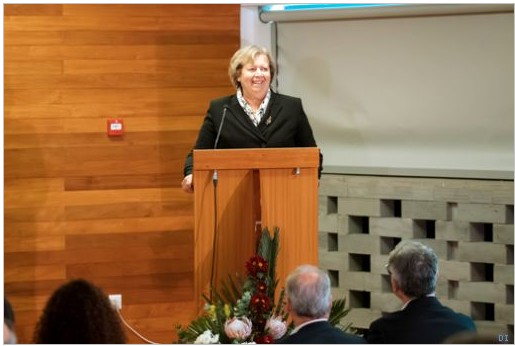
Vitorino also introduced the idea of ports as engines of wealth creation. “We must leverage the added value of ports—key nodes in the logistics chain—and have the imagination to turn them into hubs for the development of new, sea-related industries,” she argued.
Another concept highlighted at the seminar was “mobility poverty,” an idea increasingly adopted by the European Union and one that could open the door to new funding opportunities. “Mobility poverty occurs when people do not have the same access to essential activities—and to global economic activity—that exists in other parts of the European Union,” Vitorino said. “Here, the problem is more acute because the territory is fragmented,” she added, referring to the Azorean archipelago.
European Commission Recommendation 2025/1021, adopted in May 2025, explicitly recognizes transport poverty as a European social issue and calls on member states to ensure affordable and equitable mobility.
The AMT addressed this issue last April by hosting the conference “Combating Mobility Poverty,” where it presented two studies focused on the challenges and consequences of limited access to transportation.
From Diário Insular-José Lourenço-director
Translated into English as a community outreach program by the Portuguese Beyond Borders Institute (PBBI) and the Modern and Classical Languages and Literatures Department (MCLL), in collaboration with Bruma Publication and ADMA (Azores-Diaspora Media Alliance) at California State University, Fresno. PBBI thanks Luso Financial for sponsoring NOVIDADES.

 Novidades - The Islands and the Diaspora