

An Indonesian national suffering from a fracture to the left ankle required urgent medical evacuation after authorities contacted the Maritime Emergency Patient Guidance Center (CODU-MAR).
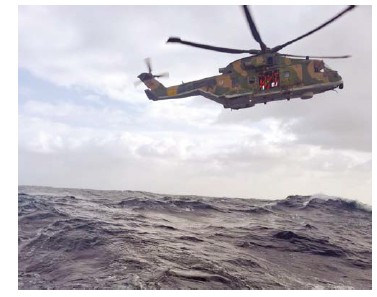
In coordination with the Air Search and Rescue Center at Lajes (RCC Lajes), an EH-101 Merlin helicopter from the Força Aérea Portuguesa was deployed to carry out the rescue operation, with support from the patrol vessel NRP Sines. The victim was subsequently transported to a hospital unit with the assistance of the Serviço Regional de Proteção Civil e Bombeiros dos Açores.
Portugal’s Navy, through its Maritime Search and Rescue Coordination Centers, provides continuous emergency response across national maritime areas of responsibility, operating 24 hours a day, 365 days a year.
Within the MRCC Lisboa’s area of responsibility, a total of 29 incidents were recorded in January, resulting in the rescue of 17 people. In the MRCC Ponta Delgada area, nine search-and-rescue operations were coordinated, saving three people.
At the Maritime Search and Rescue Sub-Center of MRSC Funchal, two rescue operations were carried out, resulting in the rescue of two individuals.
The effectiveness of Portugal’s Search and Rescue System relies on the coordinated efforts of multiple organizations and assets, including the Navy, the Autoridade Marítima Nacional, the Air Force, and other institutions within the National Search and Rescue Auxiliary Structure. Key partners include the Instituto Nacional de Emergência Médica through CODU-MAR, national and regional civil protection and fire services, maritime and port authorities, and the coastal traffic control system.
Authorities also highlighted the crucial support provided by merchant vessels and fishing boats, which frequently divert from commercial routes and suspend professional activity to assist in rescue operations, always under the coordination of MRCC Lisboa and MRCC Ponta Delgada.
In Correio dos Açores-Natalino Viveiros, director


 Novidades - The Islands and the Diaspora