

Milk producers on the island of Terceira are weighing drastic measures—including reducing production, converting dairy farms to beef operations, or taking to the streets in protest—after the price paid for milk was cut by three cents per liter.
Producers say they are angry and demoralized by the decision. “Farmers are outraged and discouraged. There has to be some solution to change this situation,” said José António Azevedo, president of the Associação Agrícola da Ilha Terceira (AAIT), speaking to reporters on Monday. He added that action now depends on producers themselves and their representatives within Unicol.
On January 31, Unicol notified milk producers on the islands of Terceira and Graciosa—via text message—that the base price paid to producers would drop by three cents per liter starting February 1, citing an “adverse economic environment.”
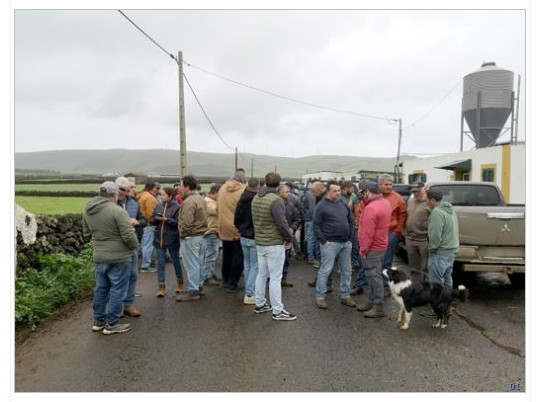
Roughly 100 Terceira producers gathered Monday at an informal meeting held on a farm in the parish of São Sebastião to discuss how to respond.
Farmers criticize lack of communication
Brian Dinis, one of the producers who helped organize the meeting, said farmers are deeply dissatisfied—not only with the price cut, but with how it was communicated.
“Getting a text message on Saturday, January 31, at 8:30 p.m., saying the price would drop just three hours later, on February 1? I think they knew about this much earlier,” Dinis said. “They should have spoken to producers in advance so we could prepare.”
The Federação Agrícola dos Açores, along with agricultural associations from Terceira and Graciosa, has requested a meeting with Unicol. Producers insist the cooperative must justify the price cut in person, not through a text message.
“We want to ask Unicol whether they believe dairy farmers can survive with a base milk price of 35 cents per liter,” Dinis said. “Producers want to hear that directly from them.”

Protest actions on the table
If no answers are forthcoming by the end of the month, farmers say public demonstrations are likely.
“It could reach a point where farmers have to organize on a large scale and go down there and shut something down until Unicol comes to talk to producers,” Dinis warned.
AAIT president José António Azevedo outlined other possible measures, though some would require authorization from the European Commission or financial support from the Governo Regional dos Açores. These include reducing milk deliveries to the factory, releasing aid to allow for the early slaughter of animals, or converting dairy farms to beef production—an option that could affect 25 to 30 producers on Terceira alone.
Lowest milk price in the Azores
With the reduction, Unicol’s base price for milk falls to 35 cents per liter—the lowest in the Azores.
“We were already being paid at cost. Now, with a three-cent cut, we’re below the cost of production,” Azevedo said. “We’re caught between a rock and a hard place. We don’t earn enough to produce, but we still have to feed animals and spend money every single day.”
The cut comes one month after Lactogal, which owns 51% of Pronicol, Terceira’s only large-scale dairy plant, also reduced the price paid to producers on mainland Portugal by three cents. Even so, Terceira and Graciosa producers note that they are still paid about 10 cents less per liter than their counterparts on the mainland.
Market justification rejected
Azevedo also rejected claims that the price cut is tied to broader European market conditions.
“Lactogal doesn’t sell its products in Northern Europe—it sells them in mainland Portugal,” he said. “Retail prices on the mainland haven’t dropped. The price decline has only occurred in central and northern Europe, where producers are being paid 57 to 58 cents per liter.”
Diego Aguiar, president of the Associação dos Jovens Agricultores Terceirenses (AJAT), called on the Regional Government to step in and support farmers as they confront the price cut.
“What’s essential is a different stance from the industry—not just on pricing, but on communication, which has fallen far short,” Aguiar said. “In my view, this shows a lack of respect for cooperative members.”
While a boycott of milk deliveries has been discussed, Aguiar cautioned that such action would need to be “very well organized” to have an impact. As an alternative, he suggested a voluntary reduction in milk production, paired with compensation for farmers, as has occurred in the past.
Aguiar also warned that the decision could further accelerate the aging of the farming sector on Terceira.
“We have the example of São Jorge, where a significant increase in milk prices encouraged more young people to enter the sector,” he said. “We do have young people willing to join farming—but with this price cut, many are already thinking twice.”
In Diário Insular-José Lourenço-director.
Translated into English as a community outreach program by the Portuguese Beyond Borders Institute (PBBI) and the Modern and Classical Languages and Literatures Department (MCLL), in collaboration with Bruma Publication and ADMA (Azores-Diaspora Media Alliance) at California State University, Fresno. PBBI thanks Luso Financial for sponsoring NOVIDADES.

 Novidades - The Islands and the Diaspora