

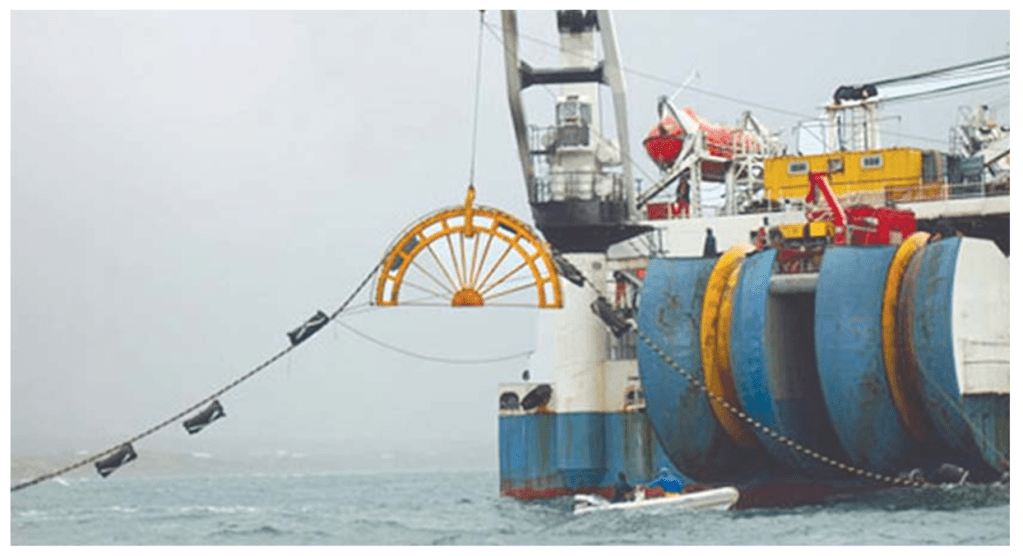
The European Commission has announced a major increase in investment to strengthen the security and resilience of subsea data cables—critical infrastructure that carries about 99% of global intercontinental internet traffic. The package earmarks €347 million for strategic projects under the Connecting Europe Facility (CEF), alongside a new risk-mitigation toolkit and a list of priority projects deemed of European interest.
The move comes amid rising threats, including intentional damage and sabotage. It builds on a risk assessment published in October 2025 that mapped scenarios, vulnerabilities, and dependencies across cable networks. The Commission’s proposed “toolbox” includes six strategic measures and four technical/support actions, paired with 13 priority investment areas to be rolled out in three five-year phases through 2040.
In the near term, the Commission said that two funding calls totaling €60 million will open in 2026 to support cable-repair modules, along with a separate €20 million call for “SMART” cable systems—integrated sensors and monitoring components. Additional calls planned for 2026 and 2027 will channel €267 million into the identified priority areas.
One of the most concrete steps is a €20 million call to finance adaptable repair modules—units to be stationed at ports or shipyards to enable rapid service restoration after outages. The initiative is described as the first phase of a broader plan covering all major EU maritime basins, including the Atlantic—where the Azores play a central role. While the pilot phase initially focuses on the Baltic Sea due to recent disruptions there, Atlantic relevance is explicitly built into the strategy.
That Atlantic importance was also underscored in Porto at the second International Summit on Subsea Cable Resilience, supported by the International Telecommunication Union. Speaking to UN News, Sandra Maximiano, president of Portugal’s national communications authority ANACOM, described Portugal as a “global corridor for data traffic” given its position between Europe, the Americas, and Africa. Demand for “more direct and resilient” routes, she said, is accelerating under pressure from new digital services and artificial intelligence.
Maximiano identified several transatlantic cables landing in Portugal—EllaLink, 2Africa, Medusa, and Equiano—and pointed to upcoming projects such as Nuvem and Sol, noting that both “are expected to connect with the Autonomous Region of the Azores.” The Nuvem and Sol cables, developed by Google, will route through the archipelago.
The Azores will also host Atlantic CAM, a subsea cable set to replace the aging CAM ring and strengthen links among mainland Portugal, the Azores, and Madeira. The project incorporates SMART technology, enabling earthquake detection and oceanic and environmental monitoring, and adds new landing points—reinforcing Portugal’s position as an Atlantic digital hub and data center gateway.
As a result, the Azores feature prominently in emerging international routes discussed in Porto, where redundancy and route diversity were emphasized as essential to service continuity during failures. Risk, officials noted, is multifaceted: roughly 70% of cable faults stem from maritime activities such as trawling, dredging, or anchoring; about 10% are environmental; and the remainder reflect geopolitical factors and deliberate actions, including sabotage and cyber intrusions.
From Brussels’ perspective, the response demands coordination and sustained investment to protect technological sovereignty and the resilience of connected societies. Under the current CEF Digital multiannual work program (2024–2027), €533 million is allocated to subsea cable projects, with €186 million already awarded to 25 projects, the Commission said.
In Diário dos Açores-Paulo Viveiros, director
Translated into English as a community outreach program by the Portuguese Beyond Borders Institute (PBBI) and the Modern and Classical Languages and Literatures Department (MCLL), in collaboration with Bruma Publication and ADMA (Azores-Diaspora Media Alliance) at California State University, Fresno. PBBI thanks Luso Financial for sponsoring NOVIDADES.

 Novidades - The Islands and the Diaspora