

Pope Leo XIV’s warning about the dangers of Artificial Intelligence, issued in his message for the 60th World Communications Day, reflects a global fear of a technology that, although innovative, still lacks regulation and has a profound impact on journalism and everyday life.
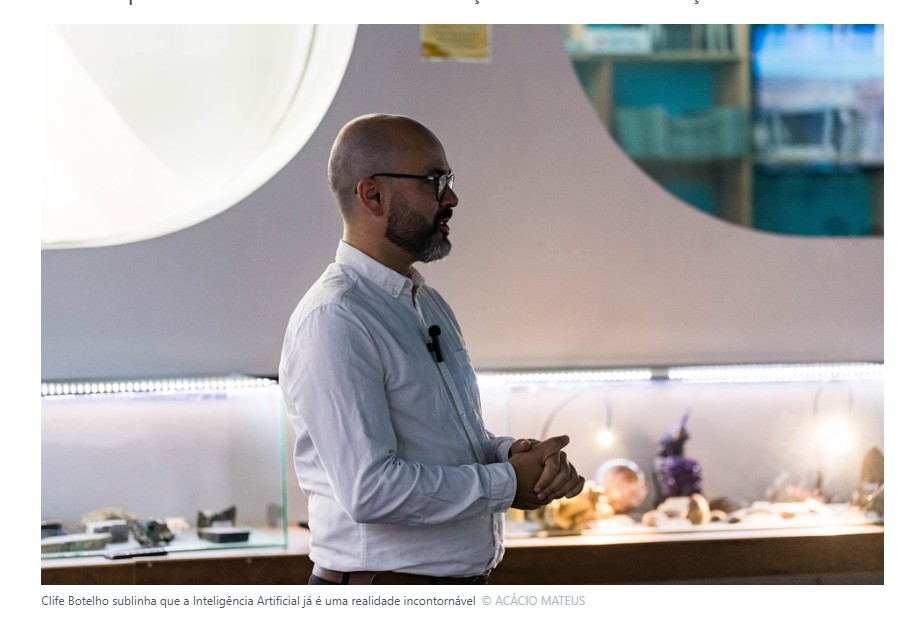
This analysis comes from Clife Botelho, director of Diário da Lagoa, who, in statements to the Igreja Açores agency, emphasized the urgency of strengthening media literacy and preserving humanism in the media. For the director, the Pope’s message echoes the “fear of the unknown,” a natural human reaction to something that evolves so quickly and unpredictably, emphasizing that the Pontiff’s voice is a relevant warning not only for the Catholic community but for all of civil society.
In the field of media, Clife Botelho emphasizes that Artificial Intelligence (AI) is already an unavoidable reality and can be an ally in newsrooms, particularly in technical tasks such as transcribing interviews or organizing data, allowing for more efficient time management. However, the director of Diário da Lagoa leaves a warning: technology should be viewed strictly as a tool and “never as a substitute for journalists.” The great risk, he points out, lies in the temptation for some media outlets to opt for content generated entirely by algorithms, which would sacrifice the ethics, critical spirit, and authenticity that define good journalism.
One of the most pressing dangers identified by the director is the rampant proliferation of fake news and digital platforms that survive on “clicks” and misleading advertising. In this ecosystem, it is becoming increasingly difficult for ordinary citizens to distinguish verified information from manipulated content. Clife Botelho recalls high-profile cases of AI-generated images that have misled millions of users around the world, warning that this widespread confusion leads people to start doubting everything, including serious and credible journalism in local communities.
The situation is exacerbated by the dependence on mobile devices for news consumption. According to the director of Diário da Lagoa, without a solid foundation of media literacy, citizens are vulnerable to disinformation and rumors that spread instantly on social media. For this reason, Clife Botelho argues that media education should be a priority in schools, starting from the early years of schooling.
The goal is to empower new generations to scrutinize sources and clearly distinguish between verifiable facts and unfounded opinions or hate speech. Clife Botelho also highlights the importance of the Pope’s call for the preservation of “human voices and faces.” In a future where virtual anchors and synthetic voices can simulate human presence, the issue of authenticity becomes central.
The director stresses that the loss of the human side of communication is not only a professional loss, but a risk to democracy itself. In addition, he points the finger at the role of algorithms that fuel social polarization, creating “bubbles” where people only receive content that reinforces their prejudices, preventing dialogue and contradiction.
Despite this challenging scenario, Clife Botelho avoids adopting a catastrophic view, believing that regulation will be the inevitable path. He points to the European Union as an example where legislative debate has already begun and reinforces the vital role of regulatory bodies in Portugal. For the head of Diário da Lagoa, local journalism now has a redoubled responsibility: to be a safe haven for truth in a sea of artificial content. “Journalism must reaffirm its essential usefulness: fact-checking,” he concludes, reinforcing that the papal message is, above all, an invitation to ethics and the defense of human communication in a digitized world.
In Diário da Lagoa
Translated into English as a community outreach program by the Portuguese Beyond Borders Institute (PBBI) and the Modern and Classical Languages and Literatures Department (MCLL), in collaboration with Bruma Publication and ADMA (Azores-Diaspora Media Alliance) at California State University, Fresno. PBBI thanks Luso Financial for sponsoring NOVIDADES.

 Novidades - The Islands and the Diaspora