

At a time when borders often harden and identities fracture under the weight of politics and forgetting, the Portuguese Beyond Borders Institute (PBBI) at California State University, Fresno, stands as a luminous countercurrent. It is not merely an academic center; it is a living Atlantic crossing — a place where memory gathers strength, where scholarship breathes in two languages, and where the diaspora is understood not as distance, but as continuity.
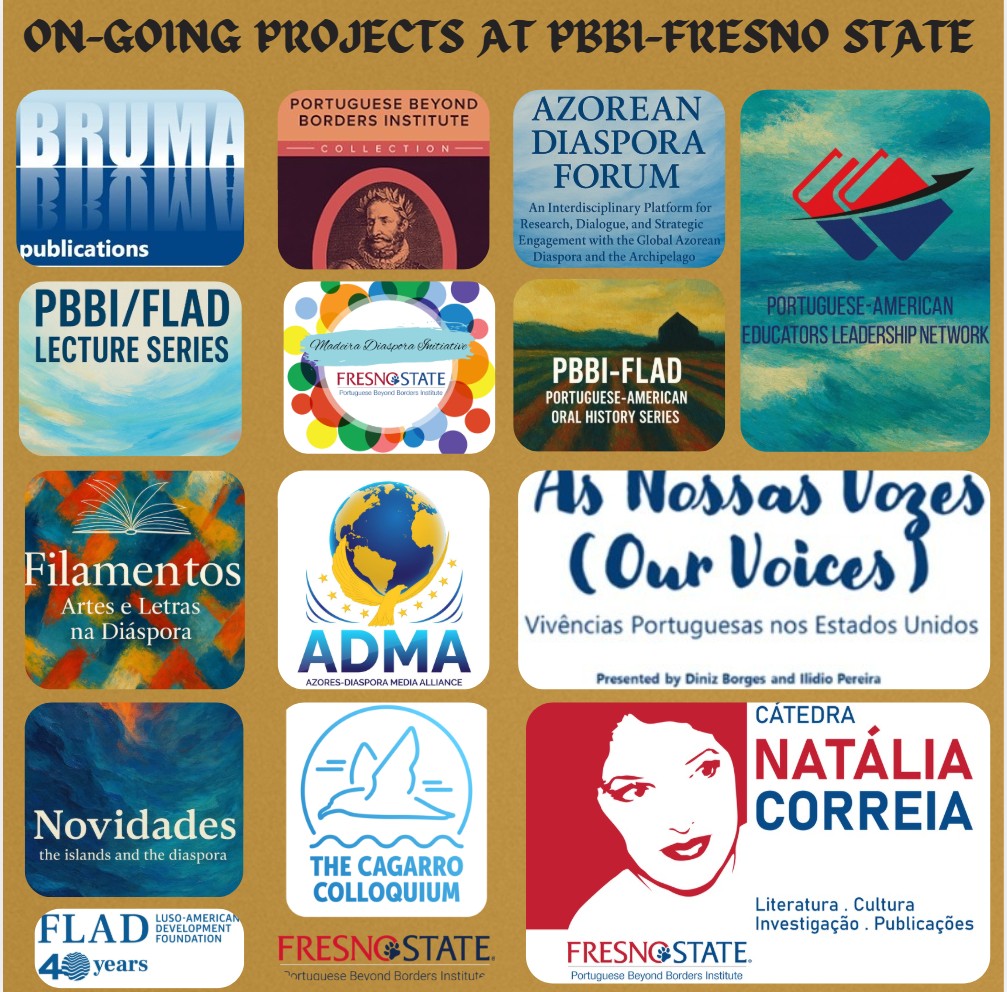
The Institute’s newly released overview of ongoing initiatives reveals not simply a list of projects, but a sustained cultural architecture: research, publishing, oral history, leadership formation, literary production, and community dialogue woven together into a coherent transatlantic vision. This work is made possible through the steadfast partnership of the Luso-American Development Foundation (FLAD), whose support undergirds every major initiative and reinforces the Institute’s enduring bridge between Portugal, the Azores, and the United States.
Accessibility remains one of PBBI’s defining commitments. Many lectures, conferences, and conversations are offered online, allowing participants from California’s Central Valley to Lisbon, from the Azores to New England and Canada, to gather in shared intellectual space. Geography no longer dictates participation. The Atlantic, once crossed by ships of uncertainty, is now traversed by dialogue in real time.
At the center of the Institute’s mission stand two major pillars.
The first is the PBBI-FLAD Portuguese-American Oral History Series, a project that has become one of the most significant archives of Portuguese-American lived experience in the United States. With more than 125 collected life stories, the series documents migration journeys, dairy and agricultural labor histories, educational advancement, civic leadership, military service, entrepreneurship, and the fragile, resilient shaping of identity across generations. These testimonies are not dormant records. They are regularly featured in the Legacy segment on the Institute’s digital platform, Novidades – The Islands and the Diaspora, ensuring that memory remains visible, audible, and shared.
From archive to screen, the project has already produced two documentary films, with two more currently in development and expected within the next 14 months. Through film, voice, and text, oral history becomes both scholarship and inheritance — an offering to future generations who will ask not only where they came from, but who carried them forward.
The second pillar is the PBBI/FLAD Lecture and Conference Series, an expansive forum for transatlantic intellectual exchange. Scholars, writers, educators, and community leaders gather to engage themes of migration, literature, politics, language, democracy, and belonging. Many of these events are accessible online, transforming Fresno State into a global meeting ground where the diaspora speaks to itself and to the world.
The Institute’s publishing program further strengthens this architecture of cultural continuity. Through Bruma Publications, more than 20 books have been released in the past three years alone — an extraordinary achievement that includes scholarly monographs, literary works, translations, and community histories. These publications are not isolated texts; they form a deliberate bridge between the United States and the Azores. Translation, in particular, has become an act of cultural diplomacy — carrying Azorean and Portuguese authors into English, expanding the canon, and ensuring that island voices resonate in North American academic and literary spaces.
Complementing this work are 14 editions of the literary journal Filamentos – Arts & Letters in the Diaspora, as well as the Institute’s daily digital platforms, Novidades and Filamentos, which provide continuous engagement with news, commentary, and creative writing. In these spaces, the diaspora is not static memory but ongoing conversation.
The Cátedra Natália Correia further deepens the Institute’s intellectual reach. Dedicated to research, publication, and programming centered on one of the Azores’ most formidable literary and political voices, the Cátedra explores themes of freedom, cultural critique, feminism, democracy, and Atlantic humanism. Through scholarship and translation, it situates Natália Correia not only as a historical figure, but as a living interlocutor in contemporary debates about ethics and imagination.
This work is sustained not only through academic rigor but through vital community partnerships. Organizations such as the Luso-American Financial, the Luso-American Education Foundation, and the Portuguese Fraternal Society of America stand as essential collaborators in what is truly both an academic and community venture. Together, they affirm that scholarship without community is abstraction — and community without memory risks amnesia.
Taken together, these initiatives position the Portuguese Beyond Borders Institute as more than a research center. It is a transatlantic crossroads, a place where scholarship meets lived experience, where memory becomes archive and film, where translation becomes bridge, and where hope is practiced through work.
Looking ahead to 2026 and the years beyond, the Institute moves forward with renewed purpose. The commitment is clear: to continue with full force — intellectually, creatively, and communally — in preserving stories, publishing voices, convening conversations, and forging new connections across the Atlantic. In an era often marked by fragmentation, PBBI stands as an act of optimism: a belief that culture can endure, that dialogue can expand, and that the diaspora is not a fading echo, but a rising tide.
And so the work continues — with discipline, with imagination, and with hope.
 Novidades - The Islands and the Diaspora