

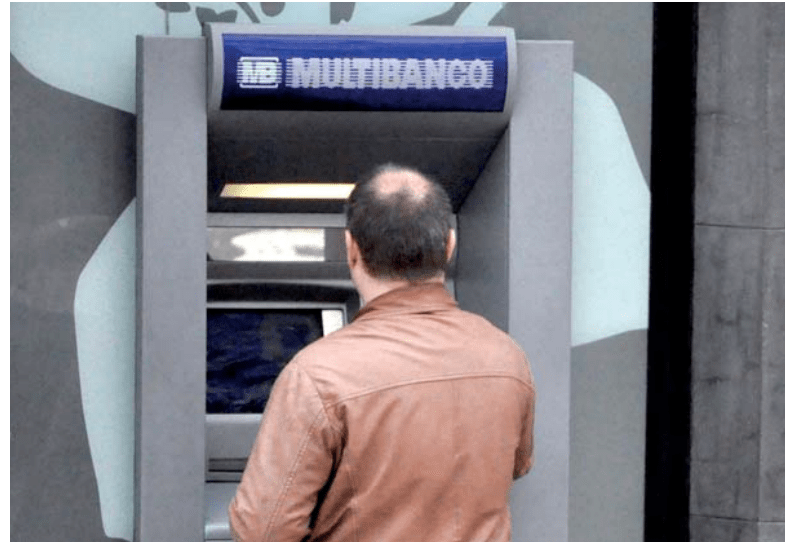
The Azores closed out December 2025 with 382 active ATM machines, 376 of which recorded transactions during the month, along with 13,689 electronic point-of-sale terminals installed across the archipelago. Of those payment terminals, 9,264 registered activity in December, according to statistical annexes released by Sociedade Interbancária de Serviços (SIBS) and made available by the Regional Statistics Service of the Azores (SREA).
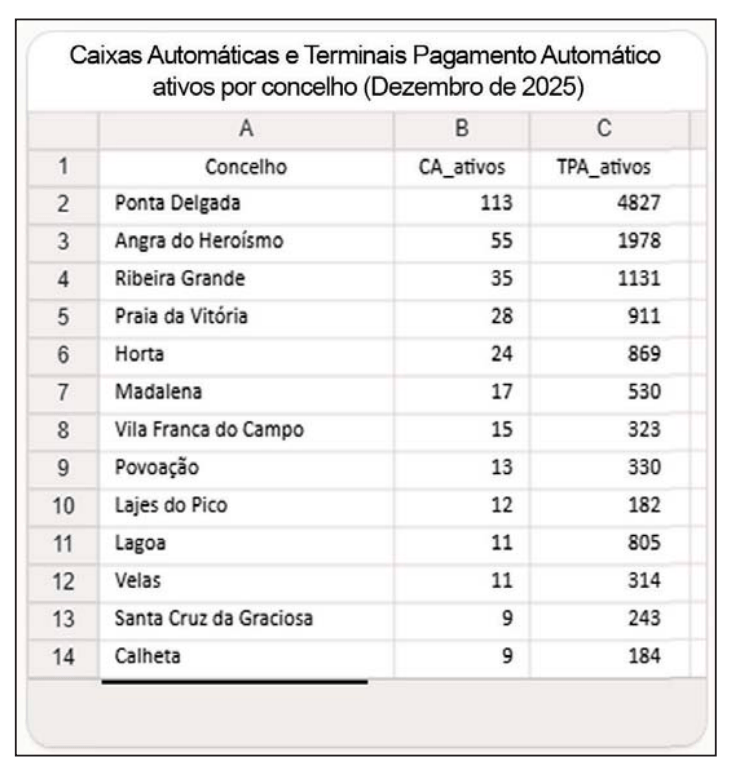
The distribution reflects a strong concentration in the region’s largest urban centers. Ponta Delgada accounts for 113 ATMs — roughly 29.6 percent of the regional total — and 4,827 payment terminals, about 35.3 percent of all terminals in the Azores. It is followed by Angra do Heroísmo, with 55 ATMs and 1,978 terminals, and Ribeira Grande, which has 35 ATMs and 1,131 terminals.
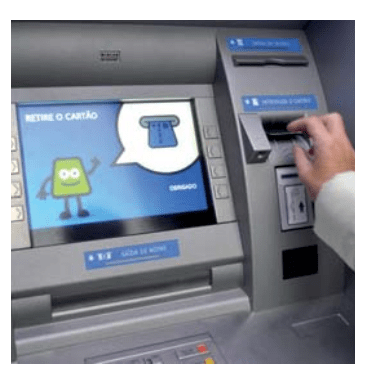
At the other end of the spectrum, the smaller municipalities show far more modest figures. Vila do Corvo, the least populated municipality in Portugal, has two ATMs and 46 payment terminals, while Lajes das Flores and Santa Cruz das Flores each operate three ATMs.
The broader trend over the past five years underscores an uneven but clear shift toward electronic payments. Between December 2020 and December 2025, the number of point-of-sale terminals rose from 10,143 to 13,689 — an increase of 3,546 terminals, or roughly 35 percent. By contrast, the number of ATMs grew only marginally, from 369 to 382, an uptick of just 13 machines, or about 3.5 percent.
Year-over-year data confirm the consolidation of electronic payments across the islands. Point-of-sale terminals have increased steadily each year, while the number of ATMs has fluctuated only slightly. ATMs reached a recent peak in December 2022, with 395 machines, before declining to 382 by the end of 2025 — a sign that while cash infrastructure remains stable, the region’s financial habits are increasingly digital.
Translated into English as a community outreach program by the Portuguese Beyond Borders Institute (PBBI) and the Modern and Classical Languages and Literatures Department (MCLL), in collaboration with Bruma Publication and ADMA (Azores-Diaspora Media Alliance) at California State University, Fresno. PBBI thanks Luso Financial for sponsoring NOVIDADES.

 Novidades - The Islands and the Diaspora