

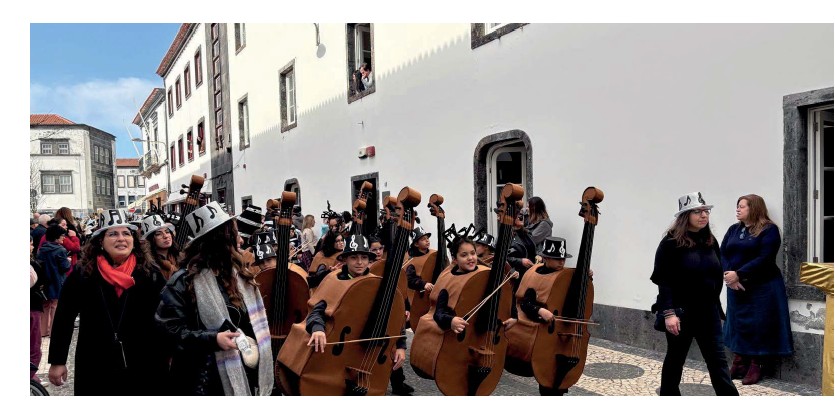
The traditional Corso de Carnaval brought smiles, high spirits, and an explosion of color to the Historic Center of Ponta Delgada this week, as schools and community organizations turned the city’s main streets into a vibrant celebration of creativity and tradition.
Carnaval season in the Azores is synonymous with festivity, laughter, and pageantry, and once again local schools embraced the occasion with enthusiasm. Several educational institutions took part in Tuesday’s parade, each presenting imaginative themes that reflected both cultural values and youthful imagination. The event unfolded in the heart of the city, where spectators lined the streets to watch children, teachers, and staff march in costume, transforming downtown Ponta Delgada into a living canvas of movement and joy.
The parade began at Campo de São Francisco and proceeded through the city’s main thoroughfares. Children and educators marched side by side, proudly displaying costumes and performances that told stories and highlighted important themes. The energy of the participants and the collective excitement of the schools turned the afternoon into a true celebration of color and creativity.
The Municipal After-School Network (Rede Municipal de ATL) chose an orchestral theme, a project that required extensive preparation. Students dressed as musical instruments—guitars, trumpets, drums, saxophones, pianos, and more—bringing the concept to life with playful flair. Margarida Pais, the program’s coordinator, said students eagerly anticipate the event each year. “There’s always tremendous interest and joy on the part of the students,” she noted. The group included 150 children.
The Social and Cultural Center of Fenais da Luz adopted an environmental message with the theme “Bees Save the Planet,” with students dressed as bees. Nélia Soares, an educational aide, explained that the center brought a smaller group of 16 students, as some children preferred celebrating at their own schools. Even so, she said participation remains a cherished tradition. “Some children are more reserved and others react with greater excitement—it depends on personality and age. But in the end, they all enjoyed it, even if just for the bus ride or the chance to be together,” she said.
At Escola Linhares Furtado in Fajã de Baixo, the theme was love—a value educators believe is increasingly important to pass on to younger generations. Carolina Raposo, a support teacher, said the school participated with two classes, first and second grade. “We chose this theme because it’s what we feel is most lacking today, and we want to pass it on to the next generation,” she explained. Graça Batista, a classroom teacher, added that 36 students took part, dancing, laughing, running, and tossing confetti and streamers along the parade route.
The Seara do Trigo Association opted for an abstract art theme, with costumes in black and white inspired by cows, allowing participants to explore creativity in a more conceptual way. The group of 15 participants, according to organizers, had eagerly awaited the day and even hoped for good weather to ensure they could take part.
At EB1/JI da Matriz Primary School, 250 students embraced the theme “Painters of Dreams,” imagining their aspirations through colorful costumes. Teacher Dalila Ferro emphasized the importance of dreaming in today’s world. “The children were happy, especially imagining their dreams. That’s something very important nowadays,” she said, noting that costume colors symbolized different emotions.
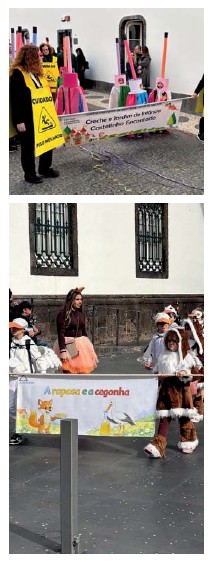
Colégio do Castanheiro invited each class to represent a different fable. About 200 students joined the parade, according to teacher Beatriz Sousa. “Their favorite part was throwing confetti at one another. Every year, they love coming,” she said.
Other participating groups included the São Pedro Social and Cultural Center, whose youngest members dressed as pirates under the theme “Pirates!! Toward Knowledge!!” The Castelinho Encantado Daycare and Preschool, from the São José Parish Social Welfare Center, focused on cleanliness, with children dressed as various cleaning tools. Jardim de Infância Bom Jesus drew inspiration from “Cookie Monsters,” outfitting children in bright red, blue, and yellow costumes.
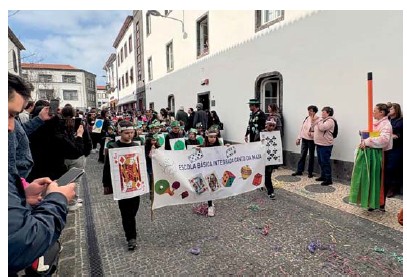
The elementary schools of Relva and Covoada joined forces with multiple themes, including one inspired by Native Americans. Meanwhile, Escola Básica Integrada Canto da Maia looked to games—playing cards, table tennis, dice, and chess pieces—for costume inspiration.
Carnaval in the Azores typically takes place between February and early March, culminating in the days leading up to Lent. The season is marked by lively corsos organized by local associations, schools, and recreational groups, featuring decorated floats, elaborate costumes, and choreographed performances prepared over months of rehearsal.
In Ponta Delgada, this year’s parade once again demonstrated how deeply the tradition is woven into community life—where imagination, heritage, and youthful exuberance come together to brighten the winter streets.
Diogo Simões Pires is a journalist for Correio dos Açores, Natalino Viveiros, director.
Translated into English as a community outreach program by the Portuguese Beyond Borders Institute (PBBI) and the Modern and Classical Languages and Literatures Department (MCLL), in collaboration with Bruma Publication and ADMA (Azores-Diaspora Media Alliance) at California State University, Fresno. PBBI thanks Luso Financial for sponsoring NOVIDADES.

 Novidades - The Islands and the Diaspora