

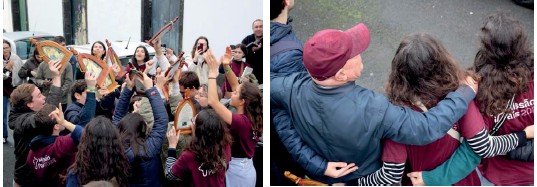
In classrooms and nursing homes, in daycare centers and homes reached one knock at a time, a group of young missionaries has been quietly stitching itself into the life of an Azorean town. For the leaders of this year’s Missão País, the goal is clear: this should not be a once-a-year visit, but the beginning of something lasting.
Mariana Sousa, a medical student who traveled from Lisbon to the Azores, now coordinates nearly 60 university volunteers. After serving as a missionary herself, she returned with a new role—and a new responsibility.
“My mission was to empower others to carry this forward,” she says.
A member of the Schoenstatt movement, Sousa believes Azorean university students must be given room to step into leadership. “The joy of living in Christ is so great that you can’t help but share it. The Church can belong to us too.”
For now, local participation remains modest—only four or five young people from the island have joined. Still, optimism persists. “The mission is just beginning here,” Sousa says. “I hope next year we’ll see even more.”
The program’s continuity appears secure. Missão País will remain connected to the University of the Azores and is expected to travel to another part of the archipelago in its next edition.
Behind the scenes, the work is as spiritual as it is practical. Inês Carvalho, a student from Évora who serves as prayer leader, returned to the island after participating last year. She describes the daily rhythm of reflection that sustains the volunteers’ outward work.
“We need to fill ourselves with joy so we can give that joy to the community,” she explains.
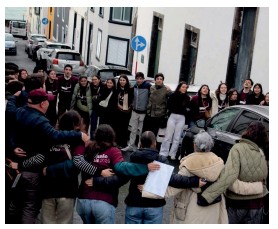
Throughout the week, conversations move from trust to surrender to doubt, weaving faith into the fabric of daily life. “Jesus doesn’t simply want us to be at peace,” Carvalho says. “He wants peace to remain within us—and for us to carry it to others.”
Father Tiago Tédeu, who accompanies the group, sees the students’ presence as a sign of hope. “It’s not only about prayer,” he says. “It’s about fellowship and, above all, about giving oneself to the community.”
He notes the warm welcome from residents of Vila Franca do Campo and the volunteers’ dedication—whether visiting door to door or assisting those most in need. “In young people, we find hope for today’s world.”
The missionaries come from diverse Catholic movements—Schoenstatt, Jesuit university centers, Opus Dei, Communion and Liberation. They carry with them the image of the Pilgrim Mother and the desire to leave behind more than memories: they want to leave an embrace that lasts beyond the week.
Between expectation, exhaustion, and gratitude, the phrase that guides them remains simple: “Peace be with you.” They depart convinced that what has been planted in Vila Franca do Campo will continue to grow—across other Azorean islands and within their own lives.
This year, Missão País is active in 75 locations, bringing together students from 60 universities across Portugal. The mission operates in Lisbon, Porto, Coimbra, Évora, Aveiro, Braga, Leiria, Santarém, the Algarve, Madeira, Covilhã, Setúbal, and the Azores.
Founded in 2003 by three students at the Universidade Nova de Lisboa, Missão País began with a simple dual desire: to dedicate time to missionary work and to create a space within the university that drew students closer to God. Inspired by what participants call the “Great Missionary”—Our Lady—the students left their routines behind and traveled across Portugal in service.
Since then, the movement has grown steadily. Now in its 23rd year, Missão País has reached 257 communities, mobilized more than 4,140 young volunteers, and established 75 missions from north to south, including Portugal’s two autonomous regions.
In Vila Franca do Campo, this year’s mission concludes Saturday at 2 p.m. with a theatrical presentation and a final moment of shared reflection—an ending that, for many, feels more like a beginning.
From Igreja Açores/Correio dos Açores
Translated into English as a community outreach program by the Portuguese Beyond Borders Institute (PBBI) and the Modern and Classical Languages and Literatures Department (MCLL), in collaboration with Bruma Publication and ADMA (Azores-Diaspora Media Alliance) at California State University, Fresno. PBBI thanks Luso Financial for sponsoring NOVIDADES.

 Novidades - The Islands and the Diaspora