

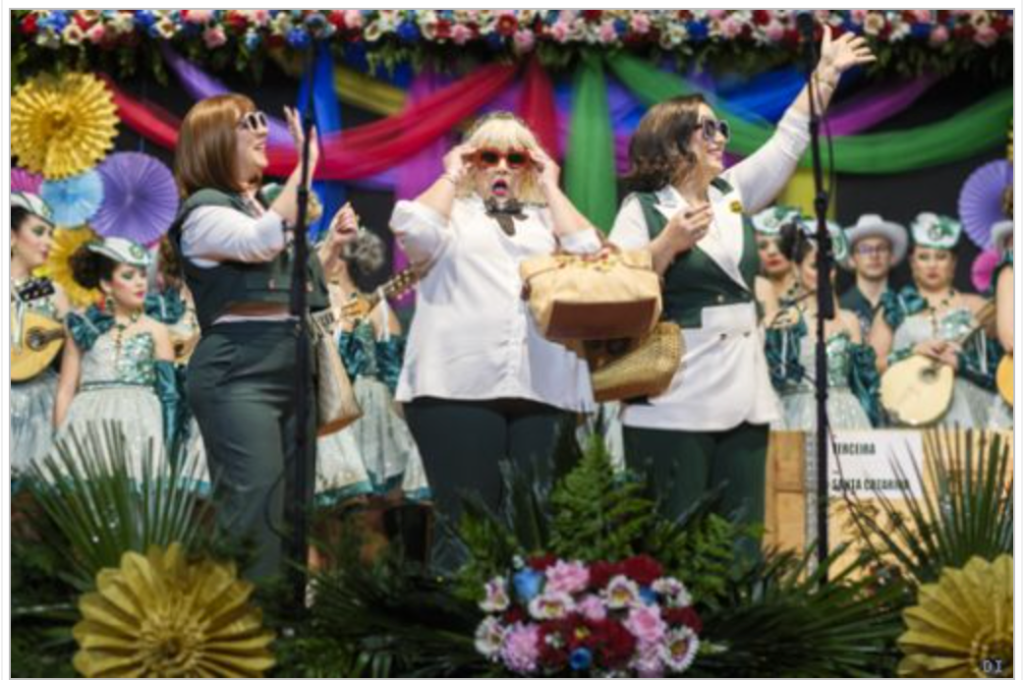
For nearly three decades, Sara and Leandra Mota have taken the stage in Terceira’s Carnaval dances and bailinhos. The love of Carnaval—something they say runs in their veins—has already passed to the next generation. And even after performing on larger stages far from the island, they return every year to the parish halls where it all began.
“What brings me back every year is the love I have for this group, the friendships that Carnaval has given me—that’s what I cherish and am most grateful for. And then there’s nothing more satisfying than the applause, the laughter, and hearing people say we did a good job,” said Sara Mota.
“We didn’t have cars or buses. We rode in open-bed vans. I remember those construction workers’ trucks with two benches in the back. We’d climb in and fall asleep there,” Sara recalled.
Daughters of the celebrated cantador ao desafio António Mota, Sara and Leandra grew up backstage at bailinhos. As children—at a time when it was still rare for women to step onto those stages—they followed their father from hall to hall.
In 1999, Sara performed as a character in a sword dance in São Sebastião, while Leandra became the lead singer—the mestre—of a bailinho in Vila Nova.
“My father was in a bailinho in Vila Nova. I went along with my mother, and we would help sing in the chorus. The men in the group said, ‘That little girl sings well—she should come lead our bailinho,’” Leandra remembered.
In their second year, the sisters led the bailinho together in two-part harmony. Today, there is hardly anyone on the island who doesn’t recognize the voices of “the Motas.”
“Before that, I had never stepped on a stage and didn’t even know if I was capable of singing harmonies the way I do now. Our voices are very different, and the original key wasn’t compatible with mine. So naturally I began finding the second voice. That’s when I realized I had a gift, an ability to create harmonies,” Sara explained.
In 2008, they founded their own bailinho, which continues to this day, welcoming new faces each year.
Filipa Lima joined the group at age eleven. “I grew up in Sara and Leandra’s house, watching them sing, and I fell in love with what they did. I always said that one day I wanted to perform in one of their dances,” she said.
“Since I was little, I played tambourine or the school flute. My games were always pretending to ‘lead’ or to play in a dance,” she added.
Maria Mota Ourique is eleven and performing this year for the fourth time.
“When I was very small, I used to go to the Auditório do Ramo Grande with my grandmother. In 2023, I started performing, and now I don’t think I’ll ever stop. Only if something very serious happens,” she said confidently.
“She loves it,” her mother, Leandra, added. “She also has this reference from her father’s side. By summer, she’s already asking if we’re going to have a bailinho.”
Maria may be the youngest on stage, but her voice fills the hall. “Sometimes there are words that people can feel all the way across the room. That’s very important to me. Singing is a gift,” she said.
From Carnaval to Other Stages
ir own voicesIt was on Carnaval stages that Sara and Leandra gained the confidence to sing beyond them. In 2016, after being invited to perform at the Ladeira Grande festivities, they formed the group Fadoalado.
Once again, Carnaval brought voices together—this time to sing fado, though with a distinctly Azorean sound.
“Filipa joined our bailinho when she was ten or eleven. She was going to play mandolin, but we realized she had a voice and she started singing. It’s funny because no one in her family sings, and she has this powerful voice. Later, Lizélia came in to play saxophone, and we discovered she could sing too. We already knew Ivânia could sing, but we didn’t realize it was with that kind of power,” Leandra said.
In 2021, Fadoalado won the national television competition Got Talent Portugal on RTP.
“I never thought we would win. We were so simple up there. It was natural—we were just ourselves, singing our music. And it was born here. It’s funny, but it was born here, from Carnaval,” Leandra reflected.
With Fadoalado, they have performed on major stages across the Azores, mainland Portugal, the United States, and Canada. Yet every year, they return to the Carnaval halls—with the same flutter of nerves.
“I get nervous every single time. Sometimes I even feel like crying before stepping on stage. My respect for Carnaval is so deep—I’m getting chills just talking about it. I can’t even fully explain what it feels like,” Sara said.
In Diário Insular-José Lourenço-director
Translated into English as a community outreach program by the Portuguese Beyond Borders Institute (PBBI) and the Modern and Classical Languages and Literatures Department (MCLL), in collaboration with Bruma Publication and ADMA (Azores-Diaspora Media Alliance) at California State University, Fresno. PBBI thanks Luso Financial for sponsoring NOVIDADES.

 Novidades - The Islands and the Diaspora